


August 8, 2020, 4:21 am | Read time: 12 minutes
Martial arts were never my thing. Instead of clenching fists, I preferred to go for a jog or lift weights at the gym. During my world trip, I was stranded in Thailand for several months due to the coronavirus and tried Thai boxing out of sheer curiosity. I wish I had discovered it twenty years ago.
Thai boxing is the term known in Germany for the traditional Thai martial art Muay Thai. They are one and the same. Muay Thai was originally developed centuries ago for the self-defense of Siamese warriors in battles against neighboring countries. After the wars ended, the martial art became a part of everyday life for the Siamese (now Thais) as a leisure activity. Later, nationwide competitions were held between the best from each region.
The modern Muay Thai in the ring, as we know it today, emerged in the 1920s. Until then, people fought without boxing gloves, using only hand wraps. Coconut shells served as groin protection. With modernization, these were naturally replaced, and fixed round times were introduced: Depending on the weight class, fighters now compete in two rounds of two minutes each, up to a maximum of five rounds of three minutes each. Thai boxing is the national sport of the Thais and is as popular as soccer in Germany.
Thai Boxing–Brutal to the Point of Bloody
While many German children join soccer clubs, in Thailand, kids as young as 30 kilograms (about 66 pounds) step into the ring to compete in Thai boxing matches. Especially in rural areas, their families earn some money this way and hope that their offspring will have a sports career and thus a better life. Some teenagers have already completed more than 100 fights.
Thai boxing is considered one of the most brutal sports because it involves not only fists but also feet, shins, knees, and elbows. Additionally, you can hold your opponent in a clinch and attack with knee strikes from close range or bring them down. The elbow is particularly feared. A hard blow to the head can knock out the opponent immediately or cause a bloody laceration.
I was never particularly interested in martial arts. As a teenager, I was fascinated by endurance sports, which led me to triathlon. In my twenties, I discovered weightlifting at the gym as a balance to office work. In hindsight, I regret spending so much time on monotonous exercises with machines and dumbbells. Out of pure habit and convenience, I stuck with the gym for almost 20 years. If only I had discovered Thai boxing earlier.
When I set off on my world trip at the end of 2019, I wanted to gain new experiences. Why not try a new sport? Due to the coronavirus pandemic, I was stranded in Thailand for several months as all Asian countries closed their borders. And so I inevitably came into contact with Muay Thai, as competitions and training studios are advertised on practically every corner.
Also interesting: Reasons why you should do martial arts
My Curiosity About Muay Thai Was Sparked
I wondered what makes Muay Thai so special and popular? And above all: Can I start it in my early forties?
For two months, I settled in the northern Thai city of Chiang Mai. In the first few days, I discovered a small Muay Thai studio during my explorations of the old town. The owners, a young Brit and his Thai girlfriend, quickly persuaded me to try a training session with their friendly manner. And the Muay Thai adventure began.
Training Day 1
The trainers speak little English, so there’s no theory lesson. But it’s enough for simple instructions. Everyone who wants to participate is integrated. Age, gender, and training level vary. Even a four-year-old participates alongside his mother–childcare included.
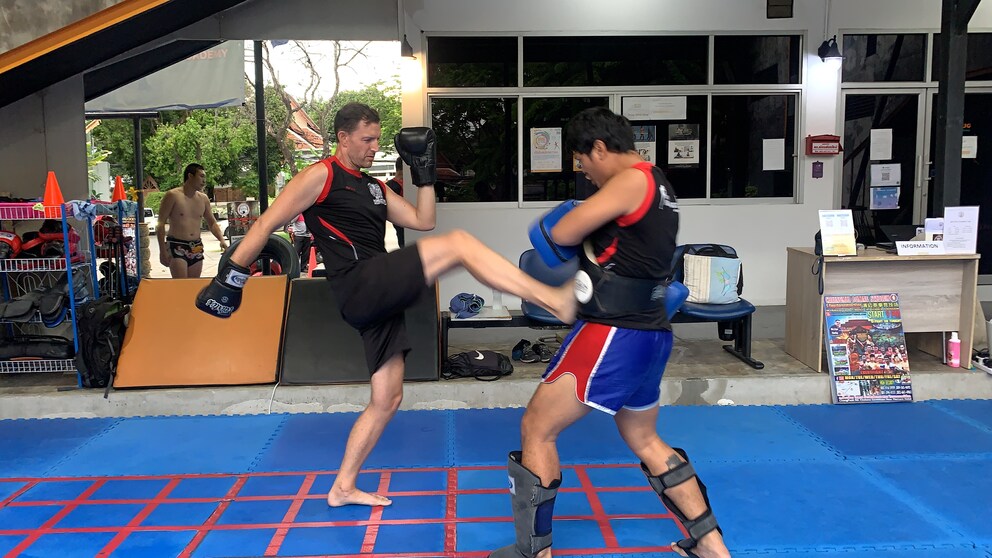
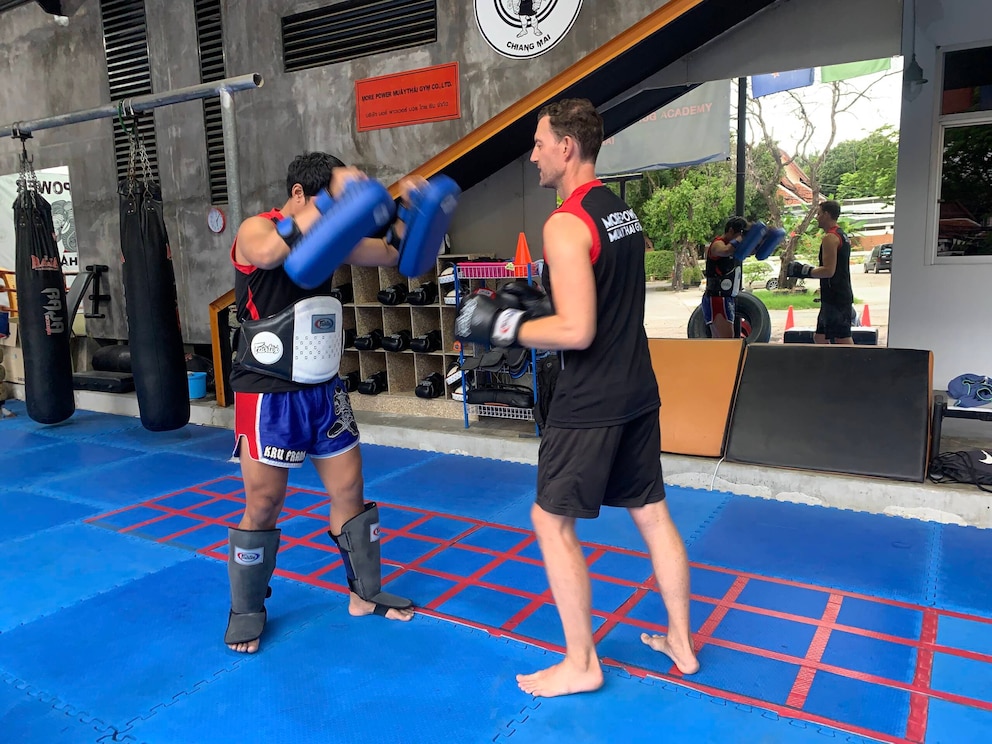
The interaction with a trainer is completely new to me. Even in the first training session, I’m allowed to punch and kick properly while he holds the pads on his arms: harder, faster, and from the hips, with a slight bounce back and forth. Those with a sense of rhythm have a clear advantage; otherwise, you have to train hard to get it.
The Stance of a Thai Boxer
Left fist forward at head height, right fist protectively close to the chin, left foot forward, right foot set back and outward–that’s how you stand ready to attack. It’s unusually wide-legged, but important to have a firm stance so you can’t be brought down by the opponent.
You rarely stand flat-footed, as that makes you sluggish. Instead, you always bounce slightly back and forth, shifting weight onto the front foot and lifting the heel. From this, you later develop the typical bouncing. It makes you quick to react and allows you to play with the opponent.
I learn the first movements in Thai boxing: left fist, right fist, right elbow, right knee, and right leg kick about rib height of the opponent. It’s very important with the leg kick to always turn the hip in the respective direction and lift the heel of the supporting leg. Let the arm (right leg kick, right arm) fall loosely backward–this also applies to the knee. After the leg kick, you must always set the leg down at the back and return to the starting position.
And never forget: After every punch, the fists must be positioned protectively at the head again. The first training session is over after a good hour–including abdominal exercises, push-ups, and stretching. I’m thoroughly exhausted, the mood is good, and there’s a lot of laughter and joking around.
Conclusion After the First Day
I never thought I had such energy and punching power in me. I had never really punched or kicked in my life before. This power from the whole body, while being yelled at by the trainer, plus the soundscape when I hit the pads properly–a great experience. I’m hooked and book ten training sessions for the equivalent of 75 euros.
Surprisingly, in Germany, you can get ten or more training sessions per month for about 70 euros if you sign up for a multi-month membership at a training studio.
Also interesting:How to find the right martial art for you
Training Day 2
Without a rest day in between, the second day is tougher. This time it’s 1.5 hours with coordination exercises, strength endurance, and a focus on the knee kick. The left leg kick is also added.
My feet hurt from the impact on the pads and sandbags, and my right foot is slightly swollen. Only now do the trainers explain to me that you should hit the pad–or later the opponent–with the shin, not the foot (which affects the ankle).
It’s a shame the trainers didn’t explain many basics to me beforehand. So I have to learn from my own mistakes and pain. Rest days and getting the body used to the strain are not a topic here. Ideally, I should come to training every day.
I give myself a day off to let my body recover, especially the heavily strained joints.
Conclusion After the Second Day
Muay Thai is a complex sport with many different movements. You use feet, shins, knees, fists, elbows, and forearms. Proper coordination of legs and arms is very important. You only learn this through a lot of practice.
Training Day 3
On the third day, the Muay Thai training is increased again to now two hours. After light warm-up and stretching, leg and arm strike training follows. This time, more punches and kicks are performed. For the first time, even the combination of leg kick, punch, defense, and counterattack.
As a beginner, I have to contribute to the entertainment involuntarily. The trainer doesn’t miss the chance to throw me onto the mat several times in front of a female audience. He deserves it, as I at least learn sustainably how important a firm stance is. After the little embarrassment, I now pay special attention to standing wide-legged and securely.
Conclusion After the Third Day
The whole body aches, especially the ankles, which I previously overstrained with incorrect leg kicks. Nevertheless, I’ve never experienced such a complex workout. Coordination, reaction speed, strength endurance, and flexibility are trained. I find it much more natural and healthier compared to weightlifting at the gym.
Training Day 4
After three days off, it’s hard for me to find the rhythm again. I also have to practice coordination and fluid movements again. But after a good hour, I’m back in it. Despite slight shoulder pain, I can complete the training well. The ankles and shins also cope well with the strain, and the pain is manageable.
Conclusion After the Fourth Day
Anyone starting Muay Thai should not take long breaks at the beginning to internalize the complex movements. I recommend three to four training days a week, such as Monday, Wednesday, and Friday. Those who need less recovery time can also train on four days, like Monday, Tuesday, Thursday, and Friday.
Personally, I find more than two training days in a row too much, as the same body parts are repeatedly strained. However, I wouldn’t pause for more than two to three days either.
Training Day 6
For the first time, I’m really enjoying the training. Endurance and coordination harmonize with each other. I’m slowly gaining control over my movements. Still an important topic for me: looseness and the playful back-and-forth bouncing. I need to learn to perform the movements fluidly, yet focused and with full body involvement.
I keep forgetting to hold my hands protectively in front of and beside my head. I also need to learn to read the opponent (in this case, the trainer), meaning having the right counter-move ready for each of his movements. Also in need of improvement: reaction speed and strength endurance.
Conclusion After the Sixth Day
Learning the movements in Thai boxing is one thing–having the right punch or best defense ready at the right moment is another. You have to be able to react extremely quickly to the opponent. The great art lies in reading the opponent to anticipate and parry their attacks.
Training Day 10
The last of my ten training days feels like the best and most demanding. Unfortunately, I overstrained my right wrist on day 8. Since then, it has been hurting from time to time.
It becomes clear to me how easily you can get injured in Thai boxing–especially if you perform a movement incorrectly or don’t warm up well enough at the beginning of the training. Only now do I understand why some participants apply a warming oil to their heavily strained body parts before training–it provides additional protection against injuries.
A Thai herbal balm also helps with my aching wrist. It especially makes muscle tension disappear overnight. After just three rest days, the slight wrist injury is completely gone.
Conclusion After the Tenth Day
From my experience, at least ten training sessions are recommended to get a good idea of Thai boxing. Only after several practice days do you get into a flow–a state where strength endurance, coordination, reaction speed, and flexibility of the body harmonize with each other.
Is it enough to step into the ring with an opponent? No, that’s still too early. You first have to learn to read the opponent to parry their movements. This requires a lot of practice. The trainers estimated about four more months for me before I could step into the ring with another beginner.
But a real Thai boxing match doesn’t have to be the goal to start the sport. The training alone is great. Whether in a small group or individually with a trainer, it’s excellent for improving fitness in almost all areas.

BJJ black belt holder: “This is what Brazilian Jiu-Jitsu does to your personality”

Soccer player Max Wilschrey on ‘Fame Fighting’: Stepping into the boxing ring despite injury
Thai Boxing Is My Athletic Discovery
I wish I had started Thai boxing twenty years ago instead of running to the gym and lifting weights. It’s a complete workout because you use your entire body, not just your fists like in boxing. The movements feel natural and powerful–you develop a good and confident body feeling. It’s not about disco muscles here, but about a flexible and balanced body.
In my opinion, anyone without health issues can start Thai boxing even over 40. A good warm-up before training, proper execution of punches, and sufficient recovery between training sessions are particularly important. Anyone who pays attention to all this should have no problems.
A Final Anecdote
During my training, I met Joseph, a Puerto Rican currently living in Chiang Mai. The software developer trains with his private trainer up to six times a week and practically bursts with energy. In my eyes, he’s a tough fighting machine. In conversation, it turned out that he has only been training Muay Thai ambitiously for about half a year. And he is completely thrilled. Before, he was overweight and sluggish for years. Now, thanks to Thai boxing, he has reached the shape of his life at the age of 36. Better late than never.