

November 3, 2023, 6:13 pm | Read time: 4 minutes
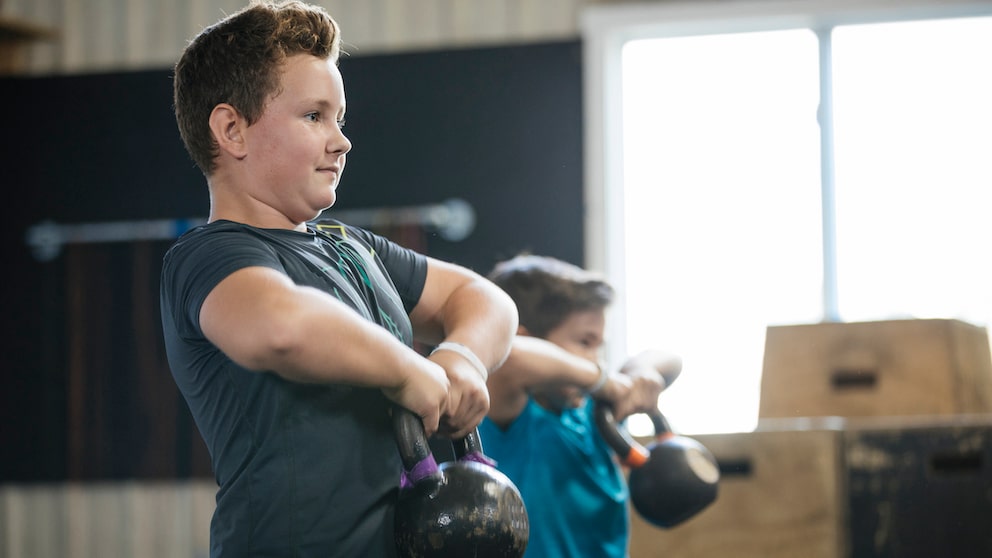
Our fitness expert–Prof. Dr. Stephan Geisler–often encounters the prejudice that children or teenagers shouldn’t do strength training. For this reason, he wants to debunk a popular myth here, which he affectionately calls the “zombie myth.”
You can’t imagine how often I’ve heard the question of whether strength training for children and teenagers is harmful or even dangerous. And no matter how often these questions are met with scientific facts, this myth seems to persist and keep coming back. That’s why I call it the “zombie myth!”
Follow the FITBOOK channel on WhatsApp now!
Overview
Does Strength Training Negatively Affect Bone Growth?
Now to the facts: The most common prejudice associated with strength training for children and teenagers is that the so-called epiphyseal plates (growth plates at the ends of bones that remain open until growth is complete, allowing bone growth) supposedly close prematurely.
In fact, there isn’t a single internationally published study that has observed such a phenomenon! Of course, there are situations where this could occur, such as with a bone fracture or extreme and prolonged overloading (like in professional gymnastics). But with controlled strength training, this is definitely not the case.
To give a vivid example: If a child climbs up a wall and then jumps down, the stress on the joints is roughly estimated to be four to five times the body weight. Now consider where and how such stress could be achieved in a fitness club (for example, on the leg press or squat)? Exactly, nowhere!
In general, it can be said that bones gain stability through appropriate stress. Thus, controlled strength training could even contribute to healthy bone growth.
Also interesting: When children should start strength training
How Should Teenagers and Children Best Practice Strength Training?
Another question is whether children and teenagers should train on strength machines, with dumbbells, or “only” with their own body weight. This can’t be answered easily: It depends.
Option 1: Strength Equipment
If children don’t fit the strength equipment due to their height, this option is ruled out. However, if a teenager is the right size, there’s no reason against equipment-based strength training. An advantage here is that the movement is more or less predetermined, making incorrect movements unlikely.
Option 2: Dumbbells
Training with dumbbells is somewhat more demanding and therefore significantly more complex to learn. The guiding principle here is: You must “earn the right” to work with dumbbells through good technique. Therefore, extensive technique training with very light weights should precede, followed by an assessment of who can and should train with what and when.
Also interesting: Eighty percent of children and teenagers don’t move enough
Option 3: Bodyweight
Training with one’s own body weight is always a viable option, but it also depends on the individual’s body weight. An overweight child will likely have more problems with this. Therefore, a lat pull-down might be more suitable than a pull-up bar.
Also interesting: Accident risk! Secure sports equipment at home from children

Children should only start strength training at this age

How Teens Can Successfully Start Strength Training
Is Strength Training Effective for Teenagers?
Finally, the question remains whether strength training before puberty is effective. Keywords: hormones and more. This question can clearly be answered with a yes, as the hormonal situation during puberty is favorable, and strength is built through improved neuromuscular cooperation. This can perhaps be trained even more effectively at a younger age.
Is Strength Training Harmful for Children and Teenagers? The Conclusion
In summary, controlled and guided strength training can be quite beneficial for children and teenagers. Compared to the risk of injury on a soccer field, the risk in a fitness club is negligible.
And for those who still don’t quite believe me, in this video I interview two of the most renowned scientists (worldwide) who have studied the topic. Enjoy watching!