


September 14, 2021, 4:04 pm | Read time: 4 minutes
If your back is tense, you lose flexibility. This means some exercises are not performed as thoroughly, making the workout less effective. Personal trainer Erik Jäger demonstrates in the FITBOOK video how to mobilize your spine. The exercises require no prior knowledge and are suitable for everyone.
The spine consists of three parts: cervical, thoracic, and lumbar spine. The first two should be stretched and activated to improve movement quality during training, release blockages, protect against injuries, and not least, to relieve muscle tension after training. The lumbar spine is different: it is a strand that provides stability in the body and should not be heavily mobilized. However, mobilizing the surrounding areas is beneficial. The more flexible the hips and chest are, the less rotation is demanded of the lumbar spine. And that’s good for a strong core! Personal trainer Erik Jäger recommends incorporating the following exercises into your training routine to mobilize the spine.
Also interesting: Learn backstroke swimming with a trick
These Exercises Are Shown in the Video
Spine Mobilization: Preliminary Exercise
Get into a quadruped position, with your knees aligned under your hips. Now exhale deeply and round your back as much as possible. As you inhale, initiate the opposite movement and look forward. Perform six to eight repetitions.
Mobilize Cervical Vertebrae
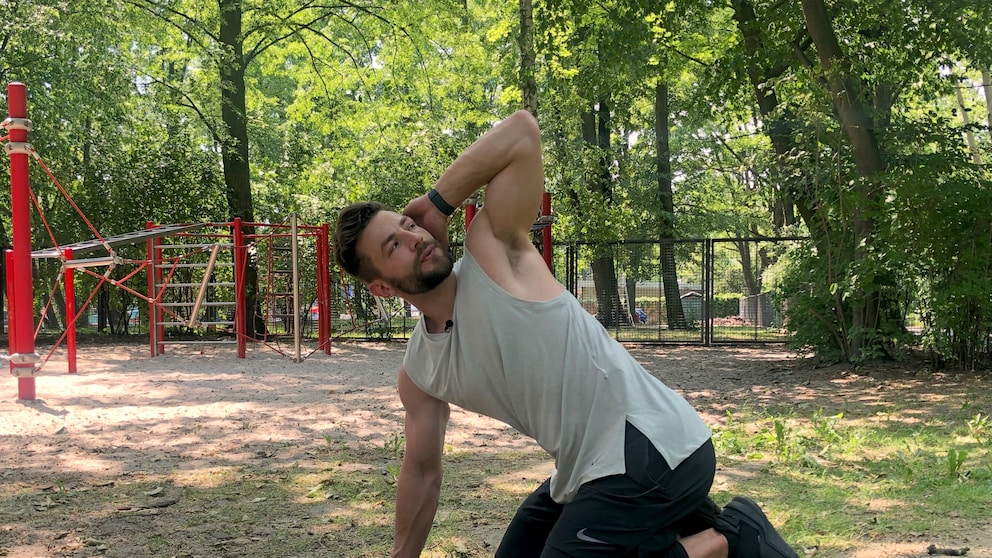
It’s important to mobilize the upper part of the spine as well. Place one hand on the back of your head. Now alternately move the elbow of the raised arm downward (inhale) and rotate it upward (exhale). Go as far as possible in both directions and follow the elbow with your gaze. Important: Keep your hips stable! The rotation comes from the spine. Do six to eight repetitions.
Tip: If you lack stability in your hips, place a foam roller or a pillow between your knees.
Also interesting: If you have back pain, you should train this organ
Mobilize Chest
In a quadruped position, thread the extended arm under the opposite one. You should feel more tension in the chest muscles. Perform six to eight repetitions of this as well.
Mobilize Hips
This exercise is ideal for expanding the range of motion in squats or deadlifts. Sit with one leg bent at a 90-degree angle in front of your body. Your shoulders should be straight and aligned parallel to the shin. Now slowly bend your upper body downward. Important: Keep your back, especially the lower part of the lumbar spine, as straight as possible. After each inhale, pull yourself deeper into the stretch (exhale). Three to four repetitions of this exercise are sufficient.
Also interesting: How to achieve your first pull-up
Mobilize Shoulders
Good shoulder mobility is essential for overhead exercises such as pull-ups, shoulder presses, or handstand training. Personal trainer Erik Jäger demonstrates two exercises in the video that promote exactly that.
- Exercise: Lie on your back with your feet planted. Move your hands over your head. Rest your elbows on the floor. From this position, slowly move your hands, which are touching, up and down. Ensure a straight body line.
- Exercise: Lie on your side with bent knees. Place the upper arm behind you on the floor. The hips should move as little as possible. Check this by watching your legs: If they don’t shift against each other, you’re doing it right. Now slide the arm (thumb pointing toward the head) along the floor upward. In the final position, rotate the hand (thumb pointing downward) and slide the arm downward.
Watch an Episode of Your Favorite Series in This Position
Finally, Erik Jäger demonstrates an exercise that helps relieve and prevent tension throughout the back. It can even eliminate recurring back pain–for which tension is the most common cause.
Also interesting: Why you should train when you have back pain
Here’s how it works: Lie on your stomach, preferably directly on the living room floor. Prop your elbows up and look forward. Let the thoracic spine relax; it should really unwind. This happens when the shoulders pull away from the ears. Now feel how far you can lower your upper body toward the floor. You can comfortably stay in this position for 20 or 30 minutes.