

January 5, 2018, 10:09 am | Read time: 5 minutes
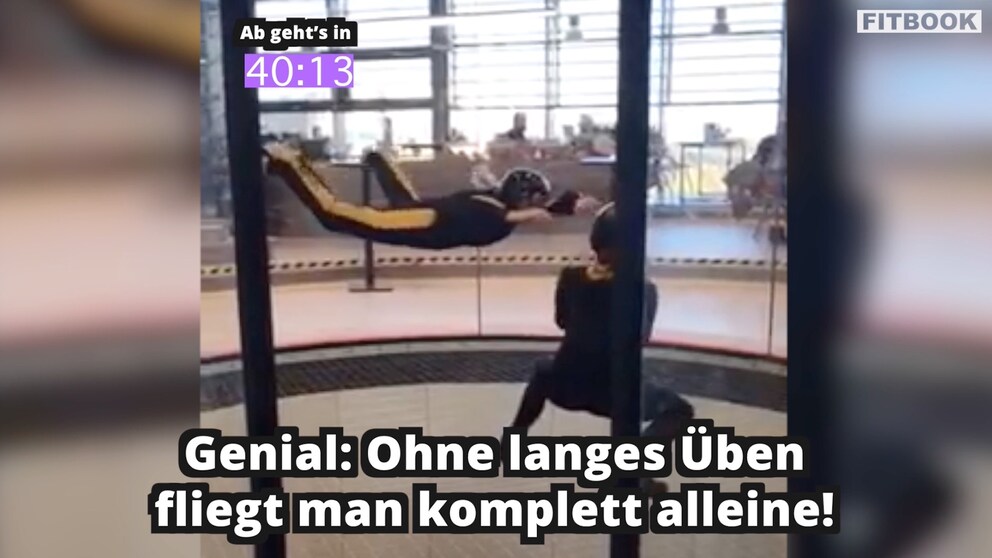
Would you dare? At Germany’s largest wind tunnel, the Hurricane Factory Berlin, you can let the wind generated by six large turbines, each with 400 horsepower, lift you into the air and glide like a bird on an airstream. Fitness level doesn’t matter. FITBOOK intern Svenja Heinol tried bodyflying–and felt a rush of happiness.
Upon arriving at the Hurricane Factory Berlin, we were greeted by a large room that impressed me mainly with its brightness, thanks to the huge glass windows. I felt a bit uneasy when I saw the first professional “bodyflyers” in the wind tunnel: They floated effortlessly in the transparent tube, somersaulting and rising. It also became clear to me that the wind tunnel was much higher than I had expected: The channel has a flight height of 15 meters, with the lower six meters being glassed. How was I supposed to handle this with my fear of heights?
Also interesting: What my first time bouldering did to my body
Flight Position Training and Safety Briefing
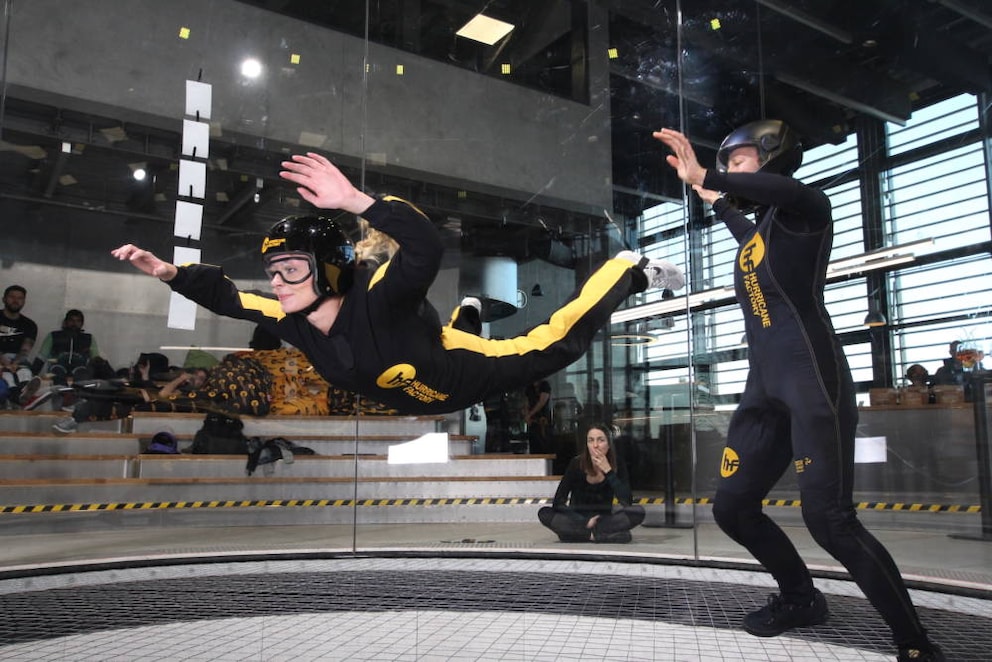
Before the briefing, we suited up. In the bulky, black-and-orange jumpsuit, I felt like Bob the Builder. Anna, who works as an instructor at the Hurricane Factory Berlin alongside two others, explained the flight process, provided flight position training (the basic position we should take while flying), and gave a safety briefing: You lie slightly arched on your stomach, with arms and legs bent. Since there’s a lot of wind in the tunnel, it’s extremely loud. So Anna showed us how to communicate with sign language during the flight. This way, she could help us correct our body posture during the flight.
Now with helmet, goggles, and earplugs–we were really ready to go.
Also interesting: On the road with gymnastics hero Andi Toba
This is How Bodyflying Works in the Tube
The glass tube at the Hurricane Factory Berlin has a diameter of 5.2 meters and is 15 meters high–allowing parachute jumps from a jump height of 4,000 meters to be simulated in the tunnel. The flight area is bordered by a steel net at the top and bottom.
Six large fans with a total output of 2,100 kilowatts generate the necessary airstream. A comparison to clarify the scale: If the fans run at full power for a day, the electricity consumption could power a family of four for a year.
The airstream you fly on is between 140 and 280 km/h fast. The speed in the cylinder can be controlled with a controller. The weight of the flying person determines the required airstream. For example, a person over 120 kilos cannot fly in the wind tunnel. Otherwise, anyone over the age of five is allowed to fly.
“Let Yourself Fall, the Wind Will Catch You!”
First, we went together with six others into the so-called pre-flight chamber, where those who were not flying at the moment had to wait. As a self-confessed scaredy-cat who would never do a parachute jump, I let the others go first and watched to see what awaited me. I was surprised at how well the other beginners did–internally, this increased the pressure on me. I was the last one. With a brave step, I approached the connecting opening to the wind tunnel.
Also interesting: What my first time bouldering did to my body
“Just let yourself fall into the tunnel, the wind will catch you,” Anna had explained. So I did. With my arms crossed in front of my chest. As I slowly opened my arms during the fall and assumed the previously discussed body position, I realized how strong the forces acting on my body were. It was extremely loud, and I could hardly breathe. I remembered what Anna had said during the briefing: “Don’t forget to breathe!”
Even the Smallest Body Movement Has an Impact
The hardest part for me was maintaining the position. Even the slightest movement of a foot, a hand, or my head had an immediate impact on whether I flew up, down, left, or right. After some time, I found out that my body moved down when I lifted my head. When I lowered it, I flew up. After the first round (one and a half minutes that felt like two hours), my body tingled, and I was trembling, especially my legs.

The Greatest Achievements of Extreme Sports Athlete Felix Baumgartner

1.95-Meter Basketball Player Wiebke Schwartau: “I was made to feel that my body was wrong and unattractive”
The Incredible Feeling of Floating
From the pre-chamber, I watched another person fly 10 meters into the air with Anna. My fear of heights returned. When I entered the chamber again, I realized that the moment would soon come when I would gain height. Anna positioned herself over me, and then we went up–a few meters were enough for me. The up-and-down floating was still an incredible feeling that I could only truly appreciate once I had my feet back on the ground. Pure happiness.
Also interesting: How To–How to increase jumping power
My Conclusion
Without a doubt–flying in the wind tunnel is an incredible experience and a great opportunity for people with a fear of heights to confront it or even overcome it. Whether the flight in the tunnel is actually comparable to a parachute jump, I cannot say. However, the price is quite high: For two flights of one and a half minutes each, you pay between 79 euros (during the week) and 99 euros (on weekends). It is also possible to book six- and nine-minute flights. This is especially recommended for more experienced skydivers, as such a flight can be incredibly exhausting. I think I would do it again.