


July 25, 2025, 2:00 am | Read time: 6 minutes
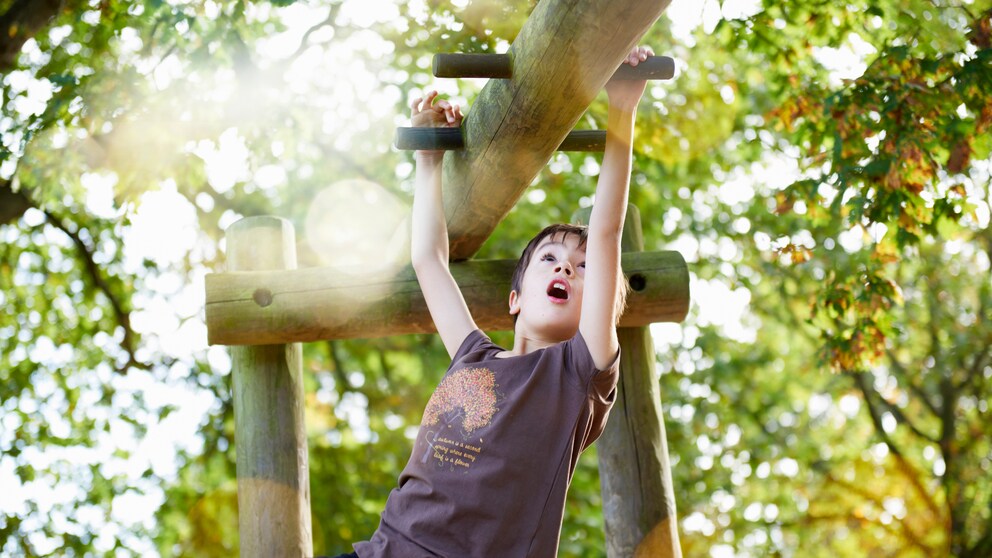
Balancing on a shaky wooden log, climbing a jungle gym backward, or jumping off a swing with arms outstretched–when kids let loose, it often just looks like fun to many adults. Well, and sometimes maybe a bit dangerous. But there’s actually much more behind this fun. FITBOOK author Doris Tromballa explains why jumping, hopping, and running play an important role for children and how you can specifically support healthy play.
Follow the FITBOOK channel on WhatsApp now!
Most children naturally have a strong urge to move. Even the youngest crawl, scoot, and pull themselves up–they discover the world through movement and develop their abilities. But playing and romping is more than just strengthening muscles and bones; it helps children learn and train all the skills we need in life.
Gross Motor Skills as a Foundation
Balancing on a wall, hopping over stones, climbing trees–all of this is part of what’s called gross motor skills. It involves large, coordinated movements where muscle groups in the arms, legs, torso, and back work together. In gross motor skills, we distinguish between movements where the child moves to another location (running, jumping, hopping), movements in place (stretching, turning, bending), and movements where an object must be controlled (throwing, catching, kicking).1 These basic skills ensure that fundamental physical abilities are learned and that children can move safely later on–not just in sports, but also in everyday life: climbing stairs, riding scooters, navigating traffic.
Moreover, gross motor skills are the foundation of fine motor skills: A child who can move, support, turn, or balance confidently will also find it easier to write, draw, or craft later on.2 And: Gross motor skills are also closely linked to emotional and social development: Those who can move confidently feel more secure–this boosts self-confidence. Additionally, movement in groups promotes social learning, such as consideration, waiting, or helping.3
Movement is Brain Doping
In short, you could say: Running, jumping, and playing make kids smart. Because when balancing, jumping, or climbing, many sensory impressions have to be processed–such as balance, body awareness, or spatial orientation. A study even proved: The more minutes of movement in the area of “object control,” the better the so-called “executive functions.”4 These are a series of cognitive abilities that enable us to plan, control, and regulate our thoughts and actions to achieve goals. They are essentially the “control center” of our mind and help us manage everyday life. A large overview study also showed that movement in children positively contributes to the development of language, memory performance, and increased concentration.5 As a result, the academic performance of active children was also better.6
Also interesting: Only one in five children gets enough exercise
Balancing for Better Concentration
The balance system–also called the vestibular system–plays a key role in overall development. It is controlled by the inner ear and is responsible for coordination, spatial awareness, and posture. Balancing particularly challenges and trains this system. Children with a well-developed sense of balance are not only much more skillful motorically, but their concentration and learning ability also depend on how well their sense of balance is trained.7
Hopping Strengthens Muscles and Bones
Jumping is not just about letting off steam; it’s about real physical work. Hopping strengthens the leg muscles, trains coordination, and improves bone density. Jumping also has positive effects on posture: Children who jump or hop regularly usually have a more upright stance and a better sense of their bodies.8
Climbing Promotes Balance–and Self-Confidence
Anyone who has ever climbed knows from experience: Climbing looks playful and relaxing, but it’s mentally very demanding and requires highly complex movements. Physically, climbing promotes strength in the arms and legs, balance, and coordination.9 But climbing is much more–a challenge for the mind! Children must concentrate and make decisions: Where do I grab? How do I shift my weight? What do I do if I can’t go further? Children must grasp holds deliberately, coordinate hands and eyes–this refines their sense of movement and touch. Every climb is like a little puzzle. Children learn to concentrate and adjust their strategy. Successes in climbing show: “I can do it!” And even if things go wrong–they realize: Getting up and trying again works too. Climbing children learn to handle stress, assess fears, and surpass themselves.10

Why Children Silently Struggle–and Parents Don’t Notice

Too Much Exercise? When Sport Becomes Unhealthy for Kids
More Movement as a Child–Healthier in Adulthood
Starting to move regularly at an early age sets the stage for a healthy life: Active children often become active adults.11 And because exercise is one of the healthiest things you can do for yourself, the World Health Organization recommends physical activity for all age groups–the earlier you start, the better.12
Studies also show that children and adolescents who move a lot and exert themselves often have less body fat–especially around the abdomen. And not just as children, but later as adults too! Early fitness acts like a shield against excess fat. And even if children or adolescents weigh a bit more, their health can be better if they are fit and active. Overweight individuals who move a lot often have healthier hearts and better metabolisms than overweight children who are less fit. Sometimes they are even healthier than children of normal weight who do little exercise.13
What Targeted Promotion Can Look Like
Not all children grow up with a natural urge to move–and not all parents know how to encourage it. It doesn’t require expensive courses or equipment. Simple everyday ideas are enough:
• Build balance courses–for example, with ropes, tape, or wooden slats in the garden or living room.
• Encourage hopping games–such as jump rope, hopscotch, or sack races.
• Create climbing opportunities–whether it’s a jungle gym at the playground or a homemade climbing wall in the child’s room.
• Let them walk barefoot–this trains foot muscles and improves balance.
• Integrate movement into everyday life–for example, walking or biking to daycare or school, taking stairs instead of elevators, balancing on curbs.
Very important: Children love to move most when they can help decide how and what is done.14 Some may not like ball games but will jump into any lake with a shout of joy. Some may find climbing boring but will passionately exert themselves on the soccer field. In this way, children may not be so different from adults. So just offer and try different things. Whether climbing, jumping, or kicking–something is sure to be fun for every child!