

November 30, 2025, 7:51 am | Read time: 8 minutes
Osteoarthritis is the most common joint disease worldwide. How to prevent it and why surgery should be the last option—FITBOOK summarizes the key facts and latest findings.
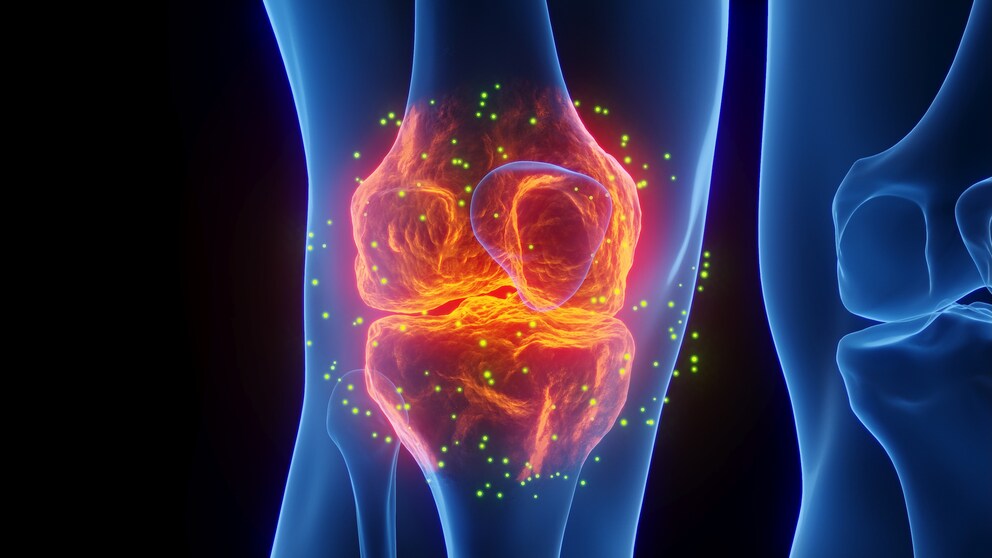
Hiking, badminton, dancing—what once seemed routine can suddenly become a torment with osteoarthritis. The disease affects all joints, from the shoulder to the ankle. However, the knee is particularly affected. Osteoarthritis gradually destroys the cartilage in the joint, which serves as a cushion between the bones. When the bare bones rub against each other, the pain becomes unbearable for those affected. Osteoarthritis is incurable. Therefore, it is crucial to prevent it and take timely action at the first signs of the disease.
What is Osteoarthritis?
Osteoarthritis is characterized by the gradual wear and tear of joint cartilage. This refers to the smooth cartilage layer that covers the joint surfaces of the bones and acts as a shock absorber. It prevents bones from rubbing directly against each other. As cartilage deteriorates, the joint loses protection—resulting in pain, stiffness, and limited movement. “Osteoarthritis refers to the wear and tear of joint cartilage. This wear is usually age-related,” experts explain. When bones rub against each other, symptoms worsen, and joint function further declines. Osteoarthritis is not curable, but there are treatments that can slow the progression of the disease.
Prevalence
Osteoarthritis predominantly occurs in the second half of life and increases with age. Women are more frequently affected than men. In 2019 and 2020, the Robert Koch Institute surveyed 23,000 people nationwide. Overall, 17.1 percent of adults aged 18 and older reported having osteoarthritis in the past 12 months.1
Among 18- to 29-year-olds, the prevalence was 0.7 percent (women) and 0.4 percent (men). Among 30- to 44-year-olds, 3.9 percent of women and 3 percent of men reported having osteoarthritis. The number of affected individuals rises sharply from age 45, with 23.9 percent (women) and 15.4 percent (men) in the 45 to 64 age group. From age 65, the disease is most widespread: 39.7 percent of women and 23.2 percent of men are affected from this age.
Why women develop osteoarthritis more often than men is unclear. According to the RKI, hormonal changes during menopause could be a reason. However, studies have not yet provided conclusive results.
Types of Osteoarthritis
In general, the human body has about 140 true joints—meaning joints consisting of two bones separated by a joint space. Osteoarthritis can occur in any of these joints. However, it most commonly affects:
- Hip joint (Coxarthrosis)
- Knee joint (Gonarthrosis)
- Hand and finger joints
The disease often progresses slowly, making it all the more important to pay attention to symptoms like pain and limited mobility early on and to take appropriate treatment measures.
Causes of the Disease
The disease primarily occurs when joints are excessively stressed over a long period. This can happen in certain sports, such as squash, especially when played professionally. It also includes occupational stresses like constant kneeling and lifting. Injuries, bacterial infections, or misalignments, such as knock-knees or bowlegs, can also trigger osteoarthritis. A major risk factor is being overweight. In obese individuals, the knee is usually affected.
Symptoms
Osteoarthritis often first manifests with the so-called “start-up pain.” The German Rheumatism League describes this as the unpleasant feeling when you get up and can’t quite get going because of pulling in the knee or hip.2 Initially, this pain is not very severe and only occurs occasionally. Over time, walking becomes increasingly strenuous, and the pain becomes a constant companion. The affected joint may also swell. The German Rheumatism League warns emphatically: “Pain is an alarm signal.” This usually means that the destruction of the joints is already in full swing.
The Following Risk Factors Favor the Development of Osteoarthritis
Various influences can accelerate cartilage wear in the joints. Biological risk factors include:
- Inflammations and previous injuries, such as meniscus damage, ligament tears, or bone fractures
- Genetic factors, if osteoarthritis has occurred more frequently in the family
- Misalignments of joints, such as in the knee or hip
- Advancing age, especially from the age of 50
- Female gender
In addition to these biological causes, lifestyle factors also contribute to the development of osteoarthritis:
- Lack of exercise, such as prolonged sitting in the office, can weaken muscles, promote postural damage, and accelerate cartilage breakdown
- Being overweight puts a heavy strain on the joints—the risk of osteoarthritis in the knee and hip is four to five times higher with severe overweight
- Sports with high joint stress, such as handball, soccer, boxing, or wrestling, can increase the risk
- Unilateral or incorrectly learned movement patterns, such as through monotonous work processes or intensive sports stress, can lead to overload
- Activities that require frequent kneeling, bending, squatting, or heavy lifting, as is common in some professions, also put a heavy strain on the joints3
What Is the Difference Between Arthritis and Arthrosis?

Do You Have Osteoarthritis? What to Watch for in Your Diet
Diagnosis
If osteoarthritis is suspected, one should see an orthopedist as soon as possible. This is the only way to avoid or delay surgeries. A doctor can use ultrasound and X-rays to determine whether it is osteoarthritis and how advanced it is.
Treatment of Osteoarthritis
Avoid or Reduce Overweight
Every pound less is a relief for those affected (and for the joints). This is scientifically proven. In a 2018 study, 240 obese participants with mild to moderate osteoarthritis were observed over a longer period. The result: Those who lost 20 percent of their weight experienced 25 percent less pain.4
Exercise—But Correctly
Those with joint pain often tend to automatically protect the affected body part. However, instead of putting your feet up when experiencing knee pain, the German Rheumatism League advises staying active to maintain joint mobility despite the pain. Specific exercises for the circulatory system, shoulder joints, torso and spine, and finger joints can be found in the brochure “Osteoarthritis—Exercise for Small Breaks.”5
Orthopedists often prescribe physical therapy in the early stages of osteoarthritis. There, you learn how to keep your joints flexible and properly load them. According to the Rheumatism League, Nordic walking and hiking, cycling, swimming, and specific strength exercises are beneficial to strengthen and build joint-stabilizing muscles.
Medication Therapy
- Painkillers: If osteoarthritis is so painful that walking is barely possible, painkillers can help maintain mobility. The RKI recommends starting with simple preparations like acetaminophen. If these are not sufficient, nonsteroidal anti-inflammatory drugs (NSAIDs) are usually prescribed. They have anti-inflammatory effects but can affect the stomach and should therefore only be taken for a short time.
- Cortisone: If osteoarthritis is already advanced, cortisone can help. It is injected directly into the joint and reduces inflammation. Patients are usually almost pain-free for weeks afterward. However, cortisone injections are not a long-term solution due to their strong side effects.
- Hyaluronic Acid: Some doctors inject this substance into the joint. Health insurance usually does not cover the costs. This therapy is one of the so-called Individual Health Services (IGeL). It is justified by the fact that a positive effect has not been sufficiently proven.6
- Chondroitin: This is a component of cartilage tissue, available over the counter in capsule form from various manufacturers. It is said to inhibit cartilage breakdown and alleviate symptoms. The Consumer Center is skeptical and points to contradictory study results. This is also why providers have not been allowed to advertise their chondroitin-containing dietary supplements with slogans like “For Healthy Joints” since 2012.
Arthroscopy
In an arthroscopy, the doctor makes small incisions in the skin to access the joint and can, for example, remove loose cartilage pieces. However, patients should not expect too much from this procedure. The Dresden University Center for Orthopedics, Trauma, and Plastic Surgery notes on its website that osteoarthritis is not eliminated by this procedure, and symptoms can reappear within weeks after the intervention.
Cartilage Transplantation
If osteoarthritis is localized to a specific area, cartilage transplantation can be beneficial and yield good results. During an arthroscopy, cartilage tissue is taken from the joint, multiplied in the lab, and then reinserted. If a large area is damaged, such a procedure is less promising.
Surgery and Artificial Joints
If there is a congenital or injury-related misalignment of the legs, the knee joint is often heavily stressed on one side. To compensate for this, the legs are straightened during surgery. Ideally, this slows down knee osteoarthritis, giving patients several years of relief.
If osteoarthritis is severe and all other treatment options (medication, physical therapy) have been exhausted, only one option remains: replacing the damaged joint with an artificial implant—either a partial or total prosthesis. Such surgery always carries the risk of infection. The Dresden University Center for Orthopedics, Trauma, and Plastic Surgery states: “This risk exists not only in the first weeks after surgery but can also occur in later years.” Severe overweight can further increase the risk of infection. Therefore, a joint prosthesis is the last resort—and reserved for older people, as such a prosthesis usually lasts only ten years.