


January 30, 2025, 3:08 am | Read time: 12 minutes
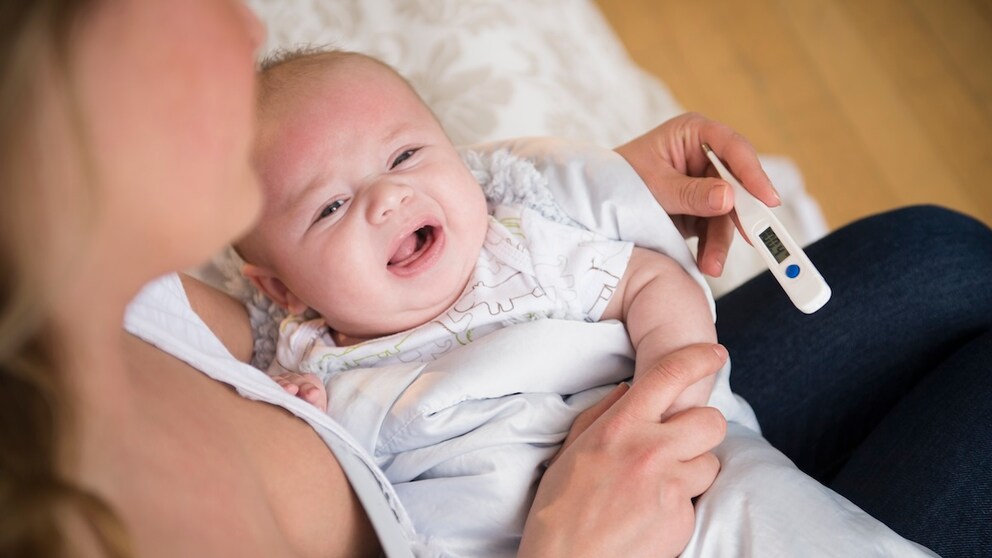
Suddenly, the forehead is hot, the baby is restless and fussy–and worry sets in: Is it a fever? And is it serious? When a child has a fever, many parents become anxious. FITBOOK explains everything important: from causes to fever suppositories to doctor visits.
Fever is one of the most common reasons parents take their children to the doctor. No wonder, since a high temperature can be very unsettling.1 In most cases, there is nothing serious behind it: Of the children who come to the family doctor’s office because of fever, less than one percent actually have a severe infection.2 FITBOOK explains what fever actually is and how to properly handle it when a baby or child is affected.
Follow the FITBOOK channel on WhatsApp now!
Overview
- What is fever?
- How should you best measure fever?
- Why does a baby get a fever?
- When should you treat a fever?
- When should you see a doctor if the baby has a fever?
- When are fever suppositories useful?
- How do fever suppositories work?
- Dosage and application: How to do it right
- When are suppositories not a good idea?
- Sources
What is fever?
Fever is not a disease in itself and not an enemy: It is primarily a symptom of the body’s strategy to fight infections. In babies, the normal body temperature is about 37 degrees Celsius. However, it also depends on age, activity, ambient temperature, weight, and time of day: Infants generally have a higher normal temperature than older children. The temperature is highest for everyone between late afternoon and early evening and lowest between midnight and early morning. In infants, body temperature can drop to as low as 36 degrees Celsius during nighttime sleep and rise to as high as 37.8 degrees Celsius during active daytime, especially after feeding.3
From 38 degrees, it is called a fever, from 39.5 degrees, it is called high fever, and above 41 degrees, it is called hyperpyrexia–the medical term for extremely high fever. Hyperpyrexia is a medical emergency that must be treated immediately.4
How should you best measure fever?
If the baby’s forehead or skin feels unusually warm, it is not yet possible to say whether it has a fever. You need to measure it. The following table shows which method is recommended for which age group:5
[table id=939 responsive=”scroll” /]
Pediatricians always measure rectally in babies–all other methods are considered unreliable.6 With a little Vaseline applied to the tip of the thermometer, it is more comfortable.
Also interesting: When do you have a fever–and how do you measure it best?
Why does a baby get a fever?
Fever occurs because the body is fighting a disease or infection. It releases so-called endogenous pyrogens. These are messengers that act on the hypothalamus, a part of the brain responsible for temperature regulation. There, the “set point” for body temperature is increased. To reach this new temperature, the body produces more heat and releases less. Defense substances such as B and T lymphocytes are activated.7
Unlike overheating of the body (hyperthermia–for example, in heat stroke), where the temperature rises uncontrollably, fever is a targeted reaction controlled by the hypothalamus. The immune system works best at temperatures around 39.5 degrees Celsius. This is the “optimal operating temperature” for the body in combat mode. The combination of fever and the activation of these defense cells shows how important fever is for protecting the body.
The most common causes of fever:
- Viral infections such as colds or flu are the most common triggers. These types of fever are usually harmless and often disappear after a few days. Children with siblings or those in childcare units have such an infection on average eleven times a year!8
- Bacterial infections such as ear infections, bladder infections, or less commonly, pneumonia can also cause fever. Depending on the severity, these may require antibiotic treatment.9
- Vaccine reactions occasionally occur after a vaccination and cause mild to moderate fever, which subsides after one to two days.10
- Teething is often cited as a cause of fever but usually does not cause temperatures above 38.5 degrees.11
- If fever occurs very frequently, it may be a sign of a chronic immune system weakness–such as more than two sinus infections.
When should you treat a fever?
“Lower the temperature!” many parents wish. But as already explained, fever is primarily a sign of a very effective defense mechanism of our body, not a disease. Also, children have fevers much more often than adults. Even with minor harmless health impairments, their body temperature increases. Fever does not always need to be eliminated. Often, it helps the body more if the immune system is allowed to work during the fever.
Nevertheless, fever can be very stressful for the baby. The goal of fever-reducing measures is not to lower the temperature at all costs. Studies also show that fever-reducing medications do not shorten the duration of the illness. However, they can relieve symptoms. That is also the goal of fever-reducing measures: to make the baby feel better.
There are several ways to better cope with fever:
- Stay in bed
- Drink plenty (fever causes dehydration)
- Moist, lukewarm washcloth on the forehead
- Calf wraps (not with chills)
- Change bed linens and towels frequently
- Do not overdress the baby with high fever, so the little body does not get even more heat
- Fever-reducing suppositories and syrups suitable for children (fever medications for adults are not suitable for babies!)12
The key factor for using fever-reducing agents is the child’s general condition, not the elevated temperature. It is important to observe and accompany the baby attentively. You can take notes–on the measured temperature and symptoms. This information helps track the course of the fever and can be shared with the pediatrician if necessary.
If the baby has a fever over 39 degrees, fever-reducing agents such as suppositories or syrups can be used in consultation with the pediatrician. Even if the fever is so stressful for the baby that it is completely restless and cannot or will not drink, fever-reducing medications can be used.
Exception: Infants under three months should be taken to the doctor immediately for any fever from 38 degrees Celsius–if they refuse to drink, are noticeably sleepy, or scream shrilly, even earlier. Reason: Children at this age cannot have high fevers even with serious illnesses–their immune system is not yet strong enough.
If the child is older than three months, you can usually wait a day with 38 degrees fever. Again, the rule is: Observe closely! If the feverish child cries unusually, is sensitive to touch, or shows a change in behavior, a visit to the pediatrician is advisable.
When should you see a doctor if the baby has a fever?
Even though fever is usually a normal bodily reaction to a mild infection or illness, in these cases, you should take the baby to the pediatrician:
- Fever from 38 degrees Celsius in babies younger than three months: Even mild fever can be a sign of a serious infection, as the immune system is not yet fully developed. Immediate medical clarification is important here.13
- Fever from 39 degrees in babies under six months: Even though the height of the fever does not necessarily indicate a real problem, a study shows that a fever of 39 degrees Celsius or higher is more likely to indicate a serious infection.
- Fever over 39.5 degrees: Especially if it does not decrease despite fever-reducing measures or if the baby appears severely stressed.
- Persistent or intermittent fever: If 39 degrees fever or more lasts longer than a day in a child under two years old or more than three days in an older child.
- Noticeable symptoms: rapid breathing or shortness of breath, bluish lips, lethargy, limp posture, seizures, pale or mottled skin, or rashes are warning signs that require immediate action.
- Low fluid intake: Signs of dehydration such as a dry diaper for several hours, sunken eyes, or dry lips can be dangerous and require medical advice.
A doctor’s visit not only provides reassurance but also helps rule out serious causes of the fever or quickly take the right measures if necessary.
When are fever suppositories useful?
Fever-reducing medications come into play when the baby is severely stressed by the fever, in pain, or extremely restless. The goal: The child should feel better, not just “cooler.” There are fever syrups (pharmacies can also prepare these if they are sold out or unavailable) and suppositories.14 Sometimes suppositories are also called “suppositories.” The word comes from Latin: “suppositus” means “placed under” or “inserted.” The term refers to the method of administration, where the medication is inserted “under” (into the body).
Especially in the first 24 hours of a fever spike, suppositories help provide relief to the baby, especially if the fever prevents it from sleeping. They are also useful for babies who have trouble swallowing syrups or tablets. However, it should not be forgotten that fever is not the enemy but part of the natural defense.
There are two common active ingredients that are well-tested and safe:15
- Paracetamol: Suitable for babies from birth. Lowers fever and relieves pain.
- Ibuprofen: Can be given from six months. Also has anti-inflammatory effects, but is not ideal for stomach problems or if the baby has drunk little.16
Very important: Do not use adult preparations–they are unsuitable for children! And: Never combine both active ingredients without medical advice! You can alternate both active ingredients, but this should be discussed with the pediatrician to avoid overdosing.17 Also: The well-known active ingredient acetylsalicylic acid (e.g., Aspirin®), which many adults take for pain or fever, is an absolute no-go for feverish children!18 It can trigger the rare but dangerous Reye’s syndrome, which damages the brain and liver, especially after viral infections like flu or chickenpox.19
How do fever suppositories work?
Fever suppositories stop the production of substances that trigger the “temperature turbo” in the brain. Fever suppositories block a specific enzyme responsible for the formation of these substances. This lowers the temperature and relieves pain.
The effect of fever suppositories usually sets in within 30 to 60 minutes. The temperature can be reduced by about 1 to 2 degrees, which is usually enough to noticeably improve the child’s well-being. But it is clear: The suppositories do not fight the cause of the fever but only relieve the symptoms. The body continues to work to overcome the actual infection. An interesting side effect is that the fever-reducing effect also reduces the body’s fluid loss. Babies with high fever tend to lose more fluid, which can lead to dehydration. Lowering the temperature not only helps against the fever itself but also relieves the child’s entire organism.
However, there are differences between the active ingredients: While paracetamol mainly has fever-reducing and pain-relieving effects, ibuprofen also has an anti-inflammatory component. This can be particularly useful in infections such as an ear infection. However, ibuprofen should be used cautiously in babies with sensitive stomachs or dehydration, as it can irritate the stomach lining.
An important point: The effect of a suppository usually lasts 4 to 6 hours. After that, if necessary and medically recommended, another dose can be given. It is important to always keep an eye on the maximum daily dose and not to administer unnecessary doses.

What can be used as a substitute for children’s fever syrup?

Why Children Are Particularly Frequently Affected by Middle Ear Infections
Dosage and application: How to do it right
Fever suppositories are dosed according to the child’s body weight.20 Often, age is given as an additional guide–but the baby’s weight is decisive. Depending on the active ingredient, preparations with 60–250 milligrams exist. As with all medications, the package inserts provide precise dosage instructions for each preparation, and doctors can give further advice on what is best individually.
For paracetamol suppositories: 10–15 mg per kilogram of body weight, maximum 60 mg per kilogram of body weight per day. At least six hours pause is required between doses.21
[table id=940 responsive=”scroll” /]
For ibuprofen suppositories: 5–10 mg per kilogram of body weight, maximum 30-40 mg per kilogram of body weight per day. At least six hours pause is required between doses. Here is the recommended dosage for Ibuprofen Pädia® 75 mg suppositories (from 8 months):22
[table id=941 responsive=”scroll” /]
Whether paracetamol or ibuprofen–the correct dose is very important when dosing fever suppositories. An overly high dose can damage the baby’s liver or kidneys, while a too low dose does not show sufficient effect. It is best to write down the dose and time after administration. The application itself is also important:
- Proper storage: Suppositories should not be too warm before use, as they become soft and harder to insert. It is best to take them out of the refrigerator shortly before use.
- Insertion technique: Carefully insert the suppository with the rounded side first into the bottom. Ideally, lay the baby on its back and slightly bend the legs.
- Observation afterward: After administration, the baby should remain calm for a few minutes so that the suppository does not slip out again.
When are suppositories not a good idea?
Sometimes caution is better. Do not give a fever suppository if:
- Your baby is allergic to the active ingredient. An allergic reaction can manifest as symptoms such as rash, itching, swelling, or breathing difficulties. In such cases, immediate medical advice is required.
- It is severely dehydrated (e.g., due to diarrhea). Dehydration can strain your baby’s circulation and make the effects of medications unpredictable. Instead, fluid intake should be ensured first. Another important point is that suppositories may not work correctly if your baby has diarrhea. In such cases, the active ingredient may not be fully absorbed, reducing effectiveness. Fever-reducing syrups could be a better alternative here, as they are absorbed directly through the gastrointestinal tract.
- It has liver or kidney problems. These organs are responsible for breaking down the active ingredients, and stress can lead to dangerous side effects.