


November 7, 2025, 4:07 pm | Read time: 11 minutes
Millions of people go to the gym once or even several times a week. Most do it not just for health reasons, but also to look good. However, the hoped-for success often leaves much to be desired. That’s why FITBOOK, together with sports physician Enrico Zessin, reveals ten simple routines to optimize your workout and promote better muscle growth.
Inexperienced strength athletes often don’t find weight training in the gym particularly complicated: Just lift weights properly, and the desired muscle growth will come. This isn’t entirely wrong, as beginners who have never done strength training before can often see quick results at first. The body is newly stimulated by weightlifting and adapts with stronger muscles. And you can see that. Unfortunately, the initial muscle gain often remains, followed by a phase of stagnation. Strength athletes fear the so-called performance plateau. With a few simple routines, you can ensure that your training doesn’t fizzle out but instead becomes noticeable through more beautiful muscles.
Overview
1. Protein, Protein, Protein
It can’t be said often enough, but protein is the necessary building block for muscles to grow at all. According to a study with strength athletes, 1.8 to 2.2 grams of protein per kilogram of body weight are needed–but only if you train hard.1,2 Sports physician Enrico Zessin also emphasizes this. Such amounts of protein are only relevant for bodybuilding: “Too much unused protein is converted into an energy source and quickly stored as fat tissue!”
Also interesting: 6 signs that you’re consuming too much protein
Otherwise, 1.3 to 1.5 grams per kilogram of body weight are sufficient. The corresponding amount should be consumed throughout the day, from early morning to late evening, to ensure the muscles are continuously well-supplied. To reach this amount, you should focus on a high protein content at every meal or treat yourself to a protein shake as a snack.
Also interesting: Is it better to consume proteins for more muscles in the morning or evening?
Additionally, many athletes swear by a portion of protein directly after training (within 30 minutes). A study confirms that proteins consumed immediately after training reach the muscles a bit faster, promoting better muscle growth.3 Especially when at least three grams of the amino acid leucine are included, along with some glucose or maltodextrin to stimulate protein synthesis.
According to sports physician Zessin, you should note the following: “For a 70-kilogram athlete, the required daily amount of protein is about 100 grams. This can be relatively easily absorbed through a normal diet.” Protein shakes are dietary supplements that are not subject to quality control and often contain additional substances that may not be necessary and could potentially lead to interactions.
Also interesting: The best dietary supplements for muscle building
2. The Length of Breaks Matters
How long should I rest between sets before getting back to the weights? Many amateur athletes in the gym ask themselves this question. An answer is provided by a small (and therefore only partially valid) study that examined 21 young and trained strength athletes.3 They all trained three times a week over eight weeks. They performed the same exercises. The only difference: One group of men rested only one minute between sets, while the other group took three minutes. The result: After the eight-week test period, both muscle strength and muscle size were significantly better in the participants with longer breaks. So it’s best to train with a stopwatch to always keep the three-minute break. Then muscle growth will also work.
Also interesting:Even one hour of training leads to an increased afterburn effect for several days
3. Split the Training
Anyone who wants to perform a full-body strength workout will quickly notice that it can easily take one to two hours. Especially if, as recommended in point 2, you take a three-minute break between each set. This tires the body and mind. It’s much more effective to divide the training into different body parts. The advantage: With split training, you can train several days in a row, and each trained body part still has at least one day to regenerate.
This is what a split training of just one hour each could look like:
- Monday: Chest, triceps, legs
- Tuesday: Back, biceps, shoulders
- Wednesday: Rest
- Thursday: Chest, triceps, legs
- Friday: Back, biceps, shoulders
- Saturday: Cardio
- Sunday: Rest
Also interesting: What exactly is split training–and what variations are there?
4. Strengthen the Mind-Muscle Connection
It sounds a bit strange at first, but you should always fully focus on the muscle being used as soon as an exercise is performed. For example, with bicep curls with dumbbells, it would be the flexor in the upper arm. While you follow and feel the contraction of the muscle with full attention, it’s called the so-called mind-muscle connection. Arnold Schwarzenegger, former Mr. Universe, swears by this technique. Similar to meditating, he focuses his entire attention on the current movement process during strength training. According to him, it is one of the best methods to successfully increase performance. Additionally, focusing on the movement ensures cleaner execution and thus a lower risk of injury.
The former world-class bodybuilder didn’t just make this up, as the effectiveness of the mind-muscle connection has been confirmed in studies. For example, a study with 18 trained men showed that they could increase the activity of the triceps and the large pectoral muscle during bench presses when they focused on it. This worked particularly well at a performance intensity of 60 percent of maximum performance.5 The effect was also confirmed in the second part of the study when participants were asked to perform push-ups.6 This time, however, the activation only worked for the pectoral muscle, while the triceps could only be addressed through the mind-muscle connection in very experienced athletes.
Also interesting: What does Arnold Schwarzenegger mean with his tip “sleep faster”?
5. Incorporate Compound Exercises as Often as Possible
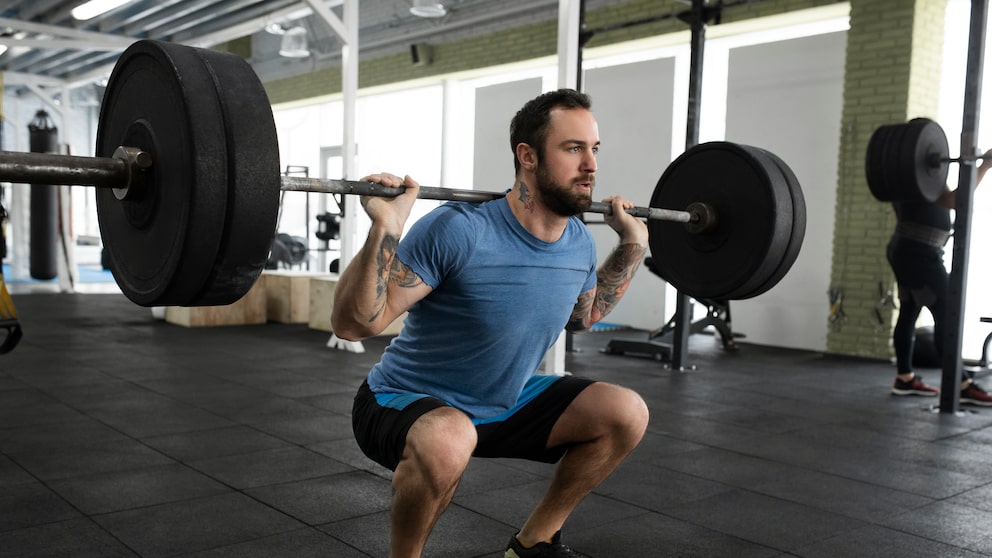
Strength exercises are divided into two major groups: isolation exercises and compound exercises, also known as basic exercises. In isolation exercises, only individual muscle groups are targeted, whether on the machine or with free weights. So, for example, only the biceps, triceps, large pectoral muscle, etc. In compound exercises, however, several muscle groups are targeted simultaneously. In bench presses, it’s the triceps and the large pectoral muscle; in squats, it’s the entire legs, glutes, and abdominal muscles. Typical compound exercises are:
- Bench press
- Squats
- Deadlifts
- Shoulder press
- Barbell rows
- Pull-ups
- Dips
Compound exercises not only save time, but they also promote better muscle growth and overall fitness. This was shown, for example, in a study with 36 young and untrained men.7 All underwent a twelve-week training program with the same training volume. Half of the participants performed isolation exercises, while the other half did compound exercises. At the end of the test period, the researchers found that both groups gained muscle and had less body fat.
However, the test participants with compound exercises achieved better results across the board: They had better muscle growth, lost more fat, developed more muscle strength, and had a higher maximum oxygen uptake. Compelling reasons to perform at least one compound exercise every training day.
Compound–or complex exercises have another decisive advantage, according to Enrico Zessin: “Since several muscle groups are targeted and even the smaller, joint-surrounding, and stabilizing muscles are strengthened, the risk of injury is significantly reduced.” The physiological function of the joints, tendons, and muscles improves significantly through compound exercises.
6. A Training Partner Helps Push to the Limit
There are certainly people who like to train alone and can motivate themselves well. However, a training partner has invaluable advantages: Together, you not only motivate each other better, but you also push each other to higher performances. Naturally, you exert more effort when someone is watching and cheering you on to complete another repetition. But not only that: You can push much better to your performance limit when a training partner protects you from potential injuries. In bench presses, for example, it’s dangerous to train alone to the point of muscle failure–because the barbell could fall on you if you can no longer hold it. A training partner can also ensure the exercises are performed cleanly, especially when you reach your load limit. This also promotes healthy training and reduces the risk of injury.
But muscle failure plays a significant role in muscle growth. This means: In every exercise, you should go to your absolute limit in the last set–until no more repetitions are possible. And this is exactly where a training partner can assist and protect you from a falling barbell. However, the topic of muscle failure is very controversial. Because those who go to their limit too often exhaust the muscles too much and require a longer recovery afterward. Nevertheless, a large study review has shown that athletes who train to muscle failure have better muscle growth.8 According to the study, this effect can be achieved by training with higher weights and fewer repetitions.

How to Get Stronger Without Building (Visible) Muscles

Superset Training: Build More Muscle and Lose Fat
7. Variety is the Magic Word
Our muscles adapt to increasing loads through growth. This means we must either lift more weight or offer our muscles new stimuli through other exercises. If you notice that you’ve reached a natural limit in weightlifting, you should try a new exercise or even a different training method.
To avoid constantly landing in a monotonous loop of the same exercises, it’s worth trying something new and “shocking” the muscles a bit. Try HIIT (High-Intensity Interval Training), CrossFit, or calisthenics, i.e., training with your own body weight. This not only stimulates muscle growth but also provides variety and more fun in training.
Also interesting: No progress in training? The most common mistake
8. Don’t Forget Cardio
When constantly thinking about better muscle growth, it’s easy to neglect cardio training, or endurance. This is not only bad for health, as cardio trains the cardiovascular system much more intensively and thus protects against cardiovascular diseases. And if you want beautifully visible muscles, you even have to do endurance training.
Muscles Otherwise Not Visible
Because only those with a low body fat percentage have clearly visible muscles. And endurance training at medium intensity is ideal for burning fat. That’s why you should do at least one hour of cardio once a week or longer. Whether it’s a session of jogging, swimming, or cycling, it’s not only good for muscle appearance but also for health.
In general, you should know that the heart is heavily stressed during strength training. When contracting large muscle groups, the heart has to work against significantly more resistance–for example, in the leg press, it has to pump up to 2 liters more blood. “Therefore, it is absolutely necessary, even as a strength athlete, to regularly perform cardio training so that the heart can handle the high loads without damage,” explains Zessin.
- 1. Campbell, B., Kreider, R.B., Ziegenfuss, T. et al. (2007). International Society of Sports Nutrition position stand: protein and exercise. J Int Soc Sports Nutr 4.
- 2. Pasiakos, S.M., McLellan, T.M., Lieberman, H.R. (2015). The effects of protein supplements on muscle mass, strength, and aerobic and anaerobic power in healthy adults: a systematic review. Sports Med.
- 3. Stark, M., Lukaszuk, J., Prawitz, A., Salacinski, A. (2012). Protein timing and its effects on muscular hypertrophy and strength in individuals engaged in weight-training. J Int Soc Sports Nutr.
- 4. Schoenfeld, B.J., Pope, Z.K,. Benik, F.M. et al. (2016). Longer Interset Rest Periods Enhance Muscle Strength and Hypertrophy in Resistance-Trained Men. J Strength Cond Res.
- 5. Calatayud, J, Vinstrup, J, Jakobsen, M.D. et al. (2016). Importance of mind-muscle connection during progressive resistance training. Eur J Appl Physiol.
- 6. Calatayud, J., Vinstrup, J., Jakobsen, M.D., Sundstrup, E., Colado, J.C., Andersen, L.L. (2017). Mind-muscle connection training principle: influence of muscle strength and training experience during a pushing movement. Eur J Appl Physiol.
- 7. Paoli, A., Gentil, P., Moro, T., Marcolin, G., Bianco, A. (2017). Resistance Training with Single vs. Multi-joint Exercises at Equal Total Load Volume: Effects on Body Composition, Cardiorespiratory Fitness, and Muscle Strength. Front Physiol.
- 8. Vieira, A.F., Umpierre, D., Teodoro, J.L., Lisboa, S.C., Baroni, B.M., Izquierdo, M., Cadore, E.L. (2021). Effects of Resistance Training Performed to Failure or Not to Failure on Muscle Strength, Hypertrophy, and Power Output: A Systematic Review With Meta-Analysis. J Strength Cond Res.