


May 5, 2025, 9:20 am | Read time: 4 minutes
This workout is sure to turn some heads! In “crunning,” you move on your hands and feet — a unique form of exercise that might initially seem like a gimmick but is actually designed to challenge numerous muscle groups. FITBOOK writer Sarah Bachmann explains the unconventional all-fours method and has spoken with an expert about the effects of this training.
One thing is certain: This form of training is not something you see every day — crunning immediately stands out. The training method involves moving on all fours, usually at a considerable speed. Together with Prof. Thimo Wiewelhove, FITBOOK examines this quirky training form.
Overview
What’s Behind the Crunning Training Method
Origin of the Training
One of the founders of this unusual training form is the Australian Shaun McCarthy, who started the first crunning community in 2017. His goal was to create an effective workout that engages as many muscle groups as possible simultaneously. However, the original elements of this movement technique are said to come from China, where it is regularly used in traditional Kung Fu training.1 Currently, there are no classic training groups in Germany.
How Crunning Works
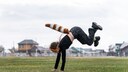
The starting position in crunning is the so-called quadruped stance: hands and feet are about hip-width apart, with knees slightly above the ground. The back remains straight, and the gaze is directed forward. For movement, the left hand and right foot are moved forward simultaneously, followed by the right hand and left foot.
It is important to maintain core tension in the abdominal and trunk area and to focus on controlled movement. Once the movement sequence is secure, the pace can be gradually increased. A flat, soft surface like parks, lawns, or sports fields is suitable for starting.
What to Watch out for During Training
To avoid injuries while crunning, several points should be considered. A stable body posture is particularly important to prevent overstrain and strains in the shoulder and back area, especially before increasing speed.
The surface also plays a crucial role: on hard surfaces, the strain on the wrists can significantly increase. It is advisable to wear gloves or bandages to relieve the joints and protect against possible foreign objects like stones or glass shards. For those who want to be extra cautious, wearing a helmet is an option, as there is a risk of losing balance, especially at the beginning.2
Fitness Hype: What Quadrobics Really Has to Do With Training

The 5 Most Important Strength Exercises for Men Over 50
Who Should Avoid Crunning?
Since crunning puts a lot of strain on the hand, shoulder, and knee joints, people with issues in these areas should avoid this training form. Caution is also advised for those with dizziness or neck problems, as looking forward and the unfamiliar posture can further stress these areas. In such cases, a joint-friendly training method is recommended.3
What the Expert Says
From a training science perspective, crunning has not yet been systematized or scientifically studied. According to Prof. Dr. Thimo Wiewelhove, a professor of training science, it is more of a fad without any discernible value as a serious movement or fitness trend.
Although there are so-called crawling exercises used in warm-ups to activate and strengthen the trunk and shoulder muscles, these have nothing to do with crunning from a training science perspective. Apart from a possible increase in motivation, he sees no significant advantages over traditional strength or endurance training. At least, he does not recognize any particular risks compared to other training forms.
Crunning is a mix of crawling and running. The term combines the English words “crawling” and “running.” Both hands and feet are used for movement, allowing one to move on all fours over varying distances.