


July 16, 2026, 8:06 am | Read time: 7 minutes
Owning a six-pack at least once in a lifetime: For many fitness enthusiasts, the six-pack is the epitome of a toned and athletic body. However, training alone is not enough: For the rectus abdominis muscle with its typical two-row packs to stand out visually, the body fat percentage must be beyond the natural norm. FITBOOK explains and reveals what body fat percentage women and men must ultimately fall below for the six-pack to appear. Health-wise, this is not entirely without risk–unless three key factors are considered.
The path to a six-pack requires, if done healthily, a lot of discipline. The fact is: It is possible! The key is a combination of adjusted carbohydrate and protein intake, specific training sessions, and the right amount of hydration.
Everyone Has a Six-pack, but for Most, It Is Not Visible
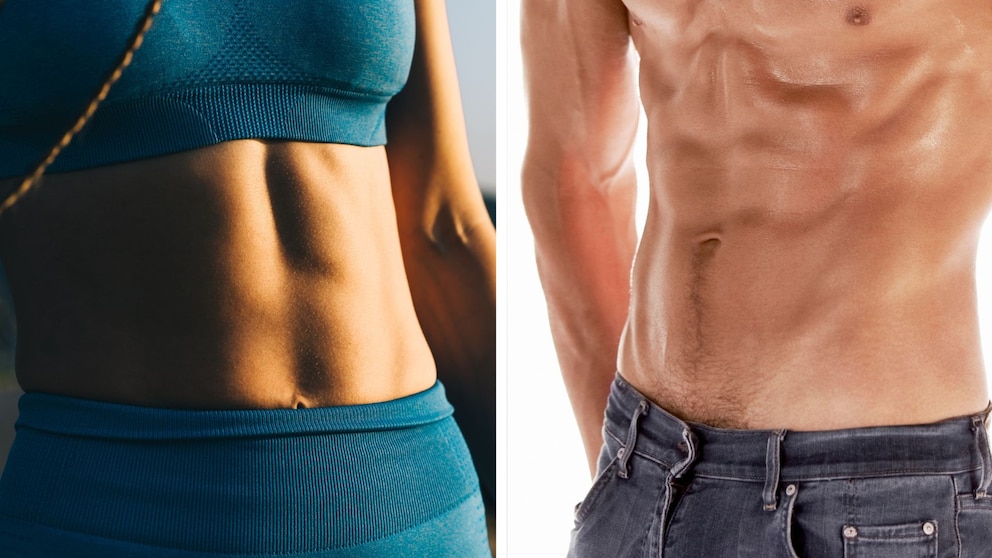
Anatomically, the rectus abdominis muscle–also known as the six-pack muscle–exists in all people. Its main function is to flex the trunk and pelvis. The individual development and division of this muscle are genetically different. For most people, this muscle is covered by the subcutaneous fat layer. If this layer is “thin” enough, the muscle–and thus the six-pack–becomes visible. The compact “chambers” or “packs” that make the muscle visually resemble a washboard are created by tendons. The key to the six-pack look is the body fat percentage of the individual.
Now for the bad news: The body fat percentage required for a visible six-pack is far from the norm. And–let’s be realistic here–the exact shaping of the abdominal muscles is genetically predisposed. Even with low body fat, one person might achieve the legendary six-pack. For others, an eight-pack might even be visible, while others might look muscular in the midsection but not have the pronounced formation of muscle packs.
Average Body Fat Percentage of Men and Women
According to sports scientist and health expert Dr. Michael Despeghel, a body fat percentage between 10 and 20 percent was common for normal-weight men in the past, and 20 to 30 percent for women. The expert believes that this norm regarding body fat percentage has now shifted upward to 20 to 25 percent (men) and 30 to 35 percent (women).
How Much Body Fat Percentage the Average Man Must Reduce for a Six-Pack
For men, the threshold for a visibly defined six-pack, according to Despeghel, is about 12 percent body fat—with a fluctuation of around one percentage point, depending on individual differences such as skin thickness. This means: At 12 percent body fat (and below), the washboard abs are there; above that, they “disappear.” The average man would need to reduce his body fat percentage by 8 to 13 percent to reach this six-pack level: According to Despeghel, the average body fat percentage for men is 20 to 25 percent.
How Much Body Fat Percentage the Average Woman Must Reduce for a Six-Pack
For women, the path to visible abdominal muscles is more challenging because they naturally have a higher body fat percentage due to hormonal functions and genetically determined fat distribution. On average, women have a body fat percentage of 30 to 35 percent. “With a bit of luck, a woman can enjoy washboard abs from 22 percent body fat. For some, it only happens at 18 percent body fat.” This means a “necessary” reduction in body fat percentage of 12 to 17 percent for the six-pack—significantly more than for the average man.
Necessary body fat percentage for six-pack visibility in men: 12 percent (average is 20 to 25 percent)
Necessary body fat percentage for six-pack visibility in women: 18 to 22 percent (average is 30 to 35 percent)
Dangers of a Too-low Body Fat Percentage
For both women and men, a very low body fat percentage leads to complex hormonal changes and a weakened immune system. “This can become dangerous. For women, the healthy lower limit is 15 percent body fat; for men, it’s eight percent,” warns Despeghel. For athletes, especially those in endurance sports, such values are not uncommon. The optimum is slightly higher for bodybuilders.
Determining Body Fat Percentage
Anyone seriously considering the goal of a six-pack should first determine their body fat percentage. Several methods are available for this: from measuring the electrical resistance in the body—such as with body fat scales—to simple calculations based on waist or hip circumference, to skinfold measurements with calipers. The latter, the caliper method, is considered convincing by sports scientist Michael Despeghel due to its reliable results and easy handling. Although not entirely free: A body fat determination using this method costs around 80 euros.
How-To: The Path to a Six-Pack
If you are of normal weight and untrained and want to achieve a visible six-pack, it is necessary to reduce body fat percentage.
What is normal weight?
The WHO defines it as a BMI of 18.5 to 24.9. However, Michael Despeghel does not think much of this measurement because the BMI says nothing about a person’s health or disease risk. He considers the answer to the question of whether one carries too much abdominal fat to be much more meaningful. He gives the green light to men with a waist circumference between 94 and 102 centimeters, and for women, he considers 80 to 88 centimeters to be unproblematic.
Why Malnutrition Is the Wrong Way to the Goal
A short-term, drastic reduction in calorie intake—such as through starvation—is not suitable for this. “I’ll just starve for a few days and then I’ll have a six-pack!” This is not the way to approach the desired goal, according to Despeghel. Although strong weight loss might hint at abdominal muscles, such an approach often comes with undesirable side effects like muscle loss and an unhealthy appearance.
Not only that: According to the expert, there is also a visual difference between whether the relief of your (untrained) abdominal muscles is due to malnutrition or due to longer, ambitious training combined with a sensible dietary change. “The former can be recognized by the fact that, in addition to the marginal six-pack, the chest, ribs, and hip bones often protrude,” explains Despeghel. And that is neither healthy nor the goal.
If you want a full six-pack, you can’t avoid two aspects: intense training and a suitable diet to reduce body fat. Let’s elaborate on that.
This Training is Needed for a Six-Pack
Strength training supports muscle building, which not only contributes to the goal visually but also increases the basal metabolic rate—the calorie consumption at rest. The more muscle mass a body has, the more energy is consumed permanently. For the goal of a “six-pack,” Despeghel recommends doing ambitious strength training three times a week. Additionally, endurance training should be planned three times a week.
Ideal Carbohydrate Intake for the Six-Pack
The expert recommends that those of normal weight with a six-pack goal reduce carbohydrate intake to a maximum of 150 grams per day. “Eat primarily long-chain carbohydrates, such as those found in legumes and potatoes. Avoid white flour products and optimize your omega-3 and -6 status!” The health-promoting, polyunsaturated fatty acids are found in flaxseeds, psyllium seeds, salmon, herring, mackerel, algae, avocado (omega 3), as well as animal and plant fats (omega 6).
Hydration and Protein Intake
Also crucial on the way to a six-pack: hydration and protein intake. Here, the expert advises 40 milliliters per kilogram of body weight and 1.3 to 1.5 grams of protein per kilogram of body weight daily.
How Much Time Should Be Planned for the Six-Pack Look?
According to the expert, those of normal weight should easily plan for a year until the desired, full six-pack look is achieved—provided they follow the tips above and stick to the training.
Also interesting: Effective Training After 40—What Women Should Pay Attention to

“Achieving a ‘Dream Body’ After 50: Tips for Men”

7 Effective Exercises for Toned Lower Abs
What Role Does Age Play?
To properly assess the chance of having your own six-pack, it is also important to know that from about 30, the muscle mass of the entire body slowly decreases. This results in an increase in the proportion of fat tissue. From about 50, the process accelerates. “If you continue to eat normally—and most people do—you have no chance of a washboard stomach,” says Despeghel.
What Must Be Done to Keep the Six-Pack?
The six-pack becomes a permanent state only if you stay in top shape and do not lose sight of your body’s energy expenditure—which, as derived from the changed ratio of muscle to fat mass described above, decreases with age.