

September 5, 2025, 9:05 am | Read time: 6 minutes
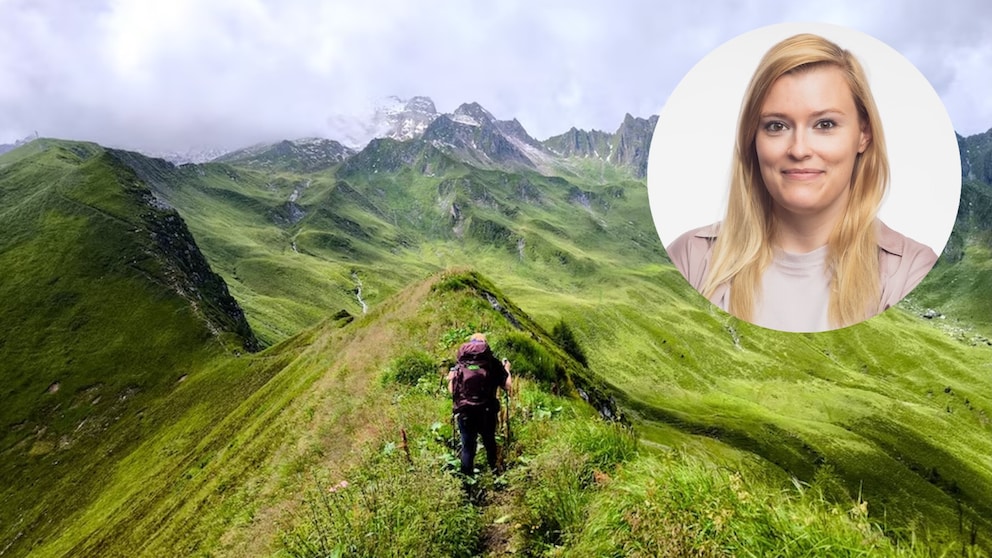
Three and a half weeks, 24,000 meters of elevation gain—and a 12-kilogram backpack on your back: Crossing the Alps is no walk in the park; it’s more like a marathon in hiking boots. FITBOOK author Louisa Stoeffler’s experience in long-distance hiking taught her to prepare for such an endeavor with targeted training over months. It paid off in the end: She only had sore muscles once.
Why I Prepared for My Alpine Crossing with Training
I consider myself athletic, but I’m not an ultrarunner. For the Alpine crossing project, it was clear to me: On this tour, the limiting factor wouldn’t be endurance but the daily strain from the elevation profile and backpack.
My focus during training for the Alpine crossing was on functional strength, especially around the knee, a stable core, and measures to avoid overloading. Joints can’t be directly trained, but the muscles that support them can. And that’s what mattered to me.
On another tour, I already experienced that the hike doesn’t always have to be intense for it to hurt. Even 20 kilometers downhill can lead to getting fitted for an orthopedic brace with tears in your eyes and paying 70 euros for it.
What I Learned About Mental Strength and Fear of Death During My Alpine Crossing
Effective Yoga Exercises for a Toned Bottom
My Training Mix for the Alpine Crossing–Strength, Stability, Mobility
Some may laugh, but it’s true: Yoga and Pilates were the ideal preparation for my Alpine crossing. However, I must say that I regularly keep fit with workouts from these categories and didn’t start from scratch. Of course, we’re not talking about three times “Om” in a cross-legged position—but about strength training with your own body weight.
1. Yoga for Balance and Mobility
Yoga was on the schedule twice a week—focusing on balance, hip opening, and body tension. During the Vinyasas, I concentrated on movement, muscle activation, and fluid control. Instead of meditation, there were varied sun salutations with lots of leg and core work: deep lunges, five to six Chaturangas per session, 100-second hold phases in plank, and warrior variations included.
Especially in combination with conscious breathing, these sessions were not only a great mobility workout but also a sweaty full-body workout. Exactly what I needed as preparation. Particularly effective:
- Sun Salutation Variations
- Side Planks
- Strengthening standing poses like Warrior II plus Reverse Warrior
- Chair Pose (Utkatasana)—wonderfully tough on the thighs
- Tree and Warrior III for balance, mobility, with stability
In short: No “incense stick yoga,” but functional strength training in flow—exactly what you need when the path becomes narrow, rocky, and steep.
2. Pilates–Muscle Burn with System
Pilates was on my training plan once a week—and not as a nice “stretch-and-breathe” workout, but as consistently divided strength training that I built up in rotation: first arms, then core, then legs—and then back to the beginning, each time until it burned. Gradually, I also incorporated weights and resistance bands to increase intensity.
My goal was to reach the deep muscles—the ones you particularly need on long stages.
Also interesting: Mountain Guide Reveals 4 Mistakes You Should Definitely Avoid When Hiking
My Typical 30-Minute Pilates Triad (With or Without Miniband)
Arms and Shoulders
- Shoulder Taps in Plank Position—for stability and coordination
- Reverse Table Top Dips—for triceps and shoulder control
- Arm Circles with extended arms and “Walnut Crushers”—small, mean, very effective
- Miniband Pull-Aparts (arms extended forward/upward)
Core Crushers
- Pilates classic “The Hundred” for activation and breathing
- Single Leg Stretch & Double Leg Stretch—great for abs and coordination
- Side Plank Hip Dips—for the lateral core muscles
- Dead Bug with extended legs and arms—focus on controlled movement
Legs and Glutes
- Glute Bridges with increasingly extended leg—for glutes, back of the legs, and balance
- Wall Sits with arm variations—static burn, like in a hut without a chair
- Small lunge + pulse—ideal for knee control
- Side-Lying Leg Lifts with flex—strengthen hip muscles and outer knee
3. Targeted Knee Strength Training for the Alpine Crossing
If there’s one body region that suffers particularly during an Alpine crossing, it’s the knees, as mentioned earlier. Especially during descent, three to five times the body weight can impact the joints—with every single step. Good mood doesn’t help here, only targeted training does.
Because: You can’t train joints—but you can train the muscles that stabilize them. And that was my approach. I focused mainly on the thighs (front and back), glutes, calves, and lateral hip muscles. This not only provides protection and cushioning but also control—especially on steep and slippery descents.
Three to four times a week, I also incorporated functional exercises—many of them with my own body weight, primarily aimed at strengthening all muscle groups that could help relieve the knees. Particularly helpful:
- Squats with chair (not fully sitting down): promotes control, strength, and joint angle
- Step-ups with backpack or weight: simulate ascents, train leg axis stability
- Lunges sideways and backward: activate thighs, glutes, and hip flexors simultaneously
- Single-leg Glute Bridges on the mat: glute power for core stability and knee guidance
- Clamshells with miniband: activate the abductors (lateral glute muscles), important for knee guidance
- Excentric stair climbing backward: trains braking power—especially helpful downhill
Here, I always tried to reach 20 to 25 repetitions. Paying attention to perform the exercises more slowly but cleanly.
Mobility and Relief: Foam Roller Was My Best Friend
Because I sit a lot in everyday life—and thus exactly the muscles shorten or “fall asleep” that I urgently need when hiking—working with a foam roller was a fixed part of my preparation. I found rolling out particularly helpful for:
- Front of the thighs (quadriceps)
- Back of the thighs (hamstrings)
- Side of the thighs (IT band area)
- Gluteal muscles (piriformis & gluteus medius)
I often rolled out these areas in the evening after a leg workout for ten to 15 minutes. It loosens, improves circulation, and helps the muscles stay flexible and efficient. And yes: It sometimes hurts—but afterward, you feel like you’ve been freshly serviced.
Backpack Training and “Ego Check” in the Living Room
I also did some workouts with a backpack—and I wasn’t alone. My husband commented on some steps of my program—especially the yoga—with a raised eyebrow and the words: “That will never be enough for 24,000 meters of elevation.”
He himself lifted weights—a lot and heavy—to prepare for our Alpine crossing. At this point, I can reveal: I had sore muscles on exactly one day of our three-and-a-half-week Alpine crossing (it was on day three after a 1,700-meter descent). My husband, on the other hand, suffered from sore muscles much more frequently. This shows: For an Alpine crossing, gentle training with slow, controlled movements may be more effective than dumbbell biceps.
How I really fared on the Alpine crossing will be in the next part, which will soon appear on FITBOOK.