

September 7, 2025, 6:24 am | Read time: 10 minutes
FITBOOK author Louisa Stoeffler crossed the Alps in July 2025 amid snow and heavy rain. Her journey took her through 20 challenging stages over the Steinernes Meer, the main ridge with the Hohe Tauern, and the Dolomites–she aimed to start something that was easier to abandon than to complete. She shares what situation triggered a crying fit, what months of training brought her in preparation, and whether she would undertake another Alpine crossing with her current experience.
Follow the FITBOOK channel on WhatsApp now!
Soaked to the Skin, Backpack Drenched
The summer of 2025 did not show its sunny side in July. Quite the opposite. From the start, it was clear: It would rain. Two and a half days were forecast. In the end, we arrived dry at the hut on only four days. Four times we were soaked to the skin, the backpack with spare clothes completely drenched. We spent three days in the Drei Zinnen National Park, only to not see the peaks of the famous mountains due to fog and later heavy rain.
Additionally, reports of hikers who had accidents on the same paths we took were piling up. The day before we hiked the Sagerecksteig, a man fell to his death there. We heard the helicopter retrieving him. Then came the news that Laura Dahlmeier died in a mountain accident in Pakistan’s Karakoram range–in this situation, it was not easy for me to tackle ascents and descents again.
I Thought I Wouldn’t Survive This Descent
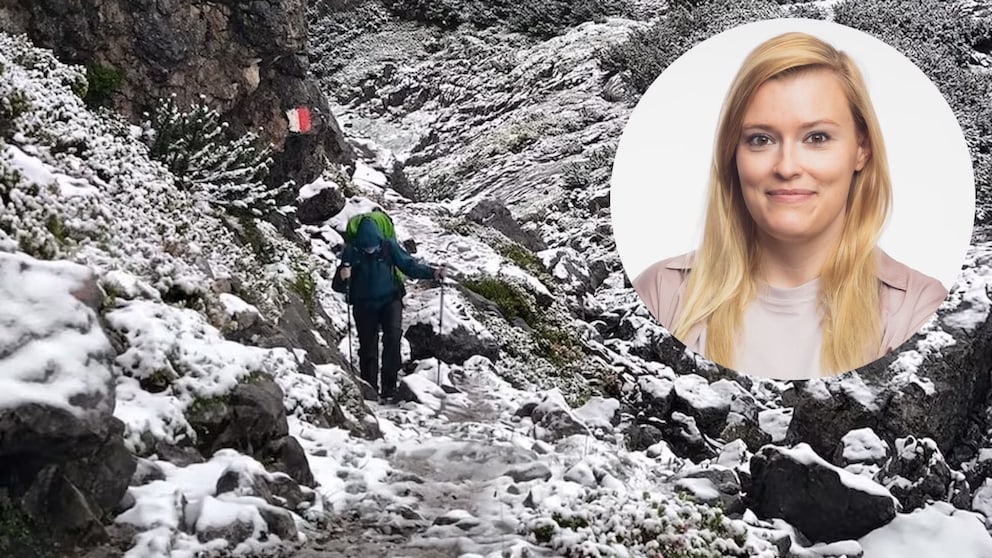
And there was something else I was completely unprepared for: a winter onset in July. After the first days of rain, the snow line dropped to 1,700 meters, meaning the Steinernes Meer should have been called “the snow sea without landmarks” that day. This led to one of the toughest moments of our Alpine crossing: the descent to Maria Alm over bare stones and snow muddied by other hikers. I thought I wouldn’t survive this descent.
Because, even if it sounds strange now: I actually have a fear of heights. It’s paradoxical that I still love the mountains, hiking, and the vastness at the summit–but that’s how it is. I’ve been battling my fear of heights since I was little and overcome it time and again. I thought I would panic when I had to go down these slippery stones. So I aborted the first attempt to descend and went back to the hut. Breathe.
Also interesting: Mountain guide on mistakes while hiking that can be fatal
The Difference Between Fear of Heights and Fear of Death
My mind had shut down on other, much less demanding and dangerous paths. I remember a hike in the Harz when a 20-percent slope on dry forest ground made my hands sweat. I thought I had overcome my fear of heights–but on the snowy descents of the Alpine crossing, I felt a different kind of fear.
I completed the first descent, my mind calm and highly focused. The fear was there, but more helpful than hindering. In the hut, another hiker told me that after the first difficult meters, there would soon be a rope safety line along much of the trail. ‘Okay,’ I said to myself–and put on my via ferrata set: ‘I can do this’–and that’s how it was.
My Personal Waterloo Happened Just Before the Descent into the Lakarscharte
Two days later, we were again battling snow, which had already begun to melt. And no safety in sight. Do you know the saying ‘to experience one’s Waterloo’? My personal Waterloo on this Alpine crossing was the Lakarscharte. On partly loose scree, mostly covered by snow, I felt a fear for my life like I had never felt before. At one point just before the descent into the saddle, I started sliding and couldn’t find any grip on the muddy snow and grass. I clung to a large stone with my fingertips and scraped my knuckles searching for a hold. Now I knew what real fear was and what distinguished the block of a fear of heights from it.
Also interesting: How to properly prepare for hut tours (via TRAVELBOOK)
Flashback and Crying Fit in the Evening at the Accommodation
In hindsight, the situation could have been much more critical. The terrain was steep but not extremely precipitous. It would have been much worse to slide on paths directly next to a precipice. This did not diminish the fear that made me tremble. Because even if I might not have died if I had slid further or let go, the next helicopter would still have had to come for me. But I found a hold again and completed the descent. In the evening at the accommodation, I still had a flashback and crying fit.
How I Prepared for My Crossing of the Alps
Mountain Guide Reveals 4 Mistakes You Should Avoid While Hiking
Conditions Demanded Mainly Mental Strength from Me
The conditions in the mountains we encountered on our Alpine crossing demanded not only physical fitness but above all mental strength. The best training is of little use if you buckle internally because the rain runs into your shoes again and the pass disappears in the fog.
On good days, I hiked with a goat, as I report here at PETBOOK, enjoyed cheese dumplings, and fell in love anew every moment with the vastness of the view. Even in fog and drizzle, I could be in a good mood, hike over flank trails and ridges, and think: “That was so cool, I want to do it again right away.”
On the worst days, I asked myself why I was doing this at all. After all, the Alps could have been crossed in less time–in six days from Oberstdorf to Meran, a high-five at the end and a new sticker for the backpack. But no, we took the Steinernes Meer, the main ridge with the Hohe Tauern, and finally the Dolomites. Once completely over everything.
Stage Overview of Our Alpine Crossing (with Prelude and Conclusion)
0. Salzburg 1.5 days city trip
1. Königssee → Wasseralm
2. Wasseralm → Kärlingerhaus
3. Kärlingerhaus → Maria Alm
4. Maria Alm → Zell am See
5. Zell am See → Kaprun
6. Kaprun → Krefelder Hütte
7. Krefelder Hütte → Uttendorf
8. Uttendorf → Berghotel Rudolfshütte
9. Rudolfshütte → Kalser Tauernhaus
10. Kalser Tauernhaus → Kals am Großglockner
11. Kals → Sudetendeutsche Hütte
12. Sudetendeutsche Hütte → Virgen
13. Virgen → Zupalseehütte
14. Zupalseehütte → St. Jakob
15. St. Jakob → Innervillgraten
16. Innervillgraten → Sillian
17. Sillian → Rifugio Carducci
18. Rifugio Carducci → Rifugio Auronzo
19. Rifugio Auronzo → Rifugio Città di Carpi
20. Rifugio Città di Carpi → Auronzo di Cadore
+ Conclusion: Venice (2.5 days)
My Eccentric Training in Preparation Paid Off
My biggest concern beforehand was my knees–especially downhill. In preparation, I did a lot of eccentric training: step-ups with weights, squats, lunges with a glute band. Muscularly, it really paid off. But even the best preparation doesn’t protect you from getting sore muscles. The descent to Maria Alm was not only mentally demanding but also one of the most physically exhausting. Eight hours and 1,500 meters of elevation can’t be simulated in advance.
If it were up to my fear of heights, I would always only ascend, never descend. And if you could ask my knees, they would probably agree with it. Many hikers know this. So here are my tips that made the strain of going downhill bearable for me.
Tips: What Made the Strain of Going Downhill Bearable
- Shift your center of gravity forward: Especially when descending, the awe-inspiring view downward invites you to lean back. However, this shifts the center of gravity and makes it easier to slip. Therefore, shift the weight more to the midfoot and don’t land with the heel first, so you walk more securely.
- Slightly bend the knees: When descending, never lock or “snap” the legs. Because then the joints bear all the load. Better to bend the knees, so the legs and buttocks do the work. If the muscles start to tremble, take a break and shake them out!
- Take small steps: I know, especially going downhill encourages many to walk faster. However, large steps put additional strain on the joints. Taking small, controlled steps allows the other leg to support a bit more and reduces the impact on the joints.
- Trekking poles help: Even if you have to get used to using them, trekking poles can be very useful and help with the descent. It’s not about balance here, but really about shifting weight to the upper body with the pole and relieving the legs.
What I Would Do Differently in Planning in Retrospect
With the buttocks and thighs as “shock absorbers,” you reduce the impact on knee and ankle joints, activate the muscles continuously–and at the end of the day, you’re not destroyed, but tired in a good way. However, despite everything, I also had knee pain. So another tip: Never plan descents and ascents in the range of 1,500 meters of elevation or more in one day. Better to ascend and then descend the next day. If planning allows, you could also take a day off in between.
After a While, You Don’t Reach 100 Percent Physically Anymore
Even the daily repetition of such a long hike cannot be trained in advance. 20 days of hiking sounds sporty–but in reality, it means: getting up every morning, packing, and setting off. One day up, one day down. Managing your energy because you know there’s another day coming. And then many more after that. After a while, you don’t reach 100 percent physically anymore, but almost nod off over the evening dumplings in the dining room at 6 p.m.
My Personal Learnings from the Alpine Crossing
Here are a few learnings I took away from my Alpine crossing:
- Fitness protects–but doesn’t replace experience
Training prepares the hiker physically. But how to deal with fear, fatigue, and uncertainty is learned only on the way. - Preparation is not to be underestimated
I had exactly the right mix: strength, core, endurance, flexibility. Without it, I would have given up–or suffered. - Regeneration is an active part of the tour
Rest days, stretching, eating, sleeping–and sometimes sitting out an extra hour of rain before setting off again–are important to start the next stage safely.
Experience Alpine Crossing: Would I Do It Again?
Anyone who has completed several long-distance hikes will eventually ask themselves: ‘Do I do the Alpine crossing this time?’ I can now say: I’m not toying with the idea anymore, I’ve done it. But would I have done it if I had known it would be so exhausting, cold, and rainy?
I would have liked more time to look at glaciers, do via ferratas, or take in a few three-thousanders. However, that wasn’t the point of this tour. It was about doing something that was easier to abandon than to accomplish.
This tour demanded everything I had. Mentally, it definitely made me stronger and showed me what it means to be alive and to rely completely on myself. Even though I believe for various reasons that this was my last tour, it probably won’t be.