

June 15, 2023, 11:14 am | Read time: 13 minutes
Stand-up paddling–or SUP for short–is the summer’s trend sport. Whether at the lake, river, or sea, courses and tours are offered in many places. FITBOOK explains how to get started with paddle boarding and what to consider when buying a board.
Want to become a stand-up paddler yourself this summer but don’t know how to start? No problem. We’ve compiled some stand-up paddling tips for you. From different types of SUP, to the first steps in the sport, to board purchasing and safety tips, you’ll get valuable insights into this trend sport. So nothing stands in the way of SUP fun in the coming months.
Overview
- What is stand-up paddling and where does it come from?
- Which muscles are trained by SUP?
- The best tips for beginners
- River, lake, or sea–where is the best place to paddle?
- Beware of ocean currents
- Windsurfers, sailors, and ships have the right of way
- Further rules of conduct
- Different types of SUP at a glance
- What to consider when buying a SUP board
- How to recognize a quality SUP board
- What to consider with fins and paddles
- The right clothing for SUP’ers
- Carelessness in SUP can harm nature
- Do not enter restricted conservation areas
What is stand-up paddling and where does it come from?
Stand-up paddling (SUP) translates to stand paddling and has become a real trend sport in recent years. You move forward standing and using a paddle on a special SUP board on the water. It’s a combination of surfing and canoeing.
In Germany, SUP has established itself as an independent sport. Competitions are even held, such as the German Championship organized by the German Canoe Association (over distances from 500 meters to 50 kilometers for men, women, and youth).
Also interesting: What surfers should definitely pay attention to
Which muscles are trained by SUP?
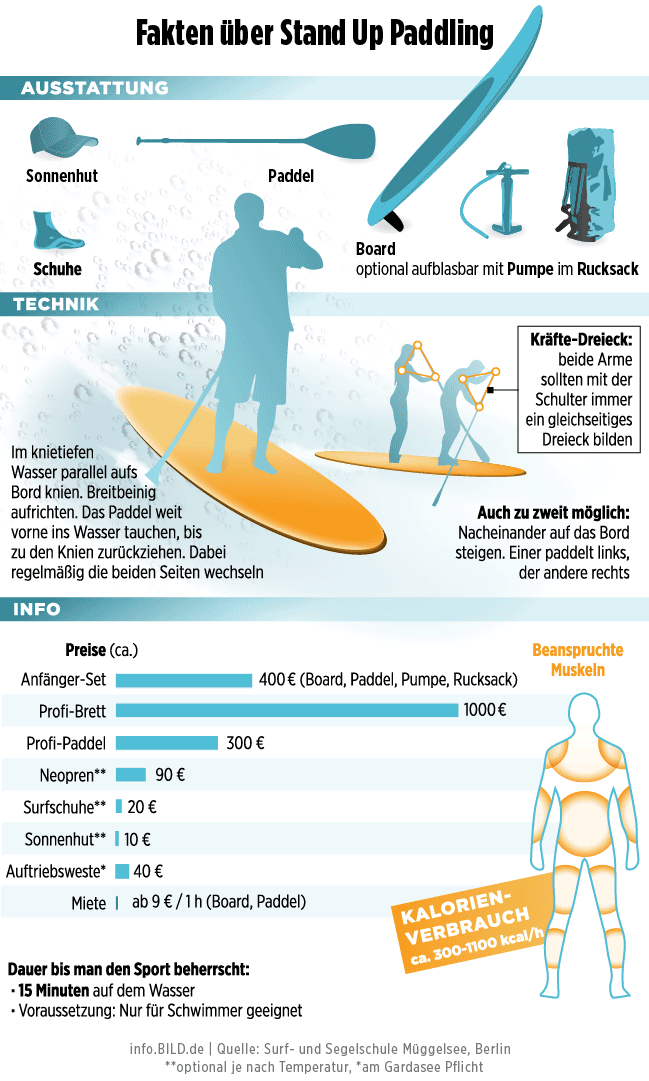
Stand-up paddling is a good cardiovascular workout, engages all muscle groups, promotes balance and coordination, and is easy on the joints. According to the German University for Prevention and Health Management (DHfPG), this makes the sport an excellent full-body workout.
Horst Frankenfeld, SUP expert of the German Canoe Association, explained to FITBOOK: “In SUP, the leg muscles have to implement a lot of balance commands from the head. The upper body must do its part for propulsion with the paddle. When done correctly, the back muscles are particularly engaged. Paddling solely with arm strength leads to quick fatigue. The paddle is inserted into the water far in front of the board, requiring a slight rotation of the upper body. Since you should switch from one side to the other after a few paddle strokes, both sides of the body and both arms are alternately engaged.”
The connection to nature in SUP is also a great balance for everyday stress.
The best tips for beginners
“The SUP sport can be practiced by anyone, regardless of age, who can swim and has no significant health restrictions, such as balance disorders or shortness of breath,” explains Horst Frankenfeld. However, a few things should be considered for the right start.
Take a beginner’s course
Of course, you can just get on the board and try to teach yourself SUP. However, according to Frankenfeld, beginners are better off in a trial course, or alternatively, renting a board with a brief introduction from an experienced SUPer. Under supervision, you get important tips for your own safety. Such courses are offered at water sports centers or SUP schools. The German SUP Association GSUPA offers an online overview of certified stations.
Pay attention to wind conditions
The upright body offers a particularly large surface area for the wind–making it more challenging to stay stable on the board. Therefore, choose a calm day for your first standing attempts.
Manage your strength properly
Another common beginner’s mistake is paddling with the wind at your back first. It seems appealing because you can cover large distances seemingly effortlessly. The problem, however, is that you have to return–and then you face annoying headwinds. This can be especially dangerous on the open sea, as you might be too exhausted to make it back to shore. Always start your paddling tour with the more strenuous part, against the wind.
Don’t look at your feet
Another tip for beginners: don’t look at your feet! Looking down disrupts your sense of balance and makes paddling much more difficult. Better: look forward and fix your gaze on a point on the horizon.
Don’t lock your knees
For a secure stance, try to relax your legs and don’t lock your knees. This strengthens body awareness and makes it easier to maintain balance.
Don’t paddle with just arm strength
What is often forgotten at the beginning: stand-up paddling is a full-body sport. Not only the arms are trained, but the entire body is used. So don’t just use your arms to move, but also pay attention to your torso, legs, and back. This way, you paddle faster and more efficiently.
Safety always comes first!
Generally, outdoor sports become dangerous only if you don’t master them properly and misjudge situations. The best protection for your own safety is qualified training. Especially as a beginner, you should take the existing dangers of water sports seriously. For example, during acute flooding, normally unproblematic waters can present special hazards. Health and life should never be put at risk, and if in doubt, it’s better to refrain from paddling. The weather should also be considered. In summer, for example, problems can arise from high sun exposure. In storms and thunderstorms, you should, of course, never get on a SUP board. Naturally, the sport is also not suitable for non-swimmers.
At the beginning, you should choose places to paddle that are not too crowded. Especially if you don’t have full control of your board yet, you avoid unnecessarily endangering others.
Also interesting: Strengthening hip flexors and vertebral joints with rowing world champion Oliver Zeidler
River, lake, or sea–where is the best place to paddle?
In general, you can do stand-up paddling in any body of water where you have enough water under the board. According to the expert, it should be at least 60 centimeters. However, there are a few things to consider.
Beginners should make their first paddling attempts on a lake. Here, there is virtually no current, and the water is calm–ideal for getting started. Almost any lake is suitable for stand-up paddling, but you should inform yourself about any nature reserves and rules and adhere to them.
Beware of ocean currents
Stand-up paddlers are also often found in the sea. However, the dangers here are significantly greater than in a lake. The Mediterranean is generally less dangerous than the wave-rich Atlantic. In general, you should always inform someone before heading out to the open sea with a SUP board. Many beaches have so-called “rip currents,” which are dangerous currents that pull swimmers out to sea and cause many drownings. Such currents also occur in the Baltic and North Seas. It’s best to inform yourself beforehand from a local about where to be cautious. For sea tours, you should definitely get a leash for safety–a special cord (usually made of elastic polyethylene) that connects the board to your leg so it doesn’t get lost in case of a fall.
Also interesting: Here are the dangers of swimming in summer
Windsurfers, sailors, and ships have the right of way
Fast-flowing rivers should not be underestimated either. You should only attempt them on your own as an advanced or even SUP expert; beginners should definitely go with a guide. Especially during high water, paddling should be avoided, and safety should always be the priority. There are also various traffic rules to observe on rivers. For example, there is a general right-hand driving rule. When encountering oncoming watercraft, you must generally move to the right. Professional sailors, as well as sailors and windsurfers, have the right of way. Inland and sea shipping lanes should be avoided. When crossing, the ships traveling here must not be obstructed.
Also interesting: Drowning people don’t call for help–and that’s the big danger!
Further rules of conduct
For paddle boarding in the sea, this may be particularly important, but it should always be observed, as Horst Frankenfeld explains: carry a waterproof phone for emergencies and inform friends or family about the planned SUP tour in advance. Also: “label your board with your name and contact information so it can be assigned if it drifts away.” If a board is lost on or in the water, it should be reported to the police immediately to avoid an unnecessary search. “If a board is drifting on a body of water or is found somewhere, its crew will also be searched for,” says the expert.
Different types of SUP at a glance
Classic SUP
In the classic version, you stand on the SUP board and move forward with the help of the special paddle. This version is usually practiced in shallow water and with little wind. Simple, relaxed, and therefore ideal for beginners!
SUP Yoga
Combine two relaxing sports, and you get SUP Yoga. The name explains itself: you do yoga exercises on the SUP board. Thanks to the board’s stability, it works wonderfully, and you get a beautiful view of the water.
SUP Safari
Things get a bit more exciting with the SUP Safari. The focus is on exploring the area or surf spot on the board and covering a longer distance. It’s best to take a guided tour with a guide familiar with the area and local paddling conditions.
SUP Race
If you’re ambitious and enjoy sporting challenges, you can also participate in SUP competitions. Races are held over various distances. You can admire and cheer on the best of the best paddlers annually at the SUP World Cup on the Baltic Sea in Scharbeutz.
Also interesting: The best SUP boards including accessories in comparison
What to consider when buying a SUP board
Depending on the use, the most important basic features differ, which according to the TÜV Association (VdTÜV) should be selected carefully.
- Thickness
- Width
- Length
Additionally, there is a distinction between:
- Hardboards
- Inflatable SUP boards (also called Inflatable Boards)
For beginners
Inflatable models are particularly suitable for beginners and occasional users. These are used by most hobby stand-up paddlers. They can be folded into a compact size, making them easier to store and transport. Often, matching backpacks are also provided, allowing access to bodies of water on foot and without much difficulty. Additionally, they are “tolerant of obstacle contact and also inexpensive,” explains Horst Frankenfeld.
For safety
The safety aspect also plays an important role. TÜV Süd, for example, recommends SUP boards with two air chambers that can be inflated and deflated separately. A second air chamber is especially useful if you don’t stay near the shore. If an air chamber breaks in the middle of the lake, stand-up paddlers can still rely on the second one to keep them afloat.
For carrying comfort
Carrying comfort should also be considered, as you often have to cover longer distances from the car to the water. Some SUP boards have special lifting and carrying devices that make transport easier.
Water sports enthusiasts should also consider the position of the valves. Important: They must be easily accessible, should not interfere when sitting, and their closures should be connected to the solid body.
Pay attention to quality
If you want to get a SUP board yourself, you shouldn’t skimp on quality for the price: “A cheap board can work for children with low body weight. But to really enjoy SUP in the long run, you shouldn’t skimp on equipment,” explains SUP instructor Robin Kassel, who offers tours and courses in Frankfurt am Main and Aschaffenburg. Horst Frankenfeld shares this view: “SUP boards are often available as a complete set with a paddle that is unfortunately often of inferior quality in terms of material, workmanship, and buoyancy.” He advises taking a closer look here to avoid frustration and, if in doubt, to dig a little deeper into your pocket.
How to recognize a quality SUP board
A high-quality board is marked with a TÜV seal. It then meets the requirements in terms of material quality, load capacity, and stability, and thus safer usability. Boards with two instead of one material layer are more robust but also more expensive and heavier. If you want a durable board, you should look for reinforced edges.
What to consider with fins and paddles
The fins also serve stability. In shallow water, a single short fin or two side fins are sufficient. In waves or currents, a large center fin and two small side fins are practical. If you focus on speed, you should opt for a large center fin.
The paddle should be about 15 to 30 centimeters taller than the paddler, fit well in the hand, not be too heavy, and be able to float on the water. Particularly practical are collapsible paddles.
The right clothing for SUP’ers
What should not be missing is the right clothing. “Not every day is so warm and sunny that simple swimwear is enough,” Frankenfeld points out. If you want to paddle regardless of the weather, you should definitely get a neoprene or dry suit. “Because air temperature is not the same as water temperature, especially in spring,” says the SUP expert. A life jacket should also be part of every SUP’er’s equipment. “Even if it doesn’t look particularly cool, it’s essential for your own safety!” he appeals.
Also interesting: At the Wellenwerk Berlin–this was the first time on a surfboard!

Beware: The Dangers of Swimming in Summer!

“It felt like I didn’t belong on the board.”
Carelessness in SUP can harm nature
One thing to pay attention to when SUPing: “In many bodies of water, especially in the edge areas, rare and endangered birds breed. If people get too close, they disturb them, and they may leave their nests,” explains Beatrice Claus, water protection officer at WWF. A disturbance can already be caused by the unfamiliar noise level or the shadow cast, Claus explains. Especially with stand-up paddlers, this is large and appears threatening. If you’re not careful on the SUP board, you can cause a lot of harm.
Do not enter restricted conservation areas
Distance for the protection of nature should be the top priority. “If an animal calls out excitedly or becomes frantic, it means: I’m too close, and I need to keep more distance,” explains Nabu expert Till Hopf. Then you should carefully retreat. Phil Mandeau, president of the Stand-up Paddle Association, adds: “It goes without saying that SUP boards and other water sports equipment should not be used in restricted nature, bird, and spawning protection areas.”
With material from dpa