



February 27, 2026, 3:57 pm | Read time: 6 minutes
There are numerous methods to improve endurance, and interval training is one of the most effective. But there are different approaches here, too. FITBOOK editor-in-chief Nuno Alves is currently integrating the so-called Norwegian Protocol into his weekly training plan. Here, he explains what exactly it is and what benefits it brings.
I am convinced that the Norwegian Protocol is one of the most effective methods of increasing cardiorespiratory fitness. This describes how well the heart, lungs, and muscles work together to absorb and transport oxygen and convert it into energy. An important measurement for this is VO2max—the maximum amount of oxygen that the body can use during exercise. An illustrative comparison: VO2max corresponds to the maximum engine power of a car, while cardiorespiratory fitness describes the efficiency with which all systems interact in everyday life. High cardiorespiratory fitness correlates with a lower risk of death.1
Overview
- How Exactly Does the Norwegian Protocol Work?
- The Choice of Training Form for Interval Training According to the Norwegian Protocol
- What Do 4×4 High-Intensity Intervals Feel Like?
- What Has Training According to the Norwegian Protocol Brought Me So Far?
- Now It’s Getting Scientific: This Is How Effective the Norwegian Protocol Is
- Conclusion on the Norwegian Protocol
- Sources
How Exactly Does the Norwegian Protocol Work?
The name Norwegian Protocol is due to the fact that two Norwegian sports scientists, Jan Hoff and Jan Helgerud, introduced the method in Norwegian competitive sport. Another Norwegian, Ulrik Wisløff, also researched this interval training concept and demonstrated the benefits for heart patients. As mentioned at the beginning, the Norwegian Protocol is a form of interval training. It consists of:
- Ten-minute warm-up
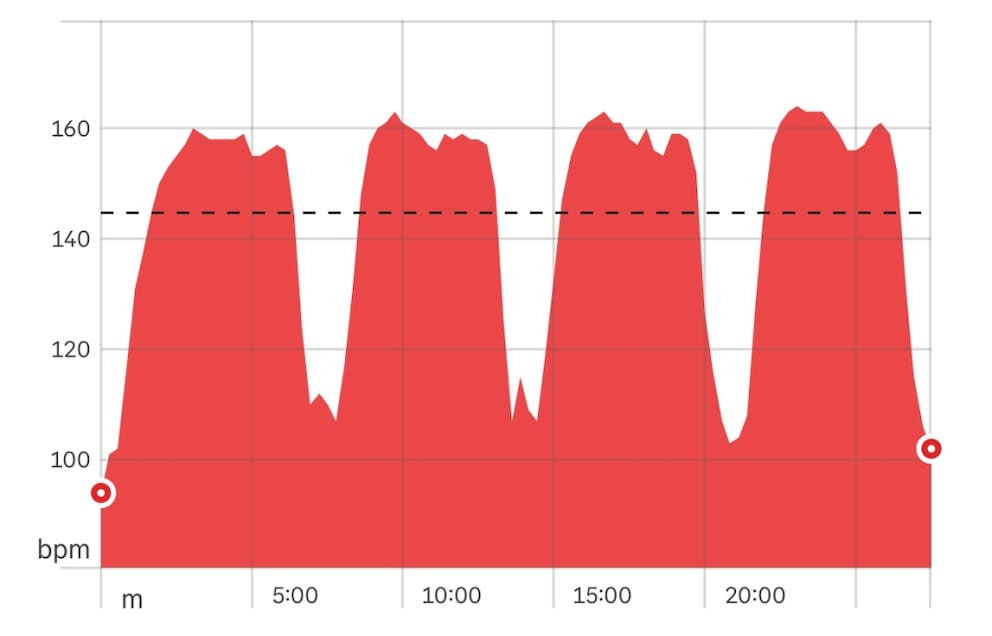
- Four intervals of four minutes each at 85 to 95 percent of maximum heart rate (HRmax)
- Three minutes of active recovery between the intervals at around 60 to 70 percent of your maximum heart rate. The last recovery phase is also the cool-down.
That sounds pretty simple, but it pushes me to my limits—and that is ultimately the goal.
Calculating Your Maximum Heart Rate (HRmax)
But where exactly are my limits? First of all, I need to know my approximate maximum heart rate. There are several formulas available here, but for the sake of simplicity, I will use the best-known one: 220 minus age.
In my case, that’s 220 – 49 = 171.
85 to 95 percent of this is around 145 to 162, which is exactly the range I need to stay in during the four exercise intervals. My lower HRmax target is 90 percent, i.e., 154. The recovery phases then amount to 60 to 70 percent of the HRmax, i.e., around 102 to 120 in my case.
To determine these ranges accurately, I wear a heart rate monitor during training. If you don’t have a sensor, you can use the following characteristics as a guide. In the range of 85 to 95 percent of HRmax…
- … speaking is hardly possible (only isolated words, but no complete sentences).
- … it is hardly possible to breathe only through the nose.
- … you have the feeling of being at your limit.
The Choice of Training Form for Interval Training According to the Norwegian Protocol
Once I have determined my maximum heart rate, the question arises: what is the most effective way to achieve this intensity? After all, it is not always easy to get your heart rate into the desired range. Particularly with certain forms of training, the muscles can tire before the cardiovascular system is really challenged.
On the spinning bike, my legs get tired long before my heart rate even gets into the desired range. After some experimentation, I have found the cross-trainer to be the optimal solution for me alongside the treadmill (at a 15 percent incline). It works both the upper and lower body, which enables me to get my heart rate reliably into the right zone.
Alternatively, other forms of training are also conceivable: Mountain runs or bike tours with lots of climbs are particularly effective, the air bike, as is the treadmill training mentioned above, with an appropriate incline. Ultimately, it is a question of individual preferences and possibilities—the only important thing is that the intensity is achieved.
What Do 4×4 High-Intensity Intervals Feel Like?
Anyone who has ever tried Tabata training—eight rounds of 20 seconds of exertion and ten seconds of recovery—knows that intervals can be pure torture. 20 seconds feels like an eternity. Imagine that multiplied by a factor of twelve, i.e., four minutes.
Interestingly, the body quickly adapts to the high exertion and finds its rhythm—even if this means that you continue panting, with a cramped expression on your face and covered in sweat. After the last interval and the subsequent three-minute recovery phase, almost exactly 28 minutes have passed. For me, it feels like a triumph every time.
What Has Training According to the Norwegian Protocol Brought Me So Far?
I have only been consistently integrating this form of interval training into my routine since mid-January, specifically twice a week. Apart from an indirect objective value—my cardio fitness measured with the Apple Watch has increased by four percent—I can only use my subjective feelings at the moment. And here I can definitely see a further improvement in my stamina, which is already quite good.

VO2 Max Linked to Higher Life Expectancy! Expert: How to Boost Your Levels

Hardly Strenuous Zone 2 Training Is Best for Reducing Body fat
Now It’s Getting Scientific: This Is How Effective the Norwegian Protocol Is
In a randomized control trial, Helgerud et al. (2007) found that an eight-week program with three weekly sessions of 4×4-minute runs at 90 to 95 percent of maximum heart rate led to greater increases in VO2max than steady, moderate endurance training.2 VO2max increased by more than seven percent. In addition, the heart’s stroke volume improved, indicating that it works more efficiently.
The benefits of longer intervals were also confirmed in a meta-analysis by Wen et al. (2018). This showed that intervals lasting more than two minutes and with a total volume of more than 15 minutes increased VO2max more effectively than shorter intervals. The Norwegian Protocol with four high-intensity four-minute intervals is therefore exactly in the optimal range.
This method can also offer advantages for heart patients. A study by Wisløff et al. examined the effect of twelve weeks of high-intensity interval training (4×4 minutes at 95 percent HRmax, three times a week) compared to moderate training at 70 percent HRmax.3 The results were impressive: while oxygen uptake increased by 14 percent in the moderate training group, the improvement in the interval group was 46 percent. In addition, heart function improved by 35 percent, and vascular health also increased. Both groups reported an improved quality of life, while the control group without targeted training showed no change.
Important note: Anyone suffering from heart problems should never try the 4×4 method without consulting a doctor and under supervision.
Conclusion on the Norwegian Protocol
The Norwegian Protocol is not only an effective method for increasing cardiorespiratory fitness, but also a challenging and useful addition to my training routine. Instead of another long session with a moderate heart rate, I now integrate this comparatively short but intensive endurance session, which pushes my heart into the upper load range.
The German original of this article was published in April 2025.