


October 23, 2025, 6:30 am | Read time: 6 minutes
How do I actually become more flexible again? As a yoga instructor, FITBOOK author and yoga teacher Nina Ponath knows the best workouts to increase mobility. A valuable exercise for the entire back of the body is the “downward-facing dog.” But what exactly does the yoga exercise do, and what should you pay attention to when performing it?
Press your legs firmly, keep your hips stable, and engage your pelvic floor upward—I can’t even count how many times I’ve described this exercise as a yoga instructor. If you practice yoga yourself, you might recognize the asana: It’s the “downward-facing dog,” which is included at least once in an average yoga class. For beginners, however, it can initially be a big challenge. I’ll guide you step by step through the asana—with a little practice, you’ll also master the downward-facing dog!
Why “Downward-Facing Dog”?
The downward-facing dog, also “Adho Mukha Svanasana” in Sanskrit (translated: “dog pose, face down”), is one of the most well-known and important yoga poses. It is part of the sun salutation and is found in almost all yoga styles. The pose is also regularly used in mobility training to warm up the body and improve flexibility.
What Does the “Downward-facing Dog” Look Like?
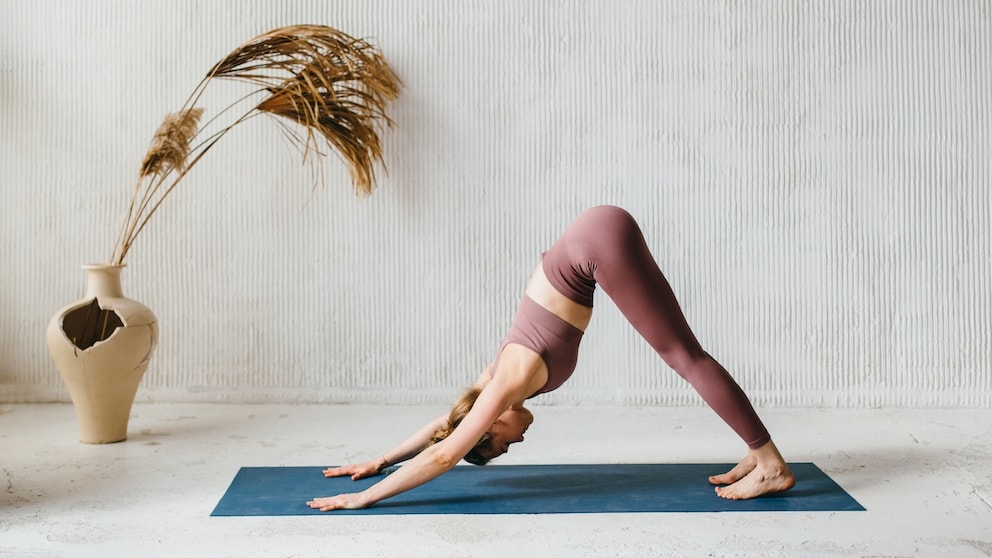
In this exercise, the body forms an inverted “V” from head to heels. The spine is long and straight, extending the legs in a line. The arms are also straight and support the body. The pelvic floor is active and pulls upward, while hands and feet are in a hip-width position. In this position, we resemble a dog stretching after getting up from its basket.
Instructions for the “Downward-Facing Dog”
- Start in a tabletop position. Place your hands under your shoulders, and your knees under your hips.
- Press the soles of your feet into the ground and lift your hips to form an inverted V. The back should be straight, and the elbows slightly bent.
- Press your heels actively into the ground without arching your back.
- Lengthen your spine by pulling the crown of your head toward your tailbone while slightly tucking your chin to your chest.
- Hold the position for a few breaths. Breathe deeply and evenly through your nose.
- Bring your knees to the ground one at a time and lower your belly onto the mat.
- A counterpose afterward is the “upward-facing dog,” which mobilizes the spine in the opposite direction.
What Is the Exercise Good for?
The “downward-facing dog” is one of the most important exercises for the entire back of the body and is highly recommended for almost anyone who works in an office. Sitting at a desk for long periods often shortens the hamstrings (muscles at the back of the thighs). Add to that car rides and evening time on the sofa, which can lead to pain in the back, legs, and knees.
Additionally, the “downward-facing dog” stretches the posterior chain, including hamstrings, calves, back extensors, and shoulder blades, improving joint flexibility and reducing the risk of injury during training. It also trains hip mobility, which benefits strength training exercises such as squats.
How Often Should You Perform the Exercise?
The “downward-facing dog” can be practiced daily. For beginners, two to three repetitions per session are sufficient, with the asana held for five to six breaths. In dynamic yoga styles, the asana often appears multiple times in a session when the body needs active recovery.
Variations of the “Downward-Facing Dog”
You may initially find it difficult to perform the exercise correctly, especially if you have a significantly shortened back of the body. In that case, you can bend your knees or use blocks as aids and place your hands on them. The elevation makes the exercise easier.
- With bent knees: This variation is ideal for beginners and people with limited leg flexibility. Of course, the exercise can also be made more challenging for advanced practitioners.
- With straight legs and elevated heels: This variation intensifies the stretch of the hamstrings and calves.
- With one leg against the wall: This variation provides additional support and allows for a deeper stretch.
- With dynamic movement: The “downward-facing dog” can also be practiced dynamically by rocking the upper body back and forth.

Effective Yoga Exercises for Strong Arms

3 yoga exercises that burn the most calories
When Is the Best Time to Do This Exercise?
The downward-facing dog can be used as a warm-up at the beginning of a workout or as a cool-down at the end. It can also be integrated into other mobility training exercises, such as lunges or squats.
Tip: Throughout the exercise, focus on even breathing and avoid pushing into pain.
Conclusion
The “downward-facing dog” is a valuable exercise that benefits the body on various levels: It increases flexibility, stretches the entire back of the body, and strengthens the joints. The exercise is ideal for anyone with a shortened back, such as from too much sitting in the office. In yoga, the “downward-facing dog” is part of various styles.