

November 18, 2026, 7:17 pm | Read time: 9 minutes
Most serious injuries don’t happen during extreme sports but in everyday life–and often a brief moment of thought would have sufficed. Prof. Dr. Thomas Kälicke sees and operates on the consequences as chief physician every day. In FITBOOK, the specialist in orthopedics and trauma surgery lists five things he would never do himself–and explains why.
Not so easy with a trauma surgeon as a dad
My children still say: ‘Not so easy with a trauma surgeon as a dad.’ They were the only ones in the neighborhood without a big trampoline in the yard. And my daughter wished for a horse for years. She got goldfish instead. I can understand these wishes. But I can’t change who I am. As a chief trauma surgeon, I see and operate on people who have had accidents every day. And when I ask during rounds how it happened, the stories often sound surprisingly similar:
“And what were you doing?”
“I just wanted to see if it was slippery.”
“And?”
“It was slippery.”
In the end, injuries can accompany you for a lifetime
It’s astonishing how carelessly we put ourselves in precarious situations. Not while skydiving or downhill biking, but when changing a light bulb, bathing, or on the way to the bakery.
Many of these accidents could have been avoided with a little attention and a brief moment of thought. And in the end, there are injuries that can accompany you for a lifetime. Trauma surgery can do a lot. But even with optimal care, these injuries don’t always heal without consequences. It’s not uncommon for movement restrictions or swelling to remain, and especially after joint injuries, premature joint wear often develops, which can lead to artificial joints.
5 things I would never do
So here are five things I personally would never do. It’s not a ranking or a complete list. I could easily name more. It’s a mix: Some happen frequently, every winter, every weekend. Others are rare but often end very badly.
Also interesting: What you should really do to strengthen your bones
1. Ride a bike barefoot or in flip-flops
Quick trip to the bakery, the lake, the ice cream parlor. Five hundred meters, why put on shoes? I see the consequences every summer.
As long as the road is smooth, everything is fine. Then comes a bump, a curb, a pothole, and the foot slips out of the flip-flop or off the pedal. If you’re lucky, you quickly get your foot back on the pedal, balance the brief wobble, and at most lose your flip-flop. But it doesn’t always go that way. Because the moment of slipping makes riding unstable for a moment, and especially when you’re going fast, the situation often tips in the other direction.
Then the foot scrapes over the asphalt, and you tear a good piece of skin off the top of your foot or toes. It heals, but it takes weeks and is dirty, so prone to infection. Or you lose your balance due to the sudden slip, jerk the handlebars, and your foot gets caught in the front wheel spokes. The bike stops, you fall, and your foot is still stuck between the spokes. Broken toes, torn-off toes, destroyed tendons and nerves in the foot, plus the injuries from the actual fall to the wrist, collarbone, and head.
Putting on a closed shoe with a firm sole takes ten seconds. It’s worth it even for the five hundred meters to the bakery.
About the author: Prof. Dr. med. Thomas Kälicke is the chief physician of the Department of Orthopedics and Trauma Surgery, Hand and Reconstructive Surgery at GFO Kliniken Bonn. Kälicke is the author of the longevity book “LNGVTY – Longer. Better. Life.” (GU).
2. Dive headfirst into unknown waters
Gravel pit lake, river, the bay on vacation. It’s hot, the water looks deep, and diving headfirst is the nicest way in. Unfortunately, it’s also the most dangerous.
The problem is that you can’t judge the depth from above. Water distorts, sandbanks shift, and where there were three meters yesterday, there might be a rock just below the surface today. If the water is shallower than expected, the head hits the bottom. But the body still has the full speed of the dive and pushes forward. The head is jerked backward, and all the energy lands in the cervical spine.
What we then see are injuries that are among the worst known to trauma surgery: fractures of the cervical vertebrae up to a broken neck, spinal cord injuries, paralysis. A young, healthy person dives into the water and, in the worst case, never walks again. Alcohol is often involved, and very often it’s young men.
That’s why there’s a simple rule that also applies to my children: Dive headfirst only where I know for sure the water is deep enough. Everywhere else, feet first. Every time.
Also interesting: Can “secondary drowning” occur while splashing in the bathtub?
3. Walk with hands in pockets where it’s slippery, uneven, or steep
The classic of winter, and it surprisingly often affects young men. Teenagers who can barely walk for coolness, hands deep in pockets, gaze into the distance. Then comes the icy puddle.
But it doesn’t have to be black ice. The same thing happens when walking on uneven terrain or going down stairs quickly when you stumble. Normally, the body has a built-in protection mechanism for such moments: The arms flail, balance out, and often catch the impending fall before it even happens. But for that, the arms need to be free. If the hands are in pockets, that balance is missing. And you simply can’t get your hands out of a pocket in the half-second a fall takes. You often end up hitting your face or the back of your head, depending on which way you fall. We see facial injuries, knocked-out teeth, stitches on the chin and forehead, concussions, and in severe cases, skull fractures and brain bleeding.
And even if the hands do make it out of the pockets, there’s often not enough time to use them properly to break the fall. They arrive too late and at an awkward angle. The result is a broken forearm near the wrist, one of the most common injuries in any emergency room in January.
My advice is unspectacular: Hands out and take small steps on slippery ground. The penguin shows how it’s done. It’s not elegant, but the penguin gets there too. This includes footwear with tread. After all, driving a car in winter is much safer with the right tires.
4. Work with a circular saw or angle grinder without protection
Saturday afternoon, the garden project needs to be finished, the safety goggles are somewhere in the garage. The hand is faster on the tool than the mind on the question of what could go wrong.
The circular saw doesn’t differentiate between wood and hand. A brief jamming, a quick grab at the running blade, and the blade cuts through skin, tendons, nerves, and bone. The hand is one of the most delicate constructs of our body. Every tendon, every nerve has its place, and what the saw destroys in a split second, hand surgeons try to piece back together in hours-long operations. Often, something remains: a stiff finger, a numb fingertip, a hand that doesn’t grip properly anymore.
The angle grinder has its own pitfalls. Cutting discs can shatter and then fly through the workshop at high speed, often toward the face. Then there’s the kickback when the disc gets stuck, and the sparks that land in the eye. We see eye injuries from metal splinters in the emergency room on weekends repeatedly.
Safety goggles, hearing protection, sturdy footwear, keep safety devices on the tool, even if they’re annoying. And two things no one likes to hear: If you’re under time pressure or have already had the after-work beer, it’s better to leave the machine off.

“How I Train People Weighing 120 Kilograms”

Why Constant ‘Clawing’ in Flip-Flops Harms Tendons and Toes
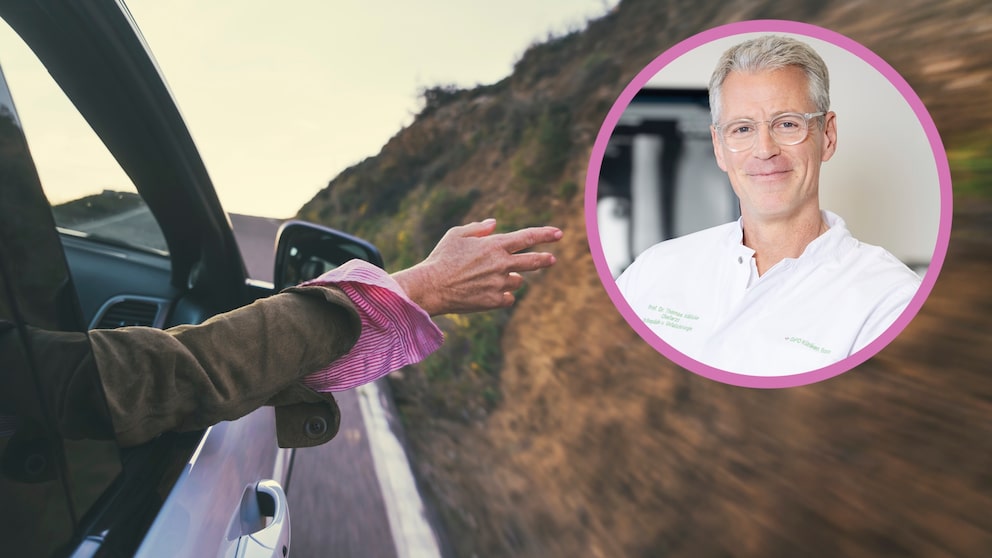
5. Stick hand or arm out of a moving car
Who doesn’t know it: the first warm days, driving with the window open, letting the fresh air into the car and enjoying it. The hand or even the whole arm rests casually on the door or hangs outside, the air caressing the skin. Pleasant. Feels like freedom.
On a country road with oncoming traffic, however, this is more dangerous than most think. Two cars pass each other at a distance of often only one or two meters. A brief moment of inattention, possibly by the other driver, and the vehicles come closer than planned. Then the contact of the arm with the side mirror of the oncoming car is enough, and that can have catastrophic consequences even at low speed. Bones, vessels, nerves, and muscles are destroyed in a fraction of a second. What’s left is, at best, a reconstruction over many operations. In the worst case, there’s nothing left to reconstruct.
Hands and arms stay inside the car. Always. Even on the country road, even at 30 mph.
Conclusion: It’s not about fear, but a second of thought
I don’t want to wrap anyone in cotton wool. I ride a bike, I swim, I work in the workshop. Movement and activity are the best things we can do for our health and aging, I’ve been preaching that for years. But an accident can be an unwanted shortcut: to the loss of quality of life and independence. Anyone interested in a long, vital life should not only focus on diet, exercise, and sleep but also on not ending up headfirst in a shallow lake.
This is even more true as we get older. Fall prevention becomes increasingly important over the years because our mechanisms for catching an impending fall don’t work as well as they did when we were younger. This includes functional training so that we can still react well to an impending fall and possibly avoid it. But it also includes using your head so that a precarious situation doesn’t arise in the first place. Pause briefly beforehand, ask yourself what you’re about to do and what if it goes wrong. Often, that’s all it takes.