


August 18, 2026, 6:01 pm | Read time: 3 minutes
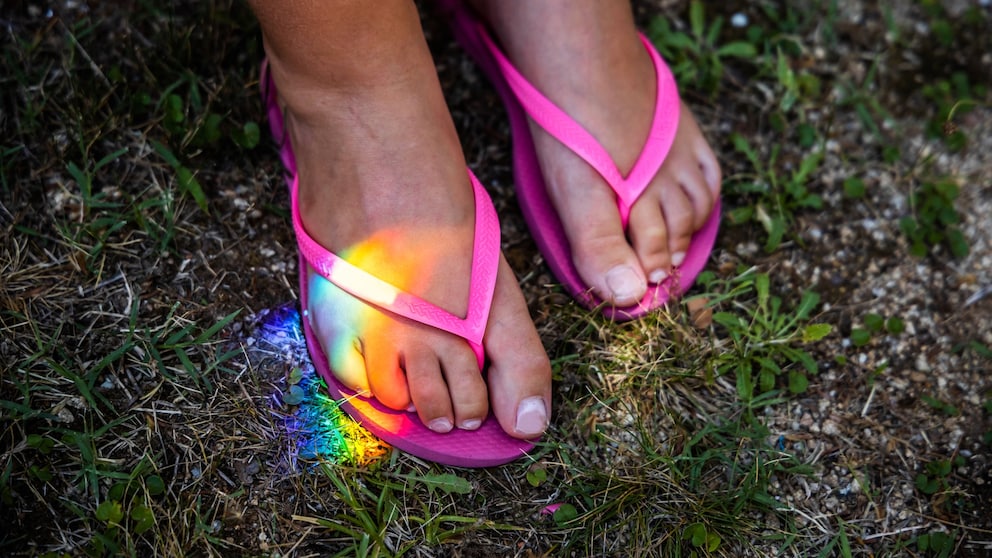
Flip-flops are light, airy, and uncomplicated. However, because they are not secured at the heel, the toes must grip with each step to keep the shoe in place. Over time, this could lead to orthopedic problems.
Biomechanics of Walking in Flip-Flops
FITBOOK spoke with Dr. Mathias Schettle, a specialist in orthopedics and trauma surgery, about the biomechanical effects on our feet and why these popular sandals can increase the risk of permanent deformities such as claw toes. “The problem is that with flip-flops, we have a type of shoe that impairs the rolling motion,” explains the doctor. Because: To keep this shoe on the foot, the toes must “grip a little.” This leads to unnatural muscular tension.
Irritations and Shortenings, Worst Case Claw Toe
If flip-flops are worn for an extended period, this tension does not remain without consequences. Due to the constant misloading, the flexor tendons of the toes can lose their natural flexibility and length, eventually forcing the toes into the typical “claw position.” This can lead to irritations and cause the tendons to become inflamed, “which can also be painful.”
In the worst-case scenario, the combination of these irritations and the shortening of the tendons leads to the formation of claw toe deformity, explains Schettle. A claw toe is a—usually not painful—deformity of the small toes, one or more. The affected toe or toes can no longer be straightened.
The orthopedist describes this as a “relatively slow process.” But: Once this process has progressed, the toe deformity is often permanent. While foot exercises and stretching can help in the early stages, in advanced stages, often only surgical correction by foot surgery remains, according to Schettle. The operation of a claw toe is often performed in connection with a hallux valgus or due to painful corns.
However, Schettle emphasizes that the risk of claw toes due to flip-flops is relatively low in our latitudes. “Our changeable weather basically prevents a wearing duration that is sufficient for real damage,” he explains.
Do Foot Misalignments Always Need Treatment?
How Harmful Are Flip-Flops for Your Feet?
Risk Factor Flatfoot
People who already suffer from flat feet are particularly at risk for one or more claw toes. In flatfoot, the transverse arch of the foot is no longer sufficiently developed. “As a result, the toes try to create a kind of arch,” explains Dr. Schettle. This can lead to claw toes. If this unstable foot is further burdened by wearing flip-flops, the negative effect is massively intensified.
So, should you completely avoid flip-flops? Dr. Schettle sees it differently. He is “personally not an opponent of flip-flops per se,” but recommends using them “in moderation.” Specifically, wearing flip-flops for a week straight in the summer is “not an issue at all.” It only becomes problematic if you wear them for several months straight.
Models with a heel strap provide significant relief. “When the heel is secured, I don’t have the forefoot-only load on the toes in front,” explains Schettle. For children, walking barefoot is most beneficial to build foot muscles. As long as there is no deformity, there is nothing wrong with occasionally wearing flip-flops.
Conclusion
Those with healthy feet can enjoy the summer comfort—as long as it remains a temporary use. However, those who already have problems with foot statics should opt for footwear with firm heel support for longer distances to protect the tendons and prevent claw toes.