

January 14, 2021, 9:57 am | Read time: 7 minutes
In a perfect world, we would use our feet optimally. Specifically, this means that when stepping (and rolling), the three most important pressure points of the foot are engaged: the ball under the big toe, the ball under the little toe, and our heel. The “perfect” foot would also have pronounced arches, an instep, and naturally beautiful toes that lie flat on the ground. But reality is different, as such an “ideal model” has become very rare. Much more common instead are foot deformities. These can be congenital or acquired, vary in severity, and often lead those affected to question whether they need treatment.
Overview
Do Foot Deformities Need Treatment?
As Dr. Mathias Schettle, an orthopedic and trauma surgery specialist from Munich, explains in a FITBOOK interview, many people don’t even notice existing foot deformities. When symptoms do occur, they are usually due to overstrained ligaments and irritated tendons. It is generally advisable to treat deformities prophylactically with insoles as soon as they become apparent. “This can potentially prevent symptoms from developing over time,” the expert explains. If the patient is already experiencing pain, there is an even greater need for action. A permanent deformity can lead to incorrect loading of the knee and hip joints and have consequences for the entire musculoskeletal system.
Most deformities are initially treated conservatively with insoles. These are customized in orthopedic practice to fit the shape and specific deformity of the foot. According to Dr. Schettle, this is also the most important form of therapy, as it supports the arch and helps the foot absorb impact better. Additionally, it can alleviate symptoms, and in certain cases, even correct the gait, the specialist further explains. To be effective, they should ideally be worn regularly. “Daily use is hardly possible,” admits the doctor, “as they don’t fit every shoe model.” Nevertheless, it is important to renew the insoles every year, as they wear out over time and lose their therapeutic properties.
Also interesting: When and how often should you change your running shoes?
Congenital Deformities
“First, one must distinguish between congenital and acquired foot deformities.” Congenital ones include clubfoot and talipes, which are now very rare in Europe. In infants, treatment begins very shortly after birth with what is known as regression therapy. In plain terms, this means they are given a cast that is changed every few days to guide the feet back in the intended direction. After a few months, surgery is usually performed.
Acquired Foot Deformities
Much more typical for our society, however, are acquired deformities. The feet of (most) people today are practically confined to shoes for their entire lives. According to orthopedic specialist Dr. Schettle, this results in less developed foot muscles. His tip: walk barefoot from time to time and instill this habit in children. This activates the foot muscles. “Starting as a child reduces the likelihood of foot deformities in adulthood.” The type of shoes can also be to blame. Especially women who squeeze into high heels can promote the development of a so-called hallux valgus, a deformity of the big toe. More on this in the next section.
Also interesting: What walking barefoot does to your feet
Why Constant ‘Clawing’ in Flip-Flops Harms Tendons and Toes
Corn – Causes, Symptoms and Treatment
The Most Common Modern Foot Deformities and Their Treatment Options
Hallux Valgus
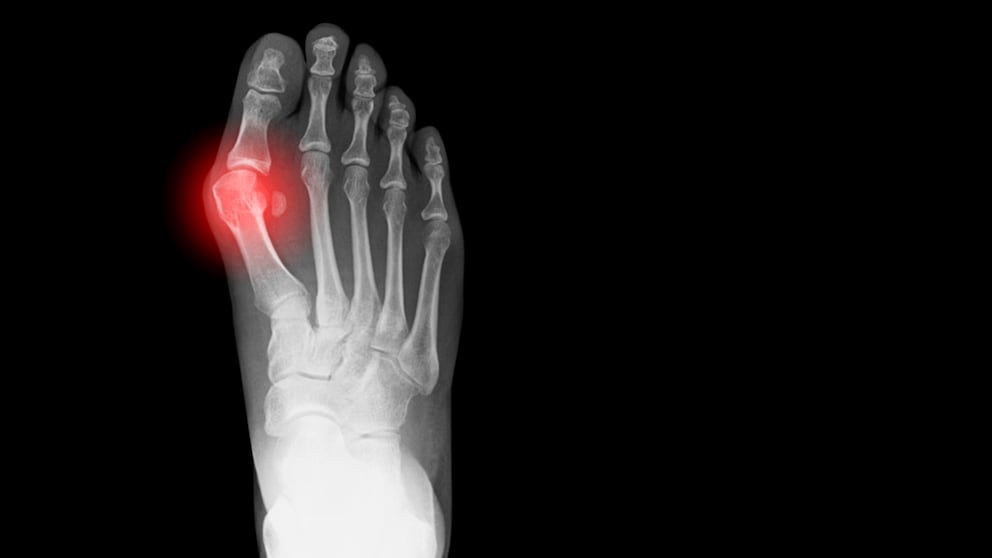
The big toe is crooked, the ball protrudes outward–in a hallux valgus, the forefoot is deformed. More precisely, the medical term refers to a misalignment of the big toe. Many find this unattractive, and it can often lead to pain when walking. Those who frequently wear high heels are more quickly affected, as experts know: the higher the heel, the greater the pressure on the forefoot area. Additionally, the big toes are pressed more firmly into the shoe tip.
However, even in flat but too short or tight shoes, the toes are strongly compressed, often with the same consequences. With a hallux valgus, the tendons no longer run centrally over the joint but laterally. The muscles in the midfoot pull the big toe inward and into a crooked position. This changes the entire biomechanics of the foot and leads to a bursitis that eventually ossifies. The result: a large bump on the big toe.
Also interesting: The most important tips for healthy feet
To lift the metatarsal bone and reduce pressure, orthopedic shoe insoles help in the early stages. But even if they noticeably relieve pressure, they cannot completely stop the development. If the hallux valgus causes pain, only surgery can straighten the foot position again. The procedure takes about an hour.
Splayfoot
Splayfoot is also an acquired foot deformity, favored by high heels and/or tight shoes. As Dr. Schettle explains, in splayfoot, the transverse arch of the foot is essentially flattened, so the front part of the foot rests on the ground. Thus, the pressure is in the middle of the forefoot–and not under the ball of the big and little toes, as it should be. This can hurt! Because the metatarsal bone is not designed for such pressure.
If pain occurs in the midfoot, it may be wise to reconsider your footwear and then adjust insoles that cushion the front of the foot and have a kind of padding in the middle. They lead to elevation in the midfoot, allowing the pressure to be better distributed again.
Flatfoot
As the name suggests, in flatfoot, the entire foot rests on the ground instead of using the usual three pressure points. This phenomenon is often observed in young children, as the foot arch typically develops around the age of six. As explained earlier, this development can be encouraged by using the feet. Best done barefoot!
If flatfoot persists into adulthood, it is also treated with insoles: on one hand, to alleviate symptoms, and on the other, to directly influence posture. While in many cases, the misdevelopment of other foot deformities can still be halted, according to Dr. Schettle, this is usually not possible with flatfoot.
Pronated Flatfoot
Pronated flatfoot lacks a pronounced longitudinal arch AND also collapses inward at the ankle. This deformity often requires treatment, as it disrupts the leg’s alignment and can lead to overloading the knee joint.
The first step in treatment is insoles, which slightly elevate the inner edge from the toes to the heel with small pads. Physiotherapy can also be beneficial, according to Dr. Schettle, to strengthen the muscles and learn correct posture. If neither measure provides relief, surgery is the last resort.
Targeted Exercises Can Also Help
Pronated flatfoot, splayfoot, flatfoot, or hallux valgus often come with very poorly developed foot muscles. The foot, with its nearly 30 bones and joints, 60 muscles, over 100 ligaments, and 200 tendons, provides the necessary physical balance. This complex structure of different components should also receive more attention in training. For example, with these five specific exercises for the feet and ankles in case of foot deformities–compiled by an expert in neurocentric training.