

September 24, 2020, 1:03 pm | Read time: 6 minutes
Most people immediately think of discs or vertebrae when it comes to back problems. However, the causes of back pain can vary greatly. One cause that is still often overlooked today is foot misalignments–which ones they are and how targeted exercises can improve foot mobility, you will learn here.
Overview
Why foot mobility is so important
When it comes to the lower body, most people focus on large muscle groups and joints, such as the front and back thighs, knees, and hips. Feet and ankles are often forgotten, even though they are crucial for physical performance.
Whether walking, brisk walking, or running, the mobility of the foot and ankle is essential for developing strength.
Foot misalignments and their causes
The best-known foot misalignments are flat feet, splay feet, and–more common in women–hallux valgus. Causes can include weak connective tissue and underdeveloped foot muscles. Poor footwear is often cited, but a more obvious reason is insufficient load and movement. The interplay between muscles, bones, and joints is a prerequisite for a healthy and efficient body, which should be able to bend, flex, and stretch in all directions.
Also interesting: What can I do preventively against hallux valgus? (via STYLEBOOK)
Did you know that over our lifetime, we stand and walk for about 20 years in total, which is roughly equivalent to circling the Earth three times?
Pay more attention to feet during training
The foot, with its nearly 30 bones and joints, 60 muscles, over 100 ligaments, and 200 tendons, provides the necessary physical balance. This complex structure of different components should also receive more attention in training.
What was once essential for survival seems secondary in the 21st-century environment. Confined in shoes for twelve hours a day, an active and mobile life for our feet is hardly possible. Flexible, mobile joints, stable bones, and supple tendons and muscles are needed to meet the demands of modern lifestyles. Only through sufficient movement can these structures maintain their function.
Also interesting: Iliosacral joint blocked? These exercises can help
How foot misalignments affect the spine
A foot misalignment changes body statics, which can restrict movement patterns. Often, a compensatory posture follows, and tension in the leg muscles can lead to joint and bone misalignments. The axis shift between the thigh and lower leg due to increased tension on one hand and weak muscles on the other often leads to pelvic misalignment. This, in turn, affects the position of the spine and beyond that, the positions of the upper body.
Also interesting: Orthopedist explains when a foot misalignment needs treatment
With a permanently forward-bent posture, it can happen that hip joints and knees can no longer be fully extended. Steps become shorter, and the feet no longer work ergonomically. The less mobile the forefoot becomes, the more inefficient the gait pattern becomes.

Burn Fat Effectively with Personal Trainer Argi’s HIIT Workout

Expert Reveals 4 Exercises That Effectively Combat Tired Legs
Fascia transmit tension to joints and muscles
It is both a curse and a blessing that everything in the body is connected. Through the fascia, a connective tissue-like sheath around the muscles, these tensions are also transmitted to the joints and muscles above. If an area is then moved less, compensatory movements and later manifest postural issues follow. Fascia training is–not just for the feet–more than sensible!
5 exercises for foot misalignments
To improve the mobility of the feet and ankles, you can try the following exercises at home.
Never push into pain during the exercises and perform movements slowly and controlled. If an exercise feels uncomfortable, stop and try to perform the exercise with less range of motion and in slow motion.
Also interesting: Why barefoot shoes are so good for health
Toe bends and stretches

Sit upright. Bend your foot and toes to the maximum. You can place the foot on the ground. Now stretch your foot and toes to the maximum and place the foot on the ground. Repeat the exercise on the opposite side.
Ankle circles

Sit upright. Lift one leg and hold the lower leg steady so that you perform the movement through the ankle and not the lower leg. Keep the toes in a neutral position and slowly and evenly make a circular movement in the ankle. Point the toes downward and repeat the movement. And again with toes pulled up. Repeat all parts of the exercise with the other foot.
Also interesting: Targeted exercises that help with sciatica pain
Mobilization of the lateral ankles

Take an upright step position. Tilt the outer edge of the front foot upward. Then tilt the inner edge of the front foot upward. Repeat the exercise with the other foot.
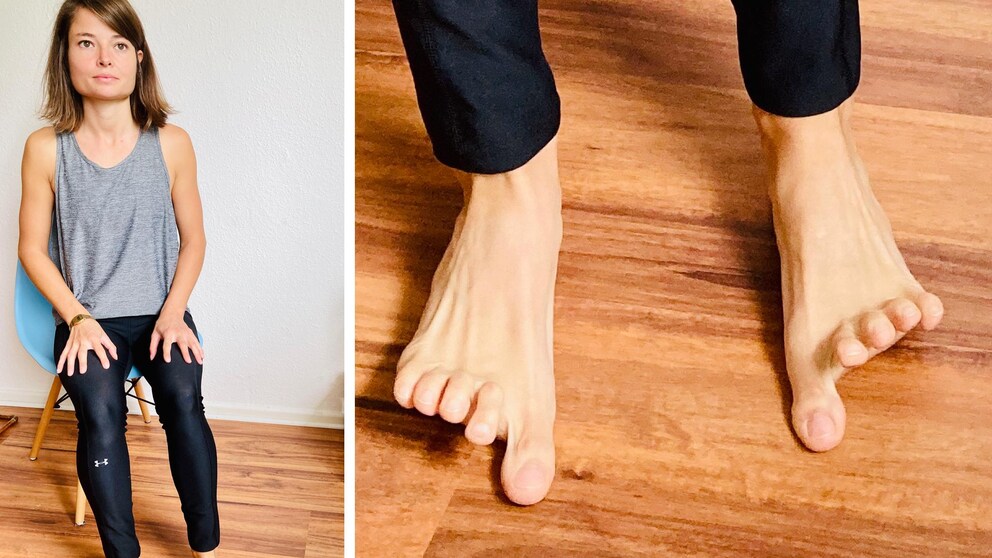
Mobilization of the big toes

Stand upright. Lift the big toes off the ground while keeping the other toes on the ground. Then press the big toes into the ground while lifting the other toes. Alternate the movement.
Also interesting: Exercises runners can do at home
Toe pulls in 3 positions

Stand upright, extend one leg back, knee in a neutral position, and curl the toes. Use the knee and foot position to achieve a stretch mobilization directly under the ankle.
Once you find the position, perform five squats in succession. Maintain the starting position and perform another five repetitions with the ankle rotated outward. Perform the same movement with the ankle rotated inward. Repeat the exercise on the other side.
About the person: Luise Walther is a personal trainer in Berlin specializing in functional neurology and neurocentric movement training. She has expertise in rehabilitation, injury prevention, and performance enhancement.