

May 24, 2022, 2:08 am | Read time: 6 minutes
Heavy and tired legs–many people know this feeling, especially in summer. But there’s a simple solution: movement. Luise Walther, an expert in neurocentric training, shows how it’s done.
Do you know the feeling of heaviness in your legs? It’s not just in summer that people experience this situation. If you suffer from tired legs consistently, you should have it checked by a doctor. If tired legs occur only occasionally, such as after prolonged sitting, which is often unavoidable during long trips, you can take action yourself. Our expert presents four exercises that help against tired legs.
Overview
How Do Tired Legs Develop?
The cause of tired legs can be overworked veins. Veins are responsible for pumping circulating blood back to the heart. This is known as the vein pump effect, which consists of two mechanisms: The muscles surrounding the vein walls contract and relax–pumping the blood back. Veins contain valves that open and close as a second mechanism. They act as gates for blood flow.
Also interesting: The Benefits of Walking Barefoot for Health
If there’s a disruption in this mechanism, such as when the vein muscles or valves function only partially, oxygen-poor blood that needs to be transported to the heart accumulates in the veins. This blood contains increased carbon monoxide, which should actually be exhaled. When this transport cycle is disrupted due to reduced vein activity, substances accumulate in the tissue. This happens more in the legs because the blood must be pumped back against gravity with increased effort. It flows upward and against the usual flow direction–hence the vein pump mechanism.
Also interesting: Tired Eyes? Expert Shows 5 Exercises That Help

5-Minute Wall Workout: Activate More Muscles Than Walking
Pilates: The 34 Traditional Exercises
What Can You Do Against Tired Legs?
There’s a simple solution for tired legs: movement. The more the feet and legs are moved, the more the muscles are activated and vein activity is promoted. Targeted exercises against tired legs can provide relief and activate and mobilize different leg muscles.
Also interesting: How to Shower Properly in Summer!
To specifically target the muscles of the vein walls, you can also take cold showers. The cold stimulus causes the veins to contract reflexively. If this is routinely incorporated into daily life, the exercises have an even greater effect.
4 Exercises Against Tired Legs
The following should be noted for the exercises:
- Do not push into pain or discomfort
- Move slowly and controlled
- Use only the range of motion and speed that feels safe and comfortable
- If possible, perform the exercises barefoot
- Breathe evenly through the nose during the exercises
Nerve Mobilization
This exercise against tired legs mobilizes and activates the leg nerves. Starting from the spinal cord, the nerves branch into all extremities. Long periods of sitting often mean the nerves, and thus the muscles and limbs, are not sufficiently moved. Perform this exercise very gently and only with low intensity, as peripheral nerves are very sensitive tissue. The exercise should never hurt or be uncomfortable.
- Sit upright and ensure a straight spine.
- Extend your right leg on the floor, place the heel on the ground, and press the knee through.
- Mobilize and activate the leg by slightly bending forward with a straight upper body, going into the stretch, and then leaning back. Bounce five to seven times into the mobilization.
To specifically target the three different leg nerves, go into the following positions:
- Pull your foot upward and draw the outer edge of your foot toward the knee.
- Pull your foot upward and draw the inner edge of your foot toward the knee.
- Extend your foot forward and rotate it inward.
- Then perform the movement with the other side.
Proceed slowly and carefully with this exercise. You can increase the intensity by pulling the pubic bone toward the navel and thus aligning your pelvis.
Also interesting: The Benefits of Foot Baths for Health and Well-being
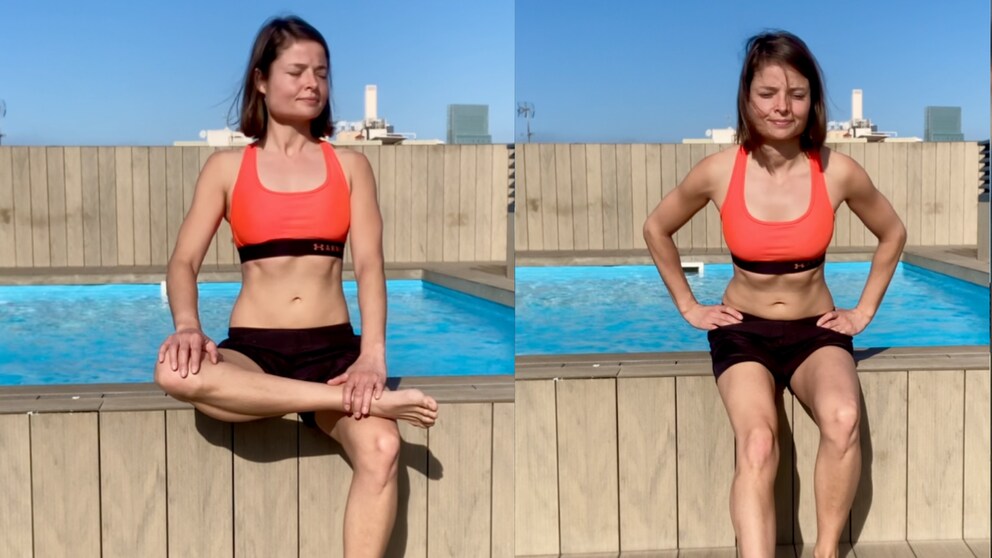
Glute Stretching and Mobilization
This exercise mobilizes and stretches the gluteal muscles. It leads to more freedom of movement in the hips and relieves tension in the thigh and gluteal muscles. Your movement competence is thereby improved.
- Sit upright and cross your legs by placing the right ankle on the left knee. Hold the right ankle with your left hand and the left knee with your right hand.
- Mobilize your pelvis a few times forward and backward and then remain in the arch.
- Now bend your upper body forward with an upright spine until you feel a slight stretch. Bounce slowly and carefully into this stretch several times and feel the relaxation of the muscles when leaning back.
- Vary the movement by rotating first to the right and then to the left when leaning forward.
- Then perform the movement sequence with the other side.
Make sure never to go into pain with this movement. You should have control over the movement at all times.
Mobilization of the Pelvis and Legs While Sitting
This exercise mobilizes the pelvis, sacroiliac joints, and hips. This restores the dynamic balance of tension and relaxation of muscle groups. It leads to better movement competence.
- Sit upright and place both feet relaxed on the floor.
- Align the pelvis forward and backward by pulling the pubic bone toward the navel and then making a slight arch.
- Now slide the knees past each other alternately, one knee forward, the other backward. Make sure the pelvis remains aligned forward. When the left knee pushes forward, simultaneously pull the right knee backward.
You can intensify the exercise by incorporating the upper body into the movement: When the left knee pushes forward, rotate to the left, and when the right knee pushes forward, rotate to the right.
Also interesting: 4 Exercises to Train the Hamstrings Effectively and Efficiently
Diaphragm Stretch
This exercise stretches the diaphragm, mobilizes the entire torso, and relieves tension from the diaphragm and pelvic floor muscles. Your breathing is improved and more efficient. This optimizes the function of each individual cell in the body. The more balanced gas exchange affects the entire organism.
- Ensure a straight spine. Sit up and pull your crown upward. If your shoulder mobility is limited, you can bend your arms during the exercise.
- Tip your pelvis backward by pulling your pubic bone toward the navel. The lower back bends slightly.
- Now breathe in maximally through the nose and stretch your arms over your head.
- Keep your arms stretched and your spine long. Now breathe out maximally through the open mouth. During exhalation, keep the pelvis pulled in, the pubic bone toward the navel.
- When you have exhaled maximally, relax your pelvis. Bring your arms down relaxed to the side of your body. Breathe in and out relaxed through the nose. Then perform the next repetition.
Pay special attention during exhalation not to perform a lip brake and to keep the mouth and jaw slightly open and relaxed at all times. Keep the spine upright and the pelvis pulled in during exhalation. Relax the pelvis between repetitions, lower the arms, and let them loose.