


January 23, 2021, 4:08 pm | Read time: 10 minutes
The gyms are closed, and it’s cold, rainy, or even snowy outside. But these are no reasons to postpone the fight against extra pounds. Personal trainer Argi has put together a full-body HIIT workout for FITBOOK that not only burns fat but also strengthens muscles and improves endurance.
Let’s get started with the HIIT workout–ideal for burning fat! HIIT stands for “High Intensity Interval Training,” which is interval training with high intensity. It trains strength, endurance, and the whole body. A nice side effect: The calories melt away. The next 40 minutes will be quite challenging, but they’re worth it–for everyone. Personal trainer and sports scientist Argi promises: “The workout is suitable for all fitness levels.”
Overview
What Are the Benefits of the HIIT Workout?
“I personally do functional strength training because I aim to be fit in old age and actively engage in life with my children for as long as possible,” says Argi. This form of training provides him with a foundation for other sports and helps him stay healthy and injury-free in everyday life.
In his HIIT workout for FITBOOK, Argi focuses on mobility and basic fitness. But the goal of “losing weight” is not neglected: “Due to the constant activity, it’s also great for burning fat.” Everyone can adapt the training shown in the video above to their own performance level and available equipment, making the exercises more challenging or easier. “All muscle groups are stimulated by activating exercises that will be used later,” promises Argi.
How Is the HIIT Workout Structured?
Argi’s 40-minute HIIT workout consists of three parts. First, it’s about mobilizing and activating. Then, the intensity is increased. “We’ll make sure to break a sweat and get the pulse up.” Finally, the cool-down with stretching exercises takes place.
It’s important to pay attention to form and find your own pace. If you feel you’re losing form or the exercises are too strenuous, you should slow down. “But if you feel there’s still something left in the tank, go ahead and push harder.” The key is to keep moving, whether you’re pushing yourself to the limit or doing the exercises more slowly.
Part 1: Mobilize and Activate
- Exercise 1: In a quadruped position, circle the shoulders with arms extended.
- Exercise 2: Round the back upward in a quadruped position, pulling in the navel and tucking the chin to the chest. Then let the belly drop into an arch. Repeat the movement several times.
- Exercise 3 “World’s Widest Stretch”: Start in a push-up position. Bring one leg forward and place it next to the hands. Then stretch the hand closest to the foot upward and place it back down. Repeat the same with the other hand. With the glutes engaged and the back leg straight, repeat the exercise several times. Then switch legs and repeat the entire sequence.
- Exercise 4: In a standing position, place one heel down and straighten the leg, bending the other leg. Sweep the arms from back to front, going deep with the back. Swap legs after each “sweep.”
- Exercise 5 “Inch Worm”: Stand with feet shoulder-width apart and squat down. Place the arms down and crawl forward into a push-up position. Hold briefly with tension, then crawl back into a deep squat. Intensify this position by shifting weight from one leg to the other or pressing the elbows against the knees from the inside. Finally, stand up straight and repeat the exercise.
Part 2: High Intensity Interval Training
This part consists of three blocks with two rounds each. All exercises alternate between exertion and relief, with a short break in between. Argi advises: “Always think ahead to the next exercise and maintain tension.” Start with six exercises for the core. Each exercise in this block is performed for 30 seconds, followed by a ten-second break.
Block 1
Exercise 1: Start in a forearm plank position. Hold the plank for 30 seconds, pulling in the navel and keeping the core from sagging.
Exercise 2: Repeat the same, but this time alternate lifting and lowering one leg. Move the leg upward with tension, not momentum.
Exercise 3: In a push-up position, alternate lifting one hand off the ground and tapping the shoulders. Keep the pelvis and back straight and engaged.
Exercise 4 “Russian Twist”: Sit down and lift the legs at a right angle so the heels are just above the ground. Interlock the hands. Then rotate the shoulders left and right, so the interlocked hands alternately touch the ground on both sides of the body.
Exercise 5 “Star Plank”: In a side position, support on one forearm and one foot, forming a straight line from head to foot. Extend the top leg and arm, then bring the knee and elbow together and repeat. For an easier version, support on the bent lower leg instead of the foot. Then repeat the entire movement on the other side.
Exercise 6 “Dead Bug”: In a supine position, lift both legs–one parallel to the ground, the other bent at a right angle over the hip. On this side, stretch the arm backward, while the arm on the long side points toward the leg. Quickly switch sides with each movement.
A second round follows with all six exercises from the first block.
Block 2
The exertion time is reduced to 20 seconds, with the ten-second break remaining. The goal is to keep the pulse high and push hard during these six exercises.
Exercise 1 “High Knees”: Quickly alternate lifting the knees. Land as softly and quietly as possible, swinging the arms.
Exercise 2 “Toe Touch”: In a push-up position, place the legs shoulder-width apart. Alternately touch the opposite foot with one hand, lifting the hips upward. Then return to the push-up position and bring the other hand to the other foot.
Exercise 3 “High Knees”: Quickly alternate lifting the knees. Land as softly and quietly as possible, swinging the arms.
Exercise 4 “Plank Push”: In a forearm plank, first place one hand down, then the other, and push up into a push-up position. From this position, place one forearm down, then the other, returning to the forearm plank.
Exercise 5 “High Knees”: Quickly alternate lifting the knees. Land as softly and quietly as possible, swinging the arms.
Exercise 6 “Swimmer”: In a prone position, lift arms and legs off the ground and move them up and down without touching the ground.
A second round follows with all six exercises from the second block.
Block 3
Instead of “High Knees,” “Squat Jumps” are added here to keep the pace and pulse high. If they become too strenuous, regular squats can be done.
Exercise 1 “Squat Jumps”: Jump up from the squat position and land as softly as possible.
Exercise 2 “Push-ups”: If you can’t do classic push-ups, place the knees on the ground instead of the toes. In both versions, the navel and chest go to the ground, keeping the back straight.
Exercise 3 “Squat Jumps”: Jump up from the squat position and land as softly as possible.
Exercise 4 “Rotating Plank”: In a push-up position, stretch the right leg and left arm sideways to the left. The body rotates, and the fingers tap the toes. Then return to the starting position and repeat the sequence with the other limbs.
Exercise 5 “Squat Jumps”: Jump up from the squat position and land as softly as possible.
Exercise 6: In a prone position, lift arms and legs off the ground. Alternate bringing the arms into a “W” and “Y” position without touching the ground. Thumbs point upward.
A second round follows with all six exercises from the third block.
Part 3: Cool-down
The last part of the workout is for relaxation.
Exercise 1: Sit on the heels, place the forehead on the ground, and lay the arms loosely beside the head. Breathe in through the nose and out through the mouth.
Exercise 2: Place the lower legs wide apart on the ground. Set one forearm at head height and slide the other arm through the opening under the set arm. This arm and the head can then be placed down. Then switch sides.
Exercise 3: In a push-up position, bend one leg in front of the pelvis and sit down. The pelvis is parallel, and the back leg is extended. Then place the sternum on the front leg. For more stretching, rotate the upper body and extend both arms to the same side. Then switch legs.
Exercise 4 “Pretzel”: In a side position, bend the top leg and place it in front of the body. Grab the ankle of the lower leg with the upper hand and pull the heel to the buttocks. Then switch sides.
Exercise 5: The lower leg of the right leg is on the ground, and the left leg is extended. From this position, move the upper body forward to stretch the front leg.
Exercise 6: From the position of Exercise 5, place the leg down and stretch the right arm upward, stretching the entire side. Then repeat both movements with the other limbs.
Home Workout With Boxing World Champion Christina Hammer
Conquer Yourself–’Crossfit Challenge’ for Home
More Home Workouts from FITBOOK
Argi’s HIIT workout is part of the FITBOOK Home Workout series. Find more exclusive training videos, such as those with ballerina Louisa Paterson, boxing world champion Christina Hammer, or Crossfit pro Hendrik Senf, here.
Who Is the Trainer in the Video?
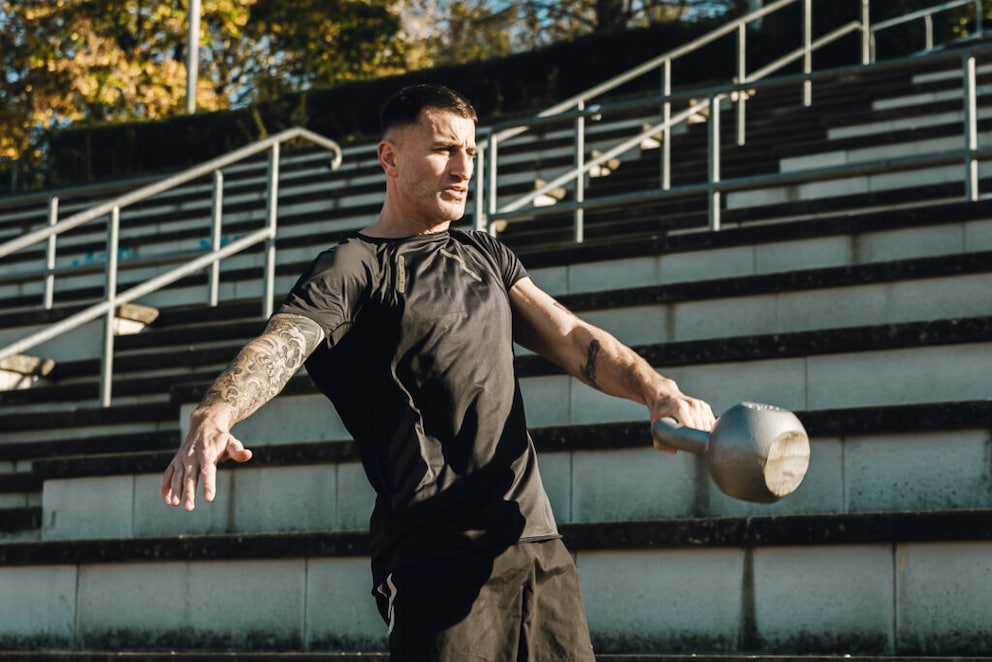
Arjevan “Argi” Kikaleishvili is 39 years old and originally from Georgia. At the age of 11, he moved to Germany with his parents. “Sports were a big part of my life. My father had a significant influence, and it was almost mandatory for me to be active in sports. That’s how I got into competitive swimming, which I did until about 19. Sometimes training twice a day in the pool and three times on land.” Basketball was his second great passion. At 23, Argi began his sports studies at the German Sport University in Cologne, focusing on prevention and rehabilitation. Since 2008, Argi has lived in Berlin, where he works as a personal trainer and coach. Learn more about his courses here.
What does sports mean to him? “Sports are omnipresent for me and a way of life. It connects body and mind, creates healthy self-confidence, and strengthens character, whether pursued competitively or as a hobby. Life without sports is unthinkable for me. Through sports, I’ve traveled to many countries and made friendships. Today, the focus of sports is more on the professional level, and I’m incredibly grateful for that. It allows me to continue meeting new people, teach them something new, and, of course, learn from them. One of the most satisfying feelings a coach can have is observing the development of a client or team.”