


August 1, 2025, 8:22 am | Read time: 11 minutes
Whether you’re tired, lacking energy, or just curious about your vitamin status, you no longer need to visit a doctor to find out how your levels are doing. A few hairs or drops of blood sent to a lab by mail, and a few days later, the results are conveniently returned digitally. The market is booming with at-home vitamin self-tests. But which method is truly reliable and worth the money? FITBOOK editor Sophie Brünke tested two popular options and compared them with lab results from a doctor’s visit. She also spoke with nutritionist Dr. Matthias Riedl about the experiment.
I mostly follow a vegan diet. However, I’m not a model candidate when it comes to supplementation. With a plant-based diet, there’s no getting around vitamin B12 tablets. These make it onto my meal plan more or less regularly. The vitamin plays a crucial role in cell division, blood formation, and nerve function. Adults should consume 4.0 micrograms daily.1 I visit my primary care physician once a year to have my levels checked. However, I often see tests in drugstores and social media ads that can be done at home and (of course) promise high accuracy. If that works, I could save time in the waiting room in the future—after all, there are two appointments: the blood draw and the results discussion. And maybe the vitamin self-tests are cheaper? I’m daring a comparison.
There Are Different B12 Levels—Which Should You Test?
If you want to test your vitamin B12 status, you’re immediately faced with an unexpected challenge: Some tests measure total vitamin B12, while others measure active B12, also known as holotranscobalamin (HoloTC). But which is useful in my case? At the doctor’s office, total vitamin B12 is usually checked first, via a blood draw. A good value is:
- 187 to 883 picograms per milliliter
However, it’s important to note: Values below 350 pg/ml can no longer reliably indicate whether the cells have enough active B12 available. In this case, a HoloTC measurement is also recommended. The reason is that only this active form can actually be absorbed by cells. Seventy to 90 percent of total B12 is bound to the protein haptocorrin. The values should be
- over 50 picomoles per liter
Otherwise, the vitamin B12 store is depleting. This doesn’t necessarily mean a metabolically manifest deficiency is present, but you’re on the way there. With HoloTC values below 25 pmol/L, a deficiency is assumed; between 25 and 50 pmol/L, a deficiency can be clarified with additional markers according to IMD Labor Berlin (homocysteine and methylmalonic acid (MMA)).2 However, nutritionist Dr. Riedl has a different opinion in response to my inquiry. He says a combination of HoloTC and MMA is sufficient, and homocysteine only needs to be checked “in cases of arteriosclerosis and a tendency to thrombosis.”
The Most Accurate Results Are from the Doctor, Right?
To determine the accuracy of the self-tests, I use the unpleasant trip to the doctor as a control: total vitamin B12 and HoloTC, please! Aside from the time aspect, I also dislike having blood drawn, as my veins like to hide, and the draw isn’t a quick prick but involves a lot of searching, hand pumping, and “Sorry, nothing here, we need to try another spot.” I’d prefer a test at home. But at least here, I’m the passive part and just have to wait patiently until it works.
Results
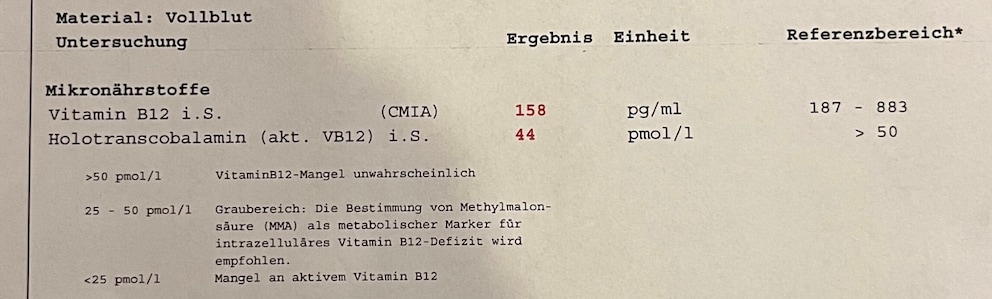
Five days later, I climb the three flights of stairs to my doctor’s office again. My doctor shows me the report. I can already tell the values aren’t good because they’re printed in red, darn! But I suspected it. Specifically, the values are:
- Total Vitamin B12: 158 pg/ml
- HoloTC: 44 pmol/L
My doctor doesn’t conduct further tests for homocysteine and MMA but directly recommends a high-dose supplement from the pharmacy, which contains 1,000 micrograms of B12 per tablet. I should take it every other day and return in six months.
- Difficulty: easy
- Duration: 1 hour for the appointment, 5 days for the result
- Price: 33.22 euros
- Accuracy: very high
Self-Test with Blood—Please Prick Your Finger
I came across Cerascreen’s vitamin self-tests in DM’s online shop. The brand advertises a “reliable lab result, without a doctor’s visit.” That would be great!
It didn’t go as quickly as I had hoped. When the package with the HoloTC test arrived, I unfolded the small but very long instructions and was disappointed to read that samples can only be sent to the lab on Sundays, Mondays, or Tuesdays. So I had to wait a bit longer. What I did do: I downloaded the mandatory app through which the result is communicated and highlighted the instructions with a marker—the many individual steps made me a bit nervous. What if I forget something, and the money for the test is wasted?
If You Can’t Stand the Sight of Blood, Think Twice
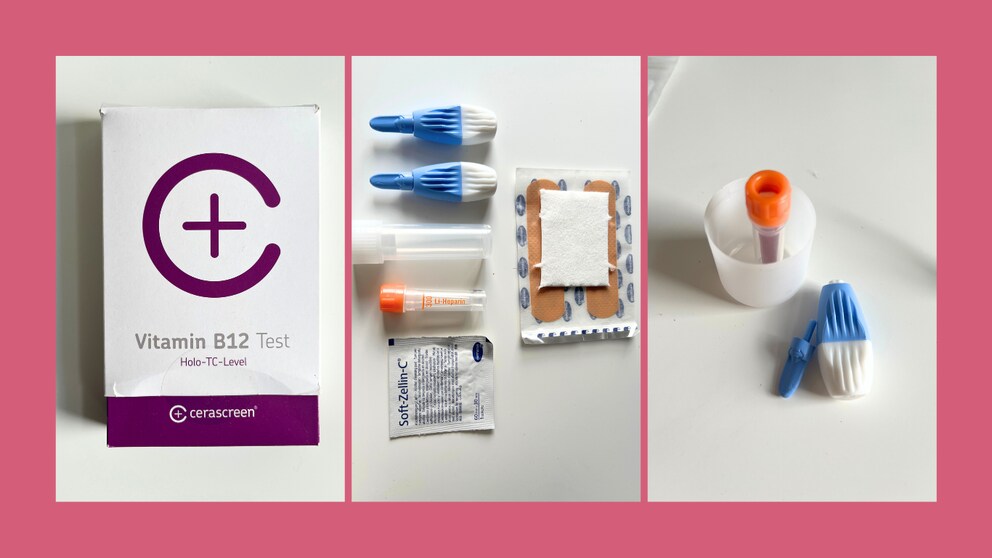
When the day finally came, I was nervous. I was supposed to run warm water over my hand and circle my arm to stimulate blood flow. I had already spread all the materials on my desk. Then, I placed the small sample container in the inverted cap of my deodorant to prevent it from tipping over. When I placed the lancet on my left middle finger, I felt a slight panic. Fortunately, it triggered the prick so quickly that I couldn’t back out. However, the next part wasn’t fun: It took several minutes of finger massaging and collection skills to fill the sample tube to the mark with my blood. At the doctor’s office, I prefer to look away during the blood draw. Here, I had to carefully guide my blood drops through the tiny opening of the sample tube.
Result
I received the result three days later via the app (according to the instructions, it takes up to five days). Graphically presented, I learned that my HoloTC is in the low range. I also received ads for a vitamin B12 spray and the offer of a free phone consultation if I had questions about my results. The supplement is significantly lower-dosed than what my doctor recommended: 25 micrograms per spray (versus 1,000 micrograms per tablet).
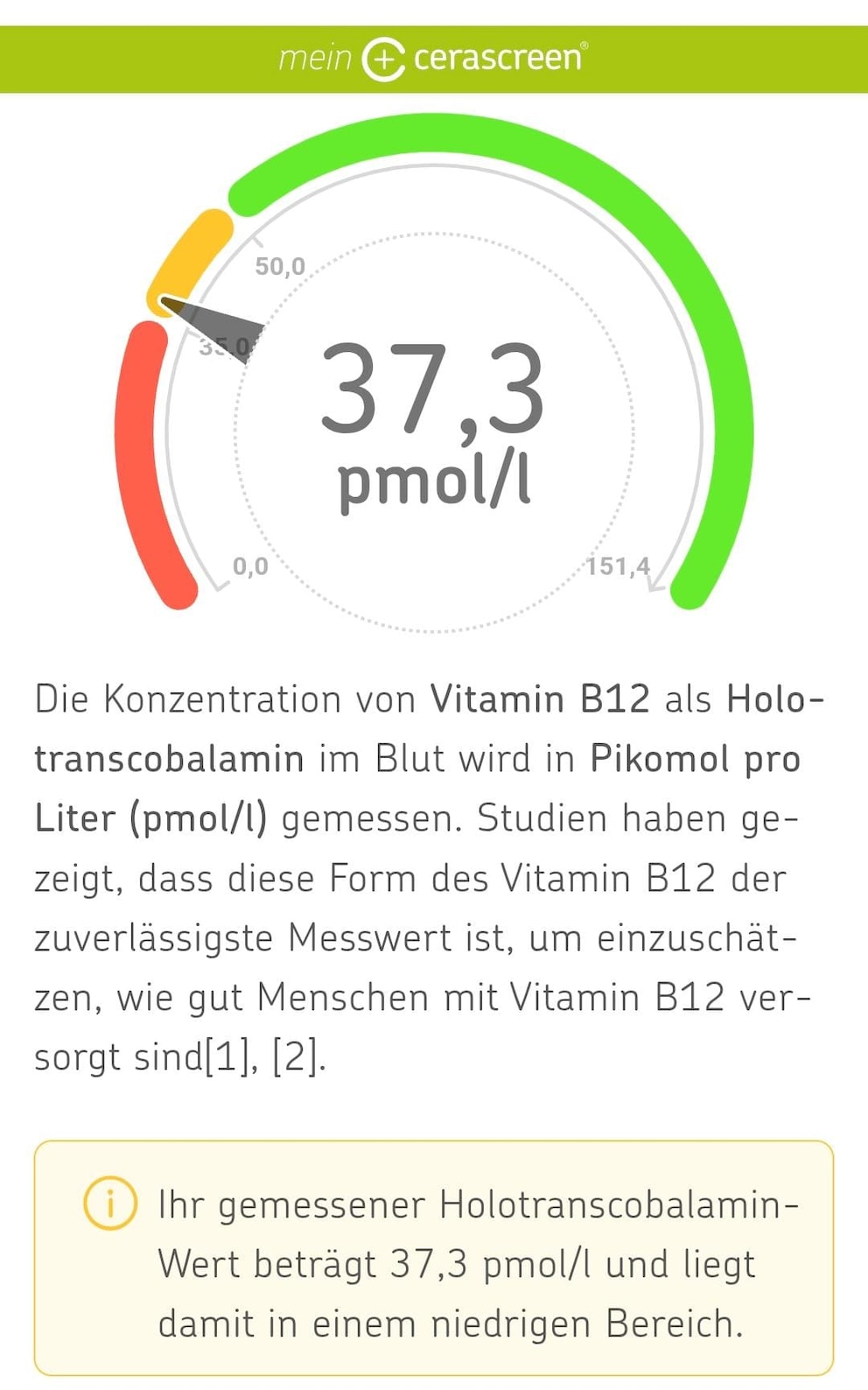
The result is relatively close to my doctor’s; at least in both cases, I found out that there is a suspicion of deficiency. Not bad! I must admit, though, that I did the test a few days after my doctor’s visit because I hadn’t read the fine print (only sendable on certain weekdays). This might slightly affect the result.
- Difficulty: medium
- Duration: 20 minutes, 3 days for the result
- Price: 50.89 euros
- Accuracy: high
Snip, Snip, Hair Off
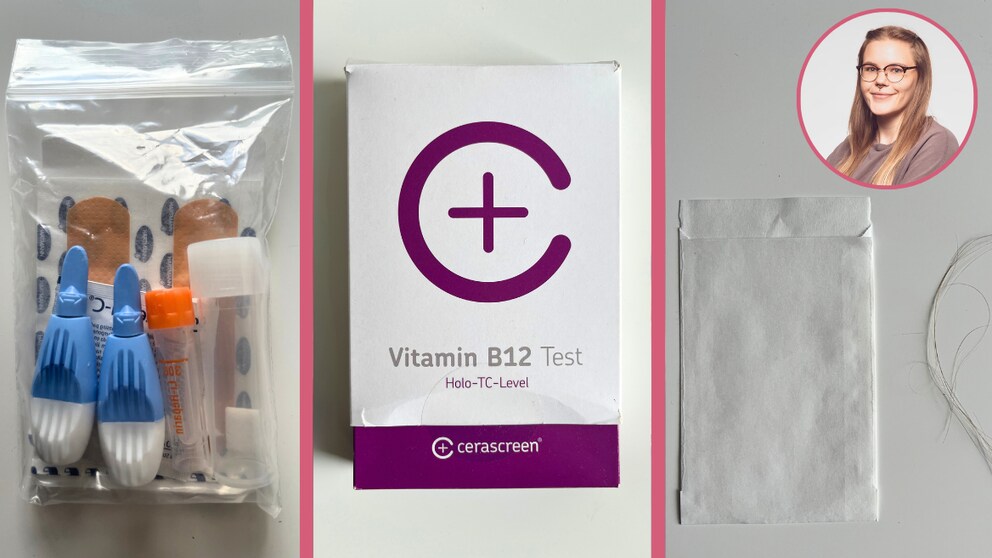
When my package from Vitalstoffkraft for the hair analysis arrived, I initially thought there was nothing in my order because the box was so flat. But the contents were just a bit more straightforward than the blood test: instructions, a questionnaire for weight, age, etc., and a paper bag for the hair. Again, I was briefly disappointed when reading the instructions: You must take hair from the body, not combed-out hair from the brush—that was my hope. However, any body hair is allowed, not just from the head. I was still suspicious of sending in my armpit hair or other. So I sacrificed ten hairs from my head, the minimum required (ten to 20 hairs according to the instructions).
You have to be patient for the result. It was stated to take ten days, but for me, it took a few days longer.
Result
The result report comes via email. I found it pleasant not to have to download an extra app for the vitamin self-test. However, the scope was a bit overwhelming: 34 pages! At the beginning is an overview of the nutrients—you couldn’t choose one specifically when sending it in, but you get a pre-set package analyzed. This data sheet uses a simplified traffic light system to indicate whether a deficiency is present. The surprise: A green checkmark appears next to vitamin B12—after the other two tests, this is rather unlikely and a sign that the analysis is not very reliable.
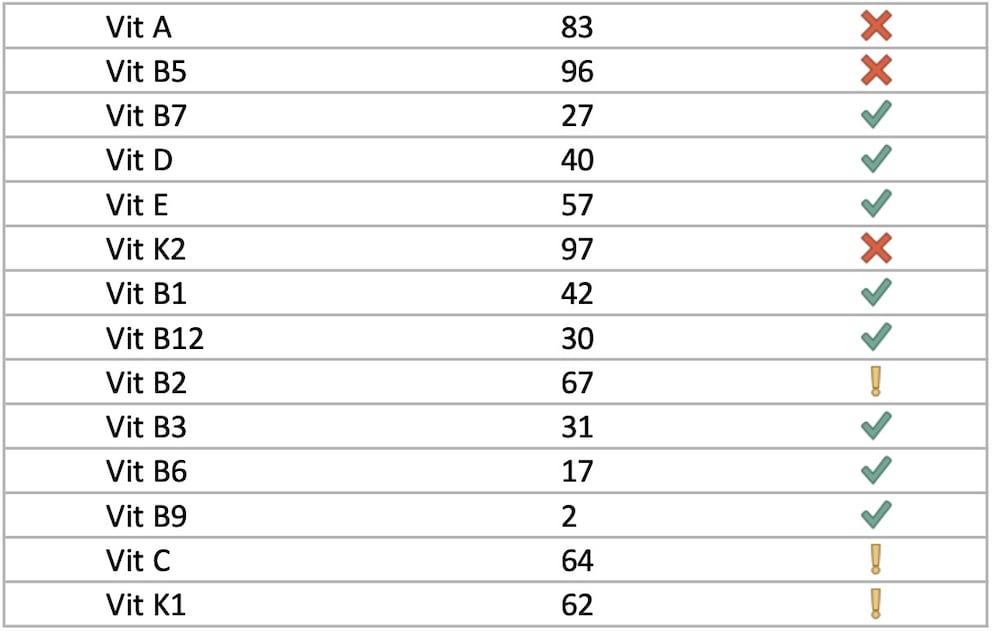
The rest of the report includes profiles of the individual nutrients. I learn, for example, which foods contain the respective nutrients and when their need is increased. I also got the offer to purchase a customized nutrient mix.
- Difficulty: easy
- Duration: 5 minutes, 16 days for the result
- Price: 53.99 euros
- Accuracy: low
Statement from the Hair Analysis Provider
After being disappointed with the result, I asked Vitalstoffkraft why the hair analysis result differed from the others. Specifically, I wanted to know:
- How do you assess the reliability of your hair analysis for vitamin B12 compared to blood testing?
- What scientific basis underlies the procedure?
I received a response the same day. Vitalstoffkraft first clarifies: “Our hair analysis for micronutrient determination is not a substitute for a conventional medical blood or urine test—and doesn’t intend to be. Both approaches pursue different goals, are based on different methods, and therefore cannot be directly compared.”
Alternative Instead of Conventional Medicine
To my first question, they say: “While a blood analysis measures biochemical current values in the blood serum at a specific point in time—to detect acute deficiencies or oversupplies—our hair analysis follows a complementary, energetic approach. It is based on methods of alternative medicine.” They continue: “It’s not about diagnosing diseases, but about determining the individual nutrient needs at the time of sample collection.”
Functional Needs Instead of Deficiencies
The methodology is also explained to me: “Our analysis scans energetic reactions based on quantum physical principles and makes connections visible that are often not recognized in a blood analysis of individual nutrients. Correlation patterns emerge that provide clues to imbalances—not specific deficiencies, but functional needs of the body.” Specifically, this means that the analysis provides indications of which micronutrients the body could particularly use at the moment, “regardless of whether these are currently within the normal range in the blood or not.” It’s not about absolute lab values, but about a holistic picture of the current supply situation. It should be mentioned again that at the time of sample collection, I definitely had a deficiency, as confirmed by the other tests—and the hair analysis did not show this.

Effects, Dosage and Potential Risks of Vitamin B12 Supplementation

Urologist Explains: You Can Save Money on Testosterone Saliva Tests
My Conclusion: Practical, but to Be Taken with Caution
At-home vitamin self-tests seem tempting at first glance: no waiting at the doctor’s, no unpleasant blood draw—just quick results conveniently on your phone. But my self-experiment shows: It’s not that simple. The blood test via finger prick performed surprisingly well and provided comparable values to the doctor’s visit. However, I didn’t receive any medical advice here. In the free phone consultation, I would have had a nutritionist on the other end of the line to clarify uncertainties, symptoms, and questions about supplement dosage. Since I didn’t take advantage of it, I can’t judge the quality compared to the doctor’s consultation. The hair analysis, on the other hand, clearly failed for vitamin B12: The result differed significantly from the other tests and therefore didn’t seem plausible. For the other tested nutrients, I can’t comment on the accuracy, as I have no comparison values—my trust has already vanished with the B12 result.
What I continue to find problematic is that the tests provide numbers but no medical interpretation or individual therapy recommendation. As mentioned before, the phone call for the blood test is voluntary, while at the doctor’s, I receive mandatory advice. Especially with critical nutrients like vitamin B12, this can lead to false security—or uncontrolled self-medication.
My conclusion: If you want to check your nutrient status, you shouldn’t shy away from the medical route. Vitamin self-tests provide an initial orientation but do not replace medical expertise. In case of doubt, a prick in the practice is less painful than the consequences of a misdiagnosis. And: The test was cheapest at the doctor’s!
The Conclusion of a Nutritionist: “It’s a Money-Making Scheme”
Dr. Riedl has a clear stance on vitamin self-tests: “These are not alternatives. It’s a money-making scheme.” He explains it to me in detail. “We are currently experiencing a ‘democratization’ or rather a flattening of medicine, especially nutritional medicine, driven by influencers and business interests. Everyone supposedly knows everything. The truth is that 75 percent of the population can’t make sense of health information. Among those under 30, only 3.6 percent can evaluate such information critically. In other words, the industry meets a naive audience that it exploits to the best of its ability.” Drip bars (vitamin infusions) and continuous glucose tests are also “a nasty rip-off” for him, as they need to be interpreted critically—and, as proven here, the results often don’t match.