

September 20, 2026, 5:47 am | Read time: 3 minutes
While we sleep, our brain tidies up. Disruption of this process is discussed in research in the context of Alzheimer’s development. Now, a new study suggests that short impulses with so-called pink noise might enhance this natural cleaning process. However, experts urge caution: The results come from a small feasibility study and do not yet allow conclusions about benefits for people with Alzheimer’s.
Why Slow Brain Waves Are So Important
Researchers already know that the brain breaks down and removes metabolic waste during sleep. The cerebrospinal fluid plays an important role in this process, washing over the brain and carrying away unwanted substances. Previous studies have shown that stronger slow brain waves can improve this fluid flow.
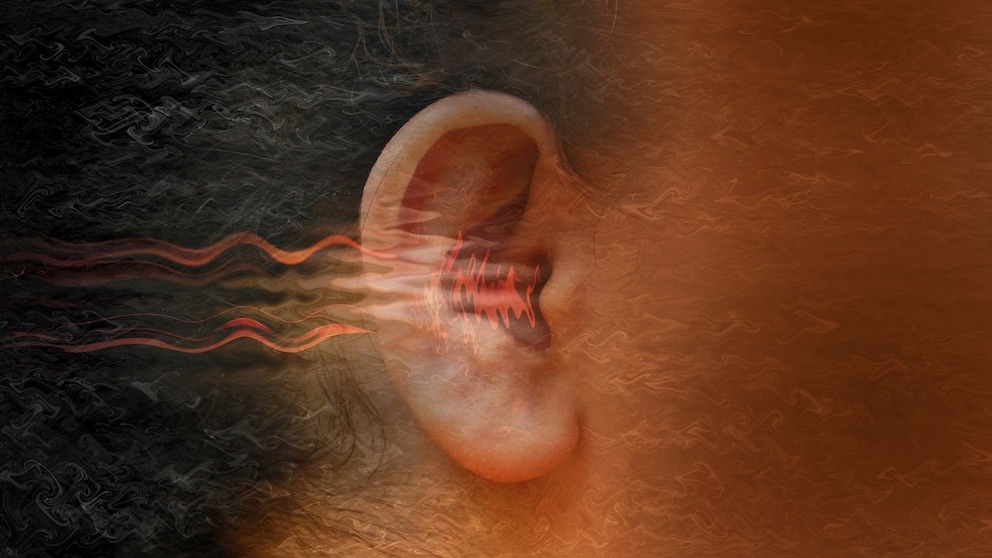
It was also known that short sound impulses with pink noise can enhance these slow brain waves. The effect is most pronounced when the tones coincide precisely with the peaks of the brain waves. “They really don’t sound like much; they’re just small static beeps,” said the author of the new study, Joshua Levitt, from Boston University in the “New Scientist.”
AI Helped with Perfect Timing
To find out if pink noise also affects the fluid flow in the brain, a research team developed an AI model.1 This was designed to predict when a slow brain wave would peak. “The AI says: ‘In about 70 milliseconds, a slow wave peak is coming.’ So we should trigger the sound stimulation at that time,” Levitt says.
Laura Lewis from the Massachusetts Institute of Technology, also quoted in the “New Scientist,” explains the challenge behind it: “You have to process the EEG signals very elaborately to recognize slow brain waves. That’s why it’s difficult to do it quickly enough in real time.”

Researchers Can Predict Risk for 1,000 Diseases Based on Sleep

How Caffeine Changes Sleep–Even When You Think You’re Sleeping Well
Pink Noise Enhanced the Brain Waves
For the study, 27 healthy adults were examined while lying in an MRI during a nap. Fourteen of them reached the N2 sleep phase. This is the light sleep phase (non-REM phase), also known as stable sleep. In this phase, pulse, breathing, and heart rate slow down. Muscles relax. In the brain, so-called sleep spindles (short, fast waves) and sudden slow waves can be measured. During selected slow brain waves, researchers played precisely timed, 50-millisecond short impulses with pink noise.
The evaluation showed: The sounds enhanced the slow brain waves with which they were temporally aligned. For research, this is an important advancement. “This really advances the field methodologically,” Sephira Ryman from the University of New Mexico told the “New Scientist.”
Also interesting: What Your Sleep Position Reveals About Your Risk for Alzheimer’s
Expert Urges Caution
Professor Dr. Christoph Kleinschnitz evaluates the results positively but warns against exaggerated conclusions: “This is an exciting but still preliminary feasibility study. It has nothing to do directly with Alzheimer’s. Only 14 healthy adults were examined–no Alzheimer’s patients. Moreover, it could ‘only’ be shown that the noise triggered stronger waves of cerebrospinal fluid. Whether this actually contributes to improved ‘cleaning’ of the brain, such as the removal of harmful proteins like amyloid or tau, is not answered.”
Anyone now considering simply running a pink noise app while falling asleep should not expect too much. “Just playing pink noise from a phone probably won’t be enough. The short tones were precisely timed to a specific phase of the sleep waves via EEG–this timing was crucial. That can’t be done via a phone.”