


October 26, 2026, 7:05 pm | Read time: 5 minutes
Strong bones are essential for healthy aging. On one hand, they help prevent fractures, as the stronger the tissue, the more stable it is in the event of a fall. On the other hand, they allow us to remain physically active for a long time. But can we specifically strengthen our bones? “Yes,” explains Prof. Dr. med. Thomas Kälicke. He is the chief physician and a specialist in surgery, orthopedics, and trauma surgery. “Bone is not a dead framework but a highly dynamic tissue that is constantly being remodeled.”
Prof. Dr. med. Kälicke: Bone follows the principle ‘use it or lose it’
In the bone, two types of cells work against each other: Osteoclasts break down old bone substance, while osteoblasts build new bone. “Normally, they balance each other out,” says Kälicke. But he also emphasizes that this balance is not set in stone. “What matters is what we demand of our bones.” The regulation is carried out by cells deeply embedded in the bone substance, the osteocytes. Kälicke compares them to small sensors that “register every load.” When a stimulus occurs, they signal that stability is needed and that building should occur. If the stimulus is absent, breakdown predominates. “The bone becomes as strong as we demand it to be. It follows the principle ‘use it or lose it,'” explains the expert. “And of course, the bone also needs building materials: sufficient protein, calcium, and vitamin D.”
What happens when the load is missing
The load on our bones is undoubtedly one of the most important factors in counteracting breakdown. The earlier we start, the better. According to Prof. Dr. med. Kälicke, we reach our maximum bone mass around the age of 30. “You can think of it like a bone account: The more you deposit in your younger years, the longer the balance lasts in old age.” But even later, every deposit is still worthwhile.
“We see how important mechanical stimuli are whenever they are absent,” says Prof. Dr. med. Thomas Kälicke. Anyone who is bedridden for weeks after an injury or serious illness loses measurable bone density. “And if I am not allowed to put weight on a leg for weeks, we often see a so-called disuse osteoporosis in X-rays, a temporary demineralization of the bone. The breakdown then clearly outweighs the buildup.”
Which loads strengthen our bones and which do less
Of course, the question arises as to what promotes bone building and ultimately bone density. There is often confusion here, as I have noticed in conversations with people at the gym or in my circle of friends. It is often assumed that any type of movement or sport is good. But that is not the case. “The bone loves strength and impact,” Kälicke explains to me. It responds primarily to high, short, and varied loads. “Endurance training is great for the heart and metabolism,” says the expert, “but less effective for the bone.” Running helps the most due to the impact load. “Swimming and cycling, on the other hand, relieve the skeleton and do little for the bone.”
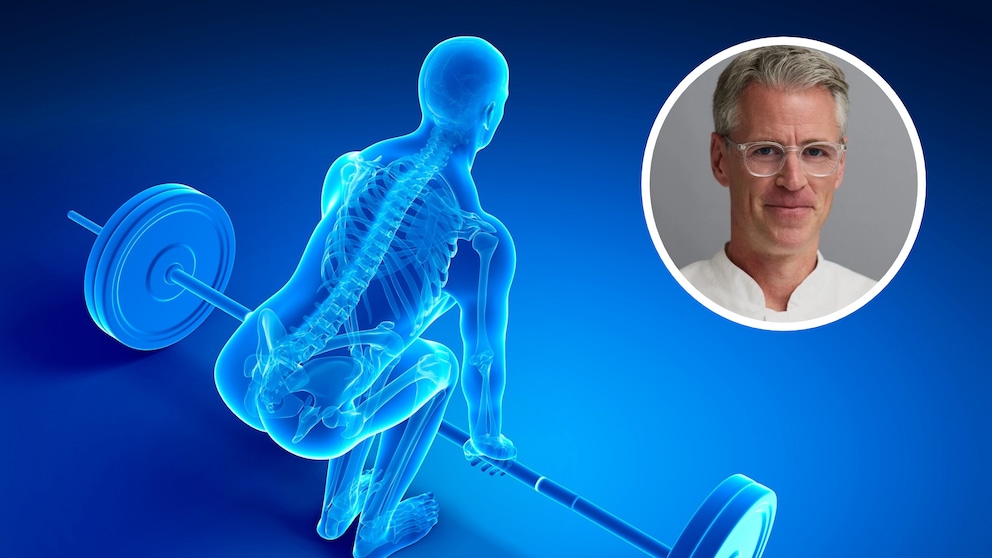
Kälicke, who exercises every day himself, recommends strength training because it provides the strongest stimulus. He advises “exercises that involve the spine and hips, such as squats, deadlifts, or overhead presses.” It is important that the stimuli and thus the weights are increased. “Only with light dumbbells and many repetitions is the stimulus for the bone low,” says Kälicke. He also recommends jump and impact loads like jumping rope, small hops, or stair climbing. The bone responds well to these short, strong impulses.

The 6 “Silent Killers” in the Body and How to Control Them for as Long as Possible

Germany no longer dies suddenly—we die quietly! This “pill” could prevent it.
Heavy weights can also help with osteoporosis
For a long time, heavy lifting was considered too risky for osteoporosis. An Australian study, which Kälicke refers to, questioned this. In the so-called LIFTMOR study, 101 postmenopausal women with low to very low bone mass trained twice a week for 30 minutes each over eight months.1 One group performed deadlifts, squats, and overhead presses with high weights (more than 85 percent of their maximum load) as well as jump exercises under supervision. The comparison group only did a light home program.
The result: In the training group, bone density in the lumbar spine increased by 2.9 percent, while in the comparison group, it decreased by 1.2 percent. The training group also performed better at the femoral neck. The participants were healthy apart from the low bone density.
So anyone suffering from osteoporosis should consider strength training. Important: One should “not stand alone under the barbell but build up the training carefully and under supervision,” warns Kälicke. It is also advisable to consult with the treating physician beforehand.
Why women in particular should do strength training
According to Kälicke, women are significantly more affected by osteoporosis than men. “About four out of five patients are female.”2 The reason is primarily hormonal. “With menopause, estrogen, which protects the bone, disappears, and in the first years after, a particularly large amount of bone mass is lost,” he explains to me. “Paradoxically, however, it is more often women who neglect strength training.” Yet it is the best osteoporosis prevention for women.