

December 31, 2025, 7:48 am | Read time: 3 minutes
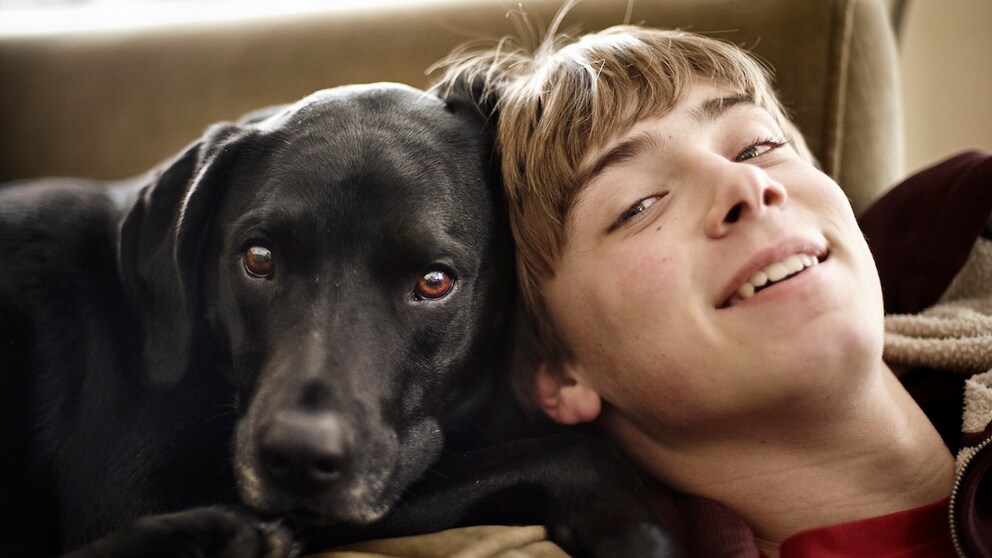
Pets can enrich our lives. Dogs, in particular, are considered man’s best friend and are often valued like a family member. It stands to reason that dogs can also positively influence the mental health of their owners. A study has now confirmed this with measurable data. Teenagers who grew up with dogs were mentally healthier than their peers without dog contact—the surprising part: Apparently, human oral flora plays an important role.
Dogs can promote their owners’ sleep, affect the gut microbiome—and change oral flora? Evidence for this was provided by a study from an interdisciplinary team led by Eiji Miyauchi and Takefumi Kikusui at Azabu University (Japan), which examined the effect of dogs on the mental health of teenagers.1
Data Analysis and Animal Experiment
For their study, the researchers used data from the Tokyo Teen Cohort (TTC), a population-based long-term study. It examined 343 teenagers (13 years old), including 96 with a dog in the household. A year later, their psychological characteristics were recorded using the Child Behavior Checklist (CBCL). Additionally, their oral flora was analyzed and characterized using 16S rRNA sequencing.
To examine the influence of microbiota on social behavior, an experiment was conducted on mice. The saliva of six teenagers (three with and three without dogs) was processed and transplanted into germ-free mice. Various behavioral analyses were then conducted on the mice, investigating possible changes in social behavior, anxiety reactions, and depressive tendencies.

How Friends Influence Our Gut Health

The Effect of Yogurt on Mental Health
Connection Between Dogs, Psyche, and Oral Flora
The researchers found that teenage dog owners exhibited fewer mental and social problems. Their scores for social problems, withdrawal behavior, aggressive behavior, and other abnormalities were significantly lower. Their oral flora also differed from test subjects without dog contact. The bacterial genus Streptococcus was more prevalent in their oral flora.
Interestingly, there seemed to be a connection between these bacteria and mental health. Several so-called ASVs (Amplicon Sequence Variants) from this genus negatively correlated with problematic behavior—meaning they appeared more frequently in mentally healthier teenagers.
The animal experiment also provided evidence for such a connection. Mice that received these bacteria showed significantly increased social activities in behavior tests, such as approaching enclosed peers. Notably, Streptococcus ASVs could be divided into two groups. Group A was associated with increased sociality, Group B with less. In mice that received the microbiome from dog owners, Group A was significantly more prevalent. The correlations between the presence of bacteria and positive behavior appeared in both humans and mice, indicating a functional connection.
Significance of the Study
Contact with dogs has an effect on social behavior. The study clearly demonstrated this. Moreover, this connection seems to be at least partially related to the microbial composition in the mouth. The fact that these connections emerged not only from the analysis of human data but also in a mouse model with transplanted human microbiota strengthens the significance of the study’s findings.
Further research is needed to prove causal relationships and explain exactly how changes in oral flora occur through dog contact and by what mechanisms they affect human social behavior and mental health.