

March 4, 2022, 6:26 pm | Read time: 4 minutes
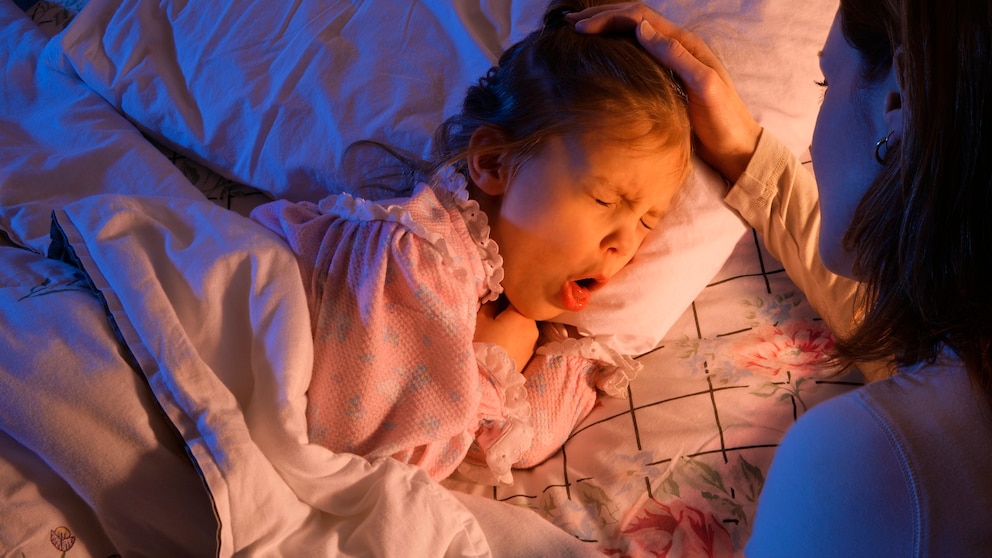
At night, the child suddenly coughs heavily and has difficulty breathing. This can cause panic for both parents and child. Often, the croup syndrome is behind these frightening moments. What helps in such a situation?
Pseudocroup is a typical childhood illness. It is mainly characterized by a barking cough, hoarseness, and a loud breathing sound when inhaling. But what exactly is behind it, and what can parents do to provide relief for their child?
Overview
What causes pseudocroup?
The symptoms usually appear in the evening or at night and more frequently in the fall or winter. Often, pseudocroup announces itself one to two days before the first “croup attack” with mild signs of infection: The child has a runny nose and possibly a slightly elevated temperature.
“The cause of pseudocroup or croup syndrome is usually a cold infection caused by parainfluenza viruses,” says pediatric pulmonologist Christian Vogelberg from the University Hospital Dresden. “In the fall and winter, these viruses are virtually everywhere, and any child can catch them.” Potential sources of infection include siblings or daycare.
During an infection, the mucous membrane in the larynx area becomes inflamed and swells. The consequences: pain, narrowing of the airways, and difficulty breathing.
Also interesting: These childhood illnesses parents should know about
Many young children affected by pseudocroup
It is estimated that 15 percent of all young children aged ten months to four years experience at least one croup attack. “At this age, the airway area is already relatively narrow,” says the pediatric pulmonologist. “An infection quickly leads to the mentioned symptoms.”
Also interesting: Infections that particularly affect children
Assessing the severity of a croup attack at home
The severity of a child’s croup attack can be well assessed at home using some indicators.
- In very mild cases, the barking cough is initially noticeable. If the affected child becomes agitated, the distinctive sound when inhaling may sometimes occur.
- In children who have a more pronounced narrowing due to the infection and inflamed airways, and consequently a somewhat more severe course, the noticeable cough and breathing sound can also occur at rest.
- Children with particularly severe narrowing of the airways suffer from significant shortness of breath and very high breathing effort. The noticeable breathing sound is present both when inhaling and exhaling.
Also interesting: Asthma – causes, symptoms, treatment

Why Children Are Particularly Frequently Affected by Middle Ear Infections

Symptoms of Sleep Apnea and How to Prevent It
First aid without medication
“As a first therapeutic measure, especially if you don’t have the appropriate medication on hand, holding the child in an upright position helps,” says pediatrician Jakob Maske. Lying down intensifies the effect of mucous membrane swelling and airway narrowing. For this reason, the croup syndrome often occurs acutely from sleep.
When you pick up the child, the blood flow in the larynx area changes. It’s similar to a cold: When you lie down, your nose gets stuffy. When you sit up, it clears after a while, and you can breathe again.
https://oembed/fitbook/affiliate/bcf73000972ef02e7caaaa0ed3bb06ed6ae1772eca55490a4baeeecc4e4777f1/900b495e-d27d-429e-892a-029abf95d223/embed
“It’s also important to calm the child and breathe together with them,” says Maske. “Often, they then realize that they can actually breathe quite well.” Additionally, you can stand with the child by an open window. Cold air causes the blood vessels to constrict, reducing blood flow and thus the swelling of the narrowed airways. This often helps, and you don’t need to take the child to the doctor.
Also interesting: COVID-19 vaccination for children aged 5 and up – what parents should know
When is treatment necessary?
If the measures at home do not help, the affected child should be seen by a doctor or in the emergency room of a children’s hospital. There, the same approach as at home is followed: The mucous membrane is reduced with medication.
Often, affected children can be discharged home directly after such treatment and a certain observation period. However, if the symptoms do not clearly improve or further treatment cycles are necessary, they are admitted as inpatients and treated until they are symptom-free. Most children experience the croup syndrome rather mildly. Severe cases are rare.
With material from dpa