

November 25, 2021, 3:21 pm | Read time: 9 minutes
In the U.S., more than two million children aged five to eleven have already been vaccinated against COVID-19. In Europe, it could start soon as well. Here’s the timeline and the open questions.
COVID-19 numbers are rising and rising. Many parents are waiting for a vaccine for children. Now the time has come. Experts from the European Medicines Agency (EMA) are paving the way. However, when it will start in Germany is still unclear.
Overview
- BioNTech for children aged 5 and up only one-third of the adult dose
- Children rarely become seriously ill from COVID-19
- BioNTech for children aged five and up – what do the studies say?
- Are the available data sufficient for an assessment?
- When will the Stiko decide?
- Can pediatricians still vaccinate children under 12?
- What are the arguments for vaccinating younger children?
BioNTech for children aged 5 and up only one-third of the adult dose
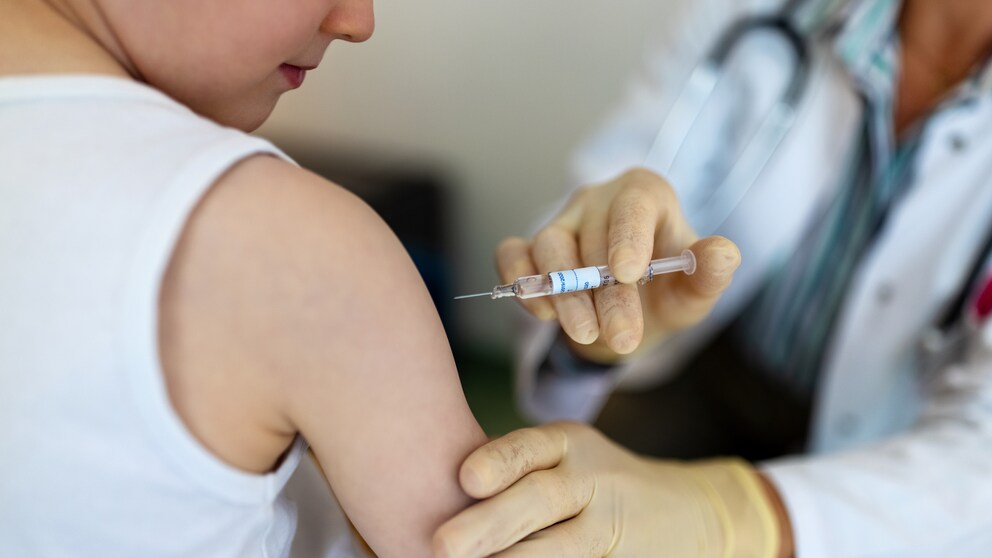
The EMA has given the green light for the approval of the BioNTech/Pfizer COVID-19 vaccine for children aged five and up. The EMA announced this in Amsterdam. It will be the first COVID-19 vaccine approved in the EU for children under twelve. Officially, the EU Commission must still agree–but that is considered a formality.
Children aged five and up should receive only one-third of the adult dose of the BioNTech/Pfizer vaccine and two doses three weeks apart. The EMA emphasized that the vaccine is safe and effective according to studies. So far, no severe side effects have been observed, only mild reactions such as fever, pain at the injection site, fatigue, or headaches. Experts have been reviewing the manufacturers’ studies since October.
So far, this vaccine is only approved in the EU for people aged 12 and up. However, in Israel and the U.S., children aged five and up are already allowed to be vaccinated with it. In Germany, according to Federal Health Minister Jens Spahn (CDU), 2.4 million doses of the BioNTech/Pfizer vaccine for children will be available starting December 20. Further deliveries are expected in the first months of the new year.
Children rarely become seriously ill from COVID-19
Children rarely become seriously ill from COVID-19. However, EMA experts say they can still become severely ill. Therefore, the benefits of vaccination should be considered higher than the possible risks. The EMA’s decision does not mean that vaccination of children is now recommended. National governments or health authorities must decide that, the EMA emphasizes. In Germany, an opinion from the Standing Committee on Vaccination (Stiko) is initially expected. They plan to issue their recommendation for COVID-19 vaccination for children aged five to eleven before the end of the year.
The chairman of the Stiko, Thomas Mertens, expressed understanding for parents who are skeptical. “I can understand that very well, and it essentially corresponds to the problem the Stiko faces with its recommendation–namely weighing the benefits and possible ‘residual risks’ for children in this age group,” Mertens told the “Schwäbische Zeitung.”
A second vaccine for children could soon follow. EMA experts are currently reviewing an application from the U.S. manufacturer Moderna.
BioNTech for children aged five and up – what do the studies say?
An evaluation published in the “New England Journal of Medicine” assesses the BioNTech study. In phase one, the dose was initially determined: For adults, it is 30 micrograms, and for children under 12, 10 micrograms was chosen after the test series was completed. Phases two and three of the study included 2,268 children aged five to eleven. Two-thirds of them received two doses of the vaccine, and one-third received a placebo. The immune response was measured one month after the second dose.
Efficacy, safety, side effects
The authors observed “a favorable safety profile,” with “no severe vaccine-related side effects observed.” In the study, scientists only found “mild and temporary reactions” such as fever, pain at the injection site, fatigue, or headaches. The evaluation concludes that the vaccination is safe and effective.
Three of the vaccinated children contracted COVID-19 during the observation period, compared to 16 in the control group. Researchers estimate the vaccine’s efficacy at 90.7 percent. The only three more severe damages during the observation period were not considered related to the vaccination–in one case, it was a broken arm. Myocarditis, which has occasionally occurred after broader vaccination of those over 12, was not observed in this relatively small group of subjects.
Also interesting: How sick does the pandemic make children and adolescents?
Are the available data sufficient for an assessment?
“Approval is something entirely different from a vaccination recommendation,” emphasizes Fred Zepp, a member of the Standing Committee on Vaccination (Stiko). To approve the BioNTech vaccine for children aged five and up, it must first be proven that the vaccination triggers a protective antibody response and that it had no acute unwanted side effects in the subjects. The study data are probably sufficient for this.
“What you don’t see in the approval study are risks that occur less frequently than statistically expected in such a small group.” To recall: Only about 1,500 children received the vaccine. “Very rare side effects cannot be detected there,” says Zepp. Myocarditis, for example, was only discovered in young men after broader use of the vaccine.
The Stiko is also concerned with obtaining data on rare vaccination complications from other countries. In the U.S., for example, younger children have been vaccinated with the lower-dose vaccine since November, and according to government figures, about 2.6 million five- to eleven-year-olds have received the first shot. However, the situation there and the health status of U.S. children are not considered directly comparable to Germany.
What does the Professional Association of Pediatricians say?
Currently, it means waiting to see how the Stiko and subsequently the policy evaluate the BioNTech data. What does the Professional Association of Pediatricians say about the topic? “We advocate waiting to see what the Stiko says first,” says the association’s spokesperson, Jakob Maske. “It would not be advisable for the policy to recommend the vaccination as long as there is no recommendation from the body that advises the policy.”
Of course, infection numbers are rising, and with them, the pressure to counteract by all means. “But the policy should not again unnecessarily pressure parents and children.” Maske expects a Stiko decision only next year. An earlier recommendation could come for children with pre-existing conditions and seriously ill relatives.
“We want a safe vaccination, and so do the parents,” said Maske. Children get infected. However, severe illness is the absolute exception, emphasizes the pediatrician from Berlin. The assessment must therefore be different for children than for adults. “Because the risk is very small, the benefit must be very large.” Therefore, much stricter criteria must apply to possible side effects. “When the disease burden is very low, the vaccination must be much safer.”
When will the Stiko decide?
According to Stiko member Zepp, the committee will “deliberate in the coming weeks.” A decision could be made in November, depending on the timing of approval, said the Mainz pediatrician. He personally considers it possible that a recommendation could initially be made for children with an increased risk due to pre-existing conditions, as was initially the case with vaccinations for 12- to 17-year-olds.
Also interesting: Infections that particularly affect children

When will the COVID-19 vaccine be available for children under 12 in Germany?

COVID-19 Vaccination for Children Ages 5 and Up: What Parents Should Know
Can pediatricians still vaccinate children under 12?
Yes, explains Jakob Maske: “That is a free medical decision.” Even before the vaccine is approved for this age group, it is not illegal to vaccinate younger children. The technical term for this is off-label use. However, Maske believes the number of pediatricians who have vaccinated children under 12 so far is small.
What do pediatricians think of COVID vaccinations for children?
Vaccinating children against an infectious disease that they usually overcome without complications is always “a difficult decision,” says pediatrician and Stiko member Zepp. “You have to weigh the risks of a SARS-CoV-2 infection against the possible rare risks of a vaccination.” It must also be considered that different group sizes are being compared: “If I vaccinate all children in an age group, I initially expose them all to the very low risk of a vaccine side effect. The risks of a COVID-19 illness are greater, but we don’t know how many children would have actually been infected and become ill.”
Also interesting: Booster vaccination and antibody test – important questions and answers
What are the arguments for vaccinating younger children?
Authors of the study in the “New England Journal of Medicine” argue for both a direct and an indirect benefit. A vaccination protects children from a–albeit rare–severe course or long-term consequences of a COVID illness. By protecting them, you also protect people in their environment who are at risk for a more severe course of illness. Unvaccinated, this age group could become transmitters, even for newly emerging variants of the virus.
According to Zepp, there are various parameters in the debate. One is the disease burden of the individual child, and the other is the benefit to society as a whole. In a pandemic, it may also be sensible to vaccinate children to enable more participation and a better quality of life for the community. However, vaccinating children has only a minor effect on the transmission of the virus between adults.
Also interesting: What keeps people from getting the COVID vaccination?
We must not forget: “A large part of our problem is unvaccinated adults. We must be careful not to have another proxy discussion to the detriment of children,” says Zepp. The most important measure to overcome the pandemic remains to protect as many adults as possible, ideally all, through vaccination.”
with material from dpa