

August 21, 2025, 1:55 pm | Read time: 5 minutes
What exactly influences the first menstruation after childbirth? And what help is available for women who experience heavier periods afterward? Women’s health expert Dr. Daniela Bach provides insights. But beware, spoiler: Unfortunately, there are no universal answers!
Many women report painful and heavy periods after pregnancy. Premenstrual symptoms (PMS) can also become more intense after the postpartum period. However, the opposite often occurs: menstrual bleeding, pain, and other premenstrual symptoms become weaker after childbirth.
Overview
After Birth – Postpartum and Breastfeeding
After childbirth, female hormones must normalize before a regular cycle (as before birth) can occur. When exactly the period resumes cannot be answered universally and varies from woman to woman. A key indicator for the timing of the first bleeding is the extent and duration of breastfeeding, as breastfeeding affects hormone balance. The hormone prolactin is produced by the female body, which not only promotes milk production but also significantly influences the cycle.1
“Women who do not breastfeed can have their first period after the postpartum period, about six to eight weeks after childbirth,” explains gynecologist and health coach Dr. Bach. “However, if the woman is breastfeeding, the period is delayed accordingly. Some women do not have a period during the entire duration of exclusive breastfeeding, meaning when the baby is only fed breast milk. Others breastfeed fully and still get their period again. Some women no longer breastfeed fully, only partially, and still only get their period after six months, a year, or even 18 months. Every woman is different, and the same goes for the amount, intensity, and pain of the first period after childbirth. There are no universal answers here either.”
Heavy Bleeding, Intense Pain
Some women report experiencing particularly heavy periods after childbirth. Conversely, others say their menstrual bleeding becomes weaker and even shorter after delivery. And what does the data say? “For most women, the normal cycle stabilizes after a certain time post-birth,” says Dr. Bach. “But how long this takes varies greatly from woman to woman. It is especially important to understand why a woman bleeds more heavily after childbirth.”
Why Does the Period Change After Pregnancy?
Not only do hormone balance and cycle change after pregnancy, but a woman’s body does too. “To illustrate the impact of childbirth on menstruation, it helps to imagine that the uterus grows and stretches immensely during pregnancy. Even though immediate recovery is completed with the postpartum period, the uterus is not yet as small as it was before childbirth. It may never be,” explains the gynecologist, describing the physical change and its effect on the intensity and strength of the period. She adds, “The regeneration and recovery of the entire body after pregnancy and childbirth can take up to two years. During this time, women often become pregnant again, which naturally extends the recovery period.”
What to Do About Breast Pain Before and During Menstruation

Menopause Is Over–What Comes Next?
Number of Pregnancies Influences Period Intensity
The number of pregnancies also affects the intensity of subsequent periods. “It may be that after a second, third, or however many pregnancies, the bleeding is initially heavier because the uterus after childbirth is not as petite as it was before the first pregnancy. This can also mean that the wound surface of the uterine lining is now larger, leading to increased menstrual bleeding,” according to Dr. Bach. However, these changes can primarily stabilize within the first two years after birth. During this period, “a lot happens in terms of recovery throughout the woman’s body,” emphasizes the gynecologist.
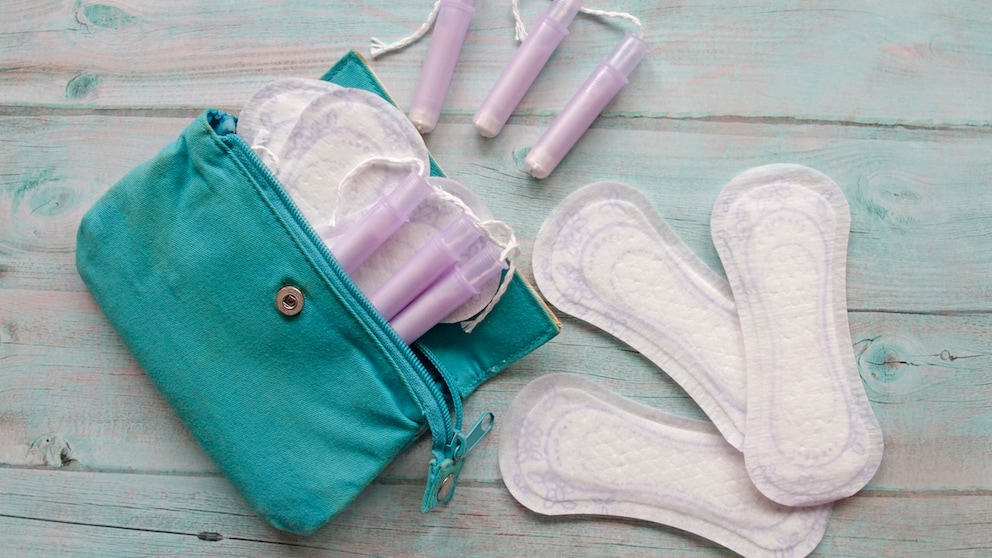
It is especially important for women to know when menstrual bleeding after childbirth is too heavy. As a rule of thumb, the expert advises: “If you need to change the pad more often than every two hours or if the pad is visibly soaked after an hour and this heavy bleeding lasts more than a day, you should definitely seek medical help.” If other symptoms occur, such as fever or severe pain, Dr. Bach advises: “Please do not suffer in silence! If the bleeding is really heavy, has changed significantly, and is affecting your quality of life, then see a gynecologist. Have it checked to ensure everything is okay organically.”
Measures for Heavy Periods After Pregnancy
If women experience persistently heavier bleeding after childbirth, the hormonal IUD can be an option to alleviate symptoms. The IUD helps “reduce the buildup of the uterine lining during the cycle, resulting in significantly less bleeding,” explains Dr. Bach.
The mini-pill is also a possible measure to control the intensity of menstrual bleeding. It is a pure progestin hormone, which is very suitable even during breastfeeding.2 Dr. Bach explains, “The progestin hormone does not pass into breast milk and does not affect milk production.”
Regarding contraception, Dr. Bach addresses the first ovulation after childbirth. This occurs—usually unnoticed—two weeks before the first period. Thus, another pregnancy could occur even during breastfeeding. “This means breastfeeding is not a reliable contraceptive,” emphasizes the gynecologist. “Because we never know when the first ovulation will occur. Women who do not plan to become pregnant again immediately should ensure reliable contraception. The mini-pill can be a good solution.”