


April 29, 2025, 3:00 pm | Read time: 5 minutes
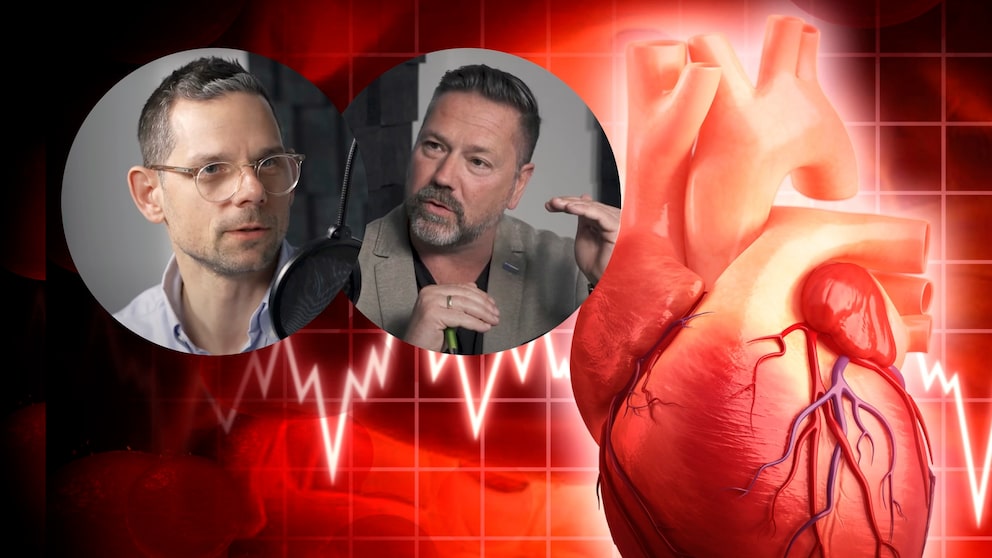
When a passion for sports meets stress, overweight, and the challenges of middle age, the heart can become a risk factor. In the video podcast “Meet the Expert,” fitness professor Dr. Stephan Geisler and cardiologist Dr. Christopher Schneeweis reveal what you can do for your heart after 40.
On his YouTube channel “Fitnessprofessor,” Prof. Dr. Stephan Geisler–a renowned sports scientist and one of the leading experts in strength training in the German-speaking world–meets with Dr. Christopher Schneeweis, a specialist in internal medicine and cardiology. The heart specialist, with experience in prevention and sports cardiology, answers questions about heart health for people who are passionate about sports and are in middle age. Among other things, the question is: Can it be dangerous for the heart if you’re in your late 40s, slightly overweight, and stressed in everyday life? Read about how high your LDL cholesterol should be at most, which other lab values you should know at this age, and what ideal training and nutrition look like.
Overview
- Training with a cold–does it harm the heart?
- Late 40s, slightly overweight, stressed–what can you do for heart health?
- Aim for the lowest possible LDL level
- Nutrition and relaxation for a healthy heart–not just after 40
- In your late 40s, adjust all the levers
- Keep the heart attack risk as low as possible
Training with a cold–does it harm the heart?
“Heart and Strength–Friend or Foe?” is the current title of the video podcast “Meet the Expert,” published by Stephan Geisler, professor of fitness and health at the IST University in Cologne, on his YouTube channel “Fitnessprofessor.” His counterpart is cardiologist Dr. Christopher Schneeweis, familiar to FITBOOK readers. The topic of heart health is explored for a very athletic audience, who, as heard from the experiences of fitness professor Stephan Geisler, are reluctant to skip training even when they have a cold. Can training with an infection already harm the heart?
“Under no circumstances should you engage in high-endurance activities–not even with a slight cold,” advises Schneeweis. You might consider switching to something like yoga. If you feel sluggish due to an infection, you should completely avoid sports to protect your heart. Forcing yourself to exercise with an infection is definitely the wrong approach to maintaining long-term heart health, says the doctor.
Also interesting: Cardiologist Dr. Schneeweis: “The optimal training volume for heart health”
Late 40s, slightly overweight, stressed–what can you do for heart health?
What should you pay attention to in order to stay fit despite stress and reduce the risk of serious cardiovascular diseases like heart attacks? “Late 40s, slightly overweight, stressed. What should you focus on?” Geisler wants to know. The cardiologist first points out the importance of looking at family history: “Were there any events among parents or siblings, especially premature ones?” You should also be aware of certain lab values at this age–you can’t tell if someone has high cholesterol just by looking at them.
Aim for the lowest possible LDL level
Heart health after 40 is an important topic. You should aim for a low LDL cholesterol level. “Under 115 is good–beware, some labs still consider 160 as good!” explains Schneeweis.
Additionally, you should have your ApoB-100, genetically determined lipoprotein (a), and HbA1c levels checked, as well as test for high blood pressure–all warning signs for heart events. You can read here what values define high blood pressure. Smoking should be completely eliminated, and studies recommend at least “150 minutes of moderate or 75 minutes of intense exercise plus strength training twice a week,” specifies cardiologist Christopher Schneeweis.
Nutrition and relaxation for a healthy heart–not just after 40
It’s also a mistake to neglect sleep and get less than seven hours of sleep. Eight to nine hours are better. In terms of diet, he advises using healthy oils (“eliminate saturated fats”) and watching glucose intake: complex carbohydrates instead of sugar; also, consume enough proteins. Keyword: Mediterranean diet. From the heart expert’s perspective, a diet doesn’t help. For heart health, only what works long-term counts, emphasizes Schneeweis.
And what about stress? For many, it’s a daily companion not just in their late 40s. Stress, according to Schneeweis, cannot be avoided–but if you are aware of it, you can and should reduce your stress level. How this can be achieved has already been explained by the cardiologist in an issue of FITBOOK Experts: “Through relaxation techniques, you can try to engage the so-called vagus nerve, the relaxation nerve. There are breathing exercises for this, but meditation techniques can also be helpful for stress management,” says Schneeweis. You can find some techniques here.

Cardiologist on Coronary Heart Disease: “Sudden Cardiac Death Can Be the First Symptom in the Worst Case”
These Unexpected Symptoms Indicate Heart Failure
In your late 40s, adjust all the levers
It’s clear: There’s no single lever to adjust in middle age that will lay the foundation for optimal heart health. Instead, you should adjust all levers like nutrition, relaxation, etc. Fitness professor Dr. Stephan Geisler agrees. When asked by FITBOOK, he said: “As a fitness scientist, I want to emphasize the particular health importance of muscle training. Regular muscle training is essential from a preventive perspective and can effectively prevent many diseases.”
Keep the heart attack risk as low as possible
Clearly, you can’t reduce the risk of a heart attack or other heart events to zero. Neither in your youth nor after 40 and beyond–heart health depends on many factors, and not all are controllable. However, you now know which “minimizers” of heart attacks and the like have some effect as you age. This way, you can keep the risk as low as possible. Incidentally, what motivated the fitness professor the most was aiming for a low LDL level. “I’ll give that a try,” Geisler told FITBOOK.