


February 27, 2026, 8:36 am | Read time: 9 minutes
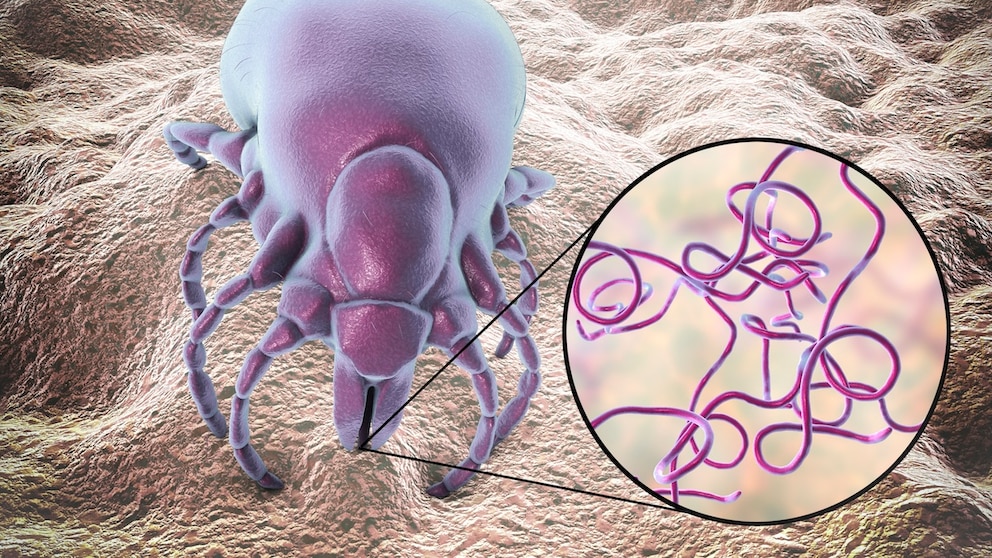
Especially in spring and summer, they lurk in the grass and woods: ticks. The “common wood tick” is a tiny, blood-sucking parasite. It bites into the skin of its host (i.e., us!) and digs its stinger into it to then suck itself full. A tick bite usually frightens many people at first, but in most cases it is harmless. Nevertheless, caution is advised. Ticks can transmit serious diseases. One of these is Lyme disease. FITBOOK author Doris Tromballa has compiled everything you need to know about this treacherous infection.
According to estimates, around 80,000 to 300,000 people in Germany contract Lyme disease every year. Exact data is not available—the disease is not notifiable nationwide, only in some federal states. However, the Robert Koch Institute describes it as a “widespread disease that must be taken seriously.”1 Sports presenter Laura Papendick told FITBOOK about her battle with Lyme disease: “It knocked me off my feet.” What are the symptoms of Lyme borreliosis, and what makes the disease so insidious?
Overview of Lyme disease
What Is Lyme Disease?
Lyme disease is called “Lyme borreliosis” or “Lyme disease” because it was first described in the US town of Old Lyme. In 1977, reddening of the skin and inflammation of the joints after tick bites became more frequent there. In 1982, the bacterium responsible for the disease was isolated for the first time by the US bacteriologist Willy Burgdorfer. Since then, the bacterium that causes Lyme disease has been known as “Borrelia burgdorferi”.2
The disease manifests in various ways: it may only affect the skin, but the bacterium can also invade the nervous system, brain, joints, and heart, leading to serious complications.
How Do You Get Infected?
In Germany, around five to 35 percent of all ticks carry the Lyme disease bacterium.3 It colonizes the tick’s gastrointestinal tract.4 And this is how the pathogen reaches humans: The tick bites into the skin and stings to suck our blood. This allows the bacteria to “migrate” into us. The longer the tick can suck on us, the greater the risk of infection. The probability of infection is still relatively low for less than twelve hours, but then increases to between ten and 25 percent. The pathogen cannot spread from person to person.
According to “Internisten im Netz”, around 1.5 to six percent of people in Germany become infected with Lyme disease after a tick bite. In turn, 0.3 to 1.4 percent can be expected to actually fall ill. The most common manifestation of this is the so-called “migratory rash,” a large, round, red skin change. This usually heals without any problems if it is treated early. If left untreated, however, it can lead to more serious complications, secondary diseases, and long-term damage.5
Incidentally, dogs and cats can also get Lyme disease from tick bites, but there is no evidence of direct transmission to humans. However, they can “introduce” the ticks into the garden at home. It therefore makes sense to regularly check your four-legged friends for ticks after a trip into the countryside.6
The Symptoms of Lyme Borreliosis
The symptoms can vary greatly, so it is not always easy to diagnose Lyme disease accurately. In addition, different symptoms occur in different phases of Lyme borreliosis.7
Symptoms in the early phase
- Migratory rash : A common symptom is the so-called “migratory rash” (medical term: erythema migrans): This is a ring-shaped reddening of the skin, at least five centimeters in size, which spreads over several days and occurs in the majority of cases three to 30 days after the tick bite. The redness is paler in the center than at the edges and usually does not itch. It can occur around the tick bite, but also on other parts of the body. This can be a sign that the bacteria have already spread in the body.8
- General feeling of illness: This is usually accompanied by fever, swelling of the lymph nodes, and muscle and joint pain.
Symptoms in the advanced phase
- Neuroborreliosis: Neuroborreliosis occurs when the pathogen attacks the nervous system. The symptoms usually only begin weeks or months after the tick bite. Typical symptoms include burning nerve pain (especially at night), facial paralysis, numbness or even paralysis of the arms and legs, and visual or hearing impairment. In children, neuroborreliosis often manifests itself as non-purulent meningitis with severe headaches or sudden facial paralysis. Suddenly, smiling is only possible on one side, or the forehead looks petrified. Around three in 100 Lyme disease sufferers develop this complication. Neuroborreliosis can also occur months to years after the tick bite.9
- Lyme arthritis: This is an inflammation of the joints, especially the knee joints, which is intermittent and recurrent. Lyme arthritis occurs in around five out of every hundred cases of Lyme disease. Like neuroborreliosis, Lyme arthritis can develop months or years after the tick bite.
- Heart problems: The pathogen can attack the heart and trigger inflammation or arrhythmia.
- Chronic skin changes: The skin on the insides of the arms, legs, or fingers then becomes paper-thin and bluish. In children in particular, nodular or blue-red skin swellings can form, especially on the ear, nipples, or in the genital area.
How Is Lyme Disease Diagnosed?
As a rule, the first indication that you have been infected with Lyme disease is the “migratory redness,” i.e., the round, red skin change. This symptom occurs in around 90 percent of Lyme disease cases. If Lyme disease is suspected, seek medical advice immediately! A blood test can be carried out in the laboratory to determine whether it is a Lyme disease infection. In the case of neuroborreliosis, a cerebrospinal fluid sample is necessary.10
How Can the Disease Be Treated?
The most important thing with Lyme disease is rapid treatment. This is because the longer the pathogen is allowed to run riot in the body, the more likely it is that complications or late damage will occur. Therefore, if you suspect that you have Lyme disease or if you notice a red rash, you should see a doctor! Lyme disease is usually treated with antibiotics over several days. The chances of recovery are very good in the early stages of the disease—most patients recover completely after this treatment.11 However, preventative antibiotics are not recommended after a tick bite without signs of illness. Neuroborreliosis can also be treated with antibiotics. In this case, two to three weeks of medication is necessary.12 In the case of Lyme arthritis, painkillers are administered in addition to a 30-day course of antibiotics to relieve joint pain.

6 Tips to Protect Children from Tick Bites, Lyme Disease, and TBE

TBE – When the Brain Becomes Inflamed
How to Protect Yourself From Lyme Disease
Unfortunately, unlike the other common tick-borne disease, TBE, there is still no vaccination against Lyme disease. Nor does an infection protect against re-infection. It is therefore best to try to avoid letting ticks touch your skin in the first place.
Clothing
It is advisable to wear long, protective clothing, tuck your trouser legs into your socks, and wear sturdy shoes when going out into nature (forests and meadows, but also when gardening at home). Light-colored clothing is often recommended to ward off ticks. However, a Swedish study provided evidence that ticks are almost 21 times more attracted to light-colored clothing than to dark-colored clothing.13 The advantage of light-colored clothing, however, is that ticks are easier to detect and remove before they reach the skin.
Sprays
In addition to the right clothing, special sprays with the active ingredients DEET or Icaridin can also help to keep ticks away. According to the Professional Association of Pediatricians, however, these products should be reapplied after three to four hours, as their protective effect wears off.14 Alternatively, clothing can be treated with the insecticide permethrin, which is also used to impregnate mattresses for house dust allergy sufferers. A Korean study confirmed its effectiveness against ticks, but pointed out that the protection wears off over time.15
How Do I Remove a Tick Correctly?
If the tick has already bitten: remove it as quickly as possible. The longer the ticks are allowed to feed, the higher the chance of transmitting their disease-causing bacteria. Here is a step-by-step guide on how to proceed:
- Important! Do not try to treat the tick with oil, glue, or other substances, as this can irritate the tick and cause it to release more saliva, increasing the risk of infection.
- Select the appropriate tool: Use special tick tweezers, tick tweezers, or tick cards. If these are not available, fine, pointed tweezers with inwardly angled tips are also suitable.
- Grasp the tick correctly: Place the tool as close to the skin surface as possible and grasp the tick by the head or mouthparts, not by the fully engorged body. This prevents the tick from being crushed and reduces the risk of transmitting pathogens.
- Remove the tick: Pull the tick slowly and evenly straight out of the skin. Avoid jerky movements or twisting, as this can lead to parts of the tick remaining in the skin.
- Treat the bite site: After removing the tick, clean the bite site thoroughly with soap and water and then disinfect it.
- Dispose of the tick: Safely dispose of the tick, for instance, by encasing it in adhesive tape and discarding it with household trash, or by placing it in a sealable container for potential future examination. If there are still remains of the tick in the wound, this is not so bad—it does not increase the risk of infection.
- Observe the bite site: Keep an eye on the bite site over the following weeks. If redness, swelling, or other unusual symptoms occur, consult a doctor.