

November 7, 2025, 3:04 am | Read time: 4 minutes
Microgreens are considered a true superfood. They are rich in vitamins, minerals, and phytochemicals. However, consuming sprouts and seedlings also carries risks. FITBOOK knows what to watch out for to harness the health benefits of microgreens.
What Are Microgreens?
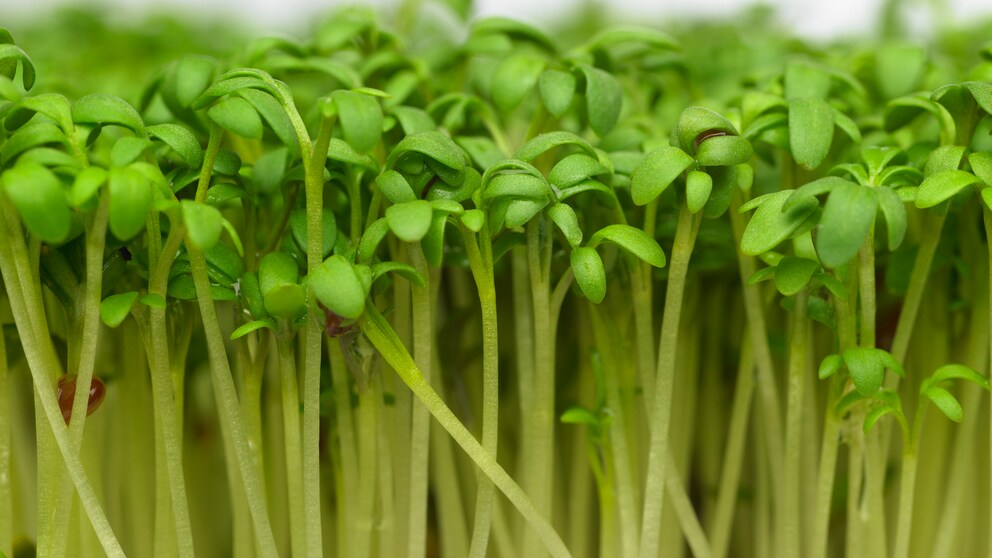
The term microgreens refers to young, edible herb and vegetable plants that can be consumed just a few days after sprouting. They impress not only with their delicate aroma but also with their high content of valuable nutrients. The definition of microgreens is closely tied to their developmental stage: Once a plant’s seed has sprouted and a small shoot tip is visible, it is called a seedling. This can be consumed entirely. If the seedling already has a green stem and a small leaf, it is referred to as a sprout. The root is usually no longer edible. If the sprouts are allowed to grow a bit longer until they have many small green leaves, they are called microgreens.1
Microgreens grow from the seeds of:
- Grains, such as seedlings from wheat, rye, oats, and barley
- Legumes, such as mung beans, soybeans, and adzuki beans
- Cruciferous vegetables, such as broccoli, radish, and mustard
- Oilseeds, such as flaxseeds, sunflower seeds, and pumpkin seeds
- Clover varieties, such as alfalfa and fenugreek2

What Are Phytochemicals and Why Are They So Healthy?

Foods That Are Especially Beneficial During Menopause
Why Are Microgreens So Healthy?
These small plants contain everything they need to grow into a large, healthy plant. This is exactly what makes microgreens so healthy for humans. Their concentration of vital nutrients is many times higher than in the same amount of the mature plant. They are rich in vitamins, minerals, antioxidants, and phytochemicals. The content of vitamins C, B1, B2, niacin, biotin, carotene, and vitamin E, as well as minerals like magnesium, potassium, phosphorus, zinc, and calcium, is even enhanced by the germination process. During the plant’s breakdown and transformation processes, the fat and protein composition of the seedlings also changes. In seeds rich in fat, the levels of polyunsaturated fatty acids and amino acids increase.
Broccoli Sprouts as Hope in Cancer Therapy
A study by the University Hospital Heidelberg examined microgreens, particularly broccoli sprouts, for their potential health benefits in cancer therapy. It was found that broccoli sprouts contain about 30 to 40 times more mustard oils than the mature broccoli plant. These substances help the young sprout protect itself from natural predators and also contribute to explaining its positive effects on the human body.3 Of particular importance is the mustard oil sulforaphane. It has been shown to weaken cancer growth and attack cancer stem cells. Laboratory studies have already demonstrated the effectiveness of broccoli sprouts against the particularly aggressive cancer stem cells of pancreatic cancer.
Growing Microgreens
Microgreens are not only extremely healthy but also very easy and space-saving to grow yourself. This is particularly easy with a sprouting jar, which requires little space and ideally supports cultivation.
- Step: Rinse seeds in a sieve with cold water, removing stones and dirt.
- Step: Soak seeds in three times the amount of water. The soaking time varies by type, about 12 to 24 hours.
- Step: Discard soaking water, rinse seeds, and sort out unswollen seeds.
- Step: Rinse seeds once or twice a day with clear water. Store in an airy place. Avoid direct sunlight and cold. The germination time varies depending on the seed type.4
Risks in Growing Microgreens
Despite their health benefits, fresh sprouts and seedlings also pose microbiological risks. Even the seeds, as an agricultural product, have a natural germ flora and are therefore not sterile, presenting a certain germ load. To keep the load as low as possible, the seeds are washed after harvest, and the germs are reduced through a special process.5
To germinate optimally, sprouts need light, oxygen, warmth, and moisture. Unfortunately, this is also the ideal environment for the growth of unwanted pathogens and spoilage organisms. The German Nutrition Society, therefore, recommends blanching microgreens once more before consumption to reduce bacterial content. This is especially important for people with weakened immune systems, children, and pregnant women.6