


August 4, 2026, 8:05 am | Read time: 6 minutes
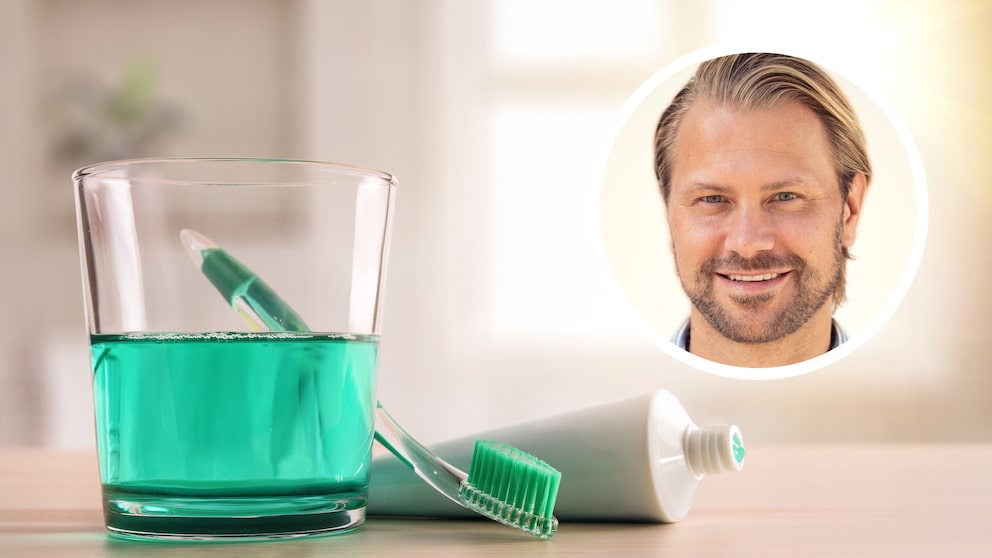
Mouthwashes are medically valuable tools—but they are often used at the wrong time out of sheer habit, dentist Martin Jaroch tells FITBOOK.
Why the Timing of Mouthwash Use Is So Important
According to dentist Dr. med. dent. M.Sc. M.Sc. Martin Jaroch, the timing of mouthwash use is crucial for dental health. “The biggest mistake is rinsing with mouthwash right after brushing your teeth. This removes the protective fluoride from the toothpaste.” His advice for daily life: “Better to just spit out the toothpaste and use the mouthwash at a different time.”
Toothpastes typically have a fluoride concentration of about 1,450 ppm (parts per million). This fluoride is the most important ingredient for hardening enamel and protecting against acid attacks. After brushing, a high concentration of this protective substance remains in the saliva and directly on the tooth surfaces. If you rinse immediately after brushing with a mouthwash that has low or no fluoride, a massive concentration gradient occurs. The valuable fluoride is simply washed away before it can solidify its protective layer on the enamel. By the way, water also has 0 ppm fluoride. Therefore, rinsing with water immediately after brushing is also a problem.
Studies, such as those by Swedish dentist Dowen Birkhead, impressively show that the fluoride concentration in saliva drops drastically after rinsing with water or low-fluoride solutions.1 Only at a fluoride concentration of 226 ppm (equivalent to a 0.05 percent NaF solution) does the fluoride availability in the mouth remain at a level comparable to or even better than just spitting out the toothpaste. Those with a particularly high risk of cavities should, according to studies, even use higher concentrations (e.g., 900 ppm fluoride) to not only maintain but enhance protection after brushing.
Mouthwash Is No Substitute for Floss or Brush
Another common misconception is the belief that chemical solutions can replace the brush. The medical consensus is clear: A mouthwash is not a substitute for a toothbrush or dental floss. The bacterial biofilm on the teeth is stubborn and must be physically broken down. Mouthwash can usefully complement oral hygiene, “but the biofilm must be removed mechanically,” emphasizes Jaroch.
The official S3 guideline of professional societies for caries prevention in permanent teeth also emphasizes that brushing twice daily with fluoride toothpaste (at least 1,000 ppm) remains the indispensable foundation.2 The brushing duration should be at least two minutes.
Beware of the Ingredient Chlorhexidine
Not every mouthwash is suitable for daily use. The expert is particularly critical of the active ingredient chlorhexidine (CHX). While it helps against plaque and gum inflammation (gingivitis), it has side effects: “Chlorhexidine is very effective but should only be used short-term, as it can cause tooth discoloration and taste disturbances,” warns Jaroch. Additionally, long-term use of CHX can disrupt the natural microbiome in the mouth. Studies confirm these effects.
British dentist Zoë Brookes, who researches the oral microbiome at the University of Plymouth, has shown that the use of CHX mouthwashes leads to reduced bacterial diversity and abundance.3 This means that the natural diversity of microorganisms in the mouth dramatically decreases. Particularly critical, according to the 2021 study, is the decline of beneficial, nitrate-reducing bacteria.
What Happens in the Mouth When You Constantly Use Mouthwash
Nitrate-reducing bacteria are important for the so-called nitric oxide metabolism. They are considered a crucial link between oral health and the entire cardiovascular system. However, the antibacterial substances indiscriminately kill these on the tongue, which can demonstrably lead to a measurable increase in blood pressure and a higher cardiovascular risk. Researchers at the University of Texas and Baylor College of Medicine in Houston found in 2019 that patients who used a chlorhexidine mouthwash twice daily experienced a significant increase in systolic blood pressure after just a few days. Even after stopping the mouthwash, it took a while for blood pressure to regulate again.4
In addition to mouthwashes with chlorhexidine, alcohol-containing products should also be used with caution, as they can irritate the mucous membrane. Alcohol-free variants are often the better choice, according to dentist Martin Jaroch. Mouthwashes with essential oils (e.g., eucalyptol, thymol, or menthol) can reduce plaque and gingivitis but may cause mucosal irritation or allergic reactions in some people.
By the way, researchers have found significantly fewer indications of relevant long-term changes for fluoride-containing or cosmetic mouthwashes.
When Mouthwashes Are Medically Useful
Nevertheless, according to the expert, there are situations where a mouthwash is medically useful. The dentist recommends them in the following cases:
- After oral surgery (e.g., after an implantation or wisdom tooth surgery) when brushing is temporarily not possible.
- For gingivitis or periodontitis, limited in time
- For high cavity risk: Here, a 0.05 percent sodium fluoride rinse can further reduce the risk in addition to fluoride toothpaste.
- For fixed braces, limited motor skills, or those in need of care

Dr. Anne Heinz: “This is my advice when choosing a toothbrush and toothpaste”

How Often Should You Brush Your Teeth?
The Three Pillars of Dental Health
In the end, mouthwash is just a small piece of the puzzle. Jaroch names three things that are far more important for healthy teeth:
- Brush twice daily—with fluoride toothpaste.
- Daily cleaning of interdental spaces (dental floss or interdental brushes) to prevent inflammation and periodontitis.
- Low-sugar diet and prevention: Less sugar (ideally under five percent of total energy intake according to guidelines) and regular dental check-ups.
His ultimate advice for a bright smile is surprisingly simple: “The right diet is far more important than anything we can think of to protect our teeth!” Because dental problems often start with what we eat—even before we reach for the toothbrush.
Conclusion
For many people who don’t brush as well as they think, a mouthwash solution is a good addition. But: If you want to optimally protect your teeth, you should abandon the notion that more (chemicals) is better. No mouthwash in the world can replace the mechanical breakdown of the biofilm by a toothbrush and interdental cleaning. Antiseptics like chlorhexidine are medical agents for short-term use (e.g., after surgeries). Long-term use can massively disrupt the natural microbiome in the mouth and displace beneficial bacteria. After brushing your teeth, you should only spit out the toothpaste. If you rinse immediately with mouthwash or water, you provoke the “wash-out effect” and deprive your teeth of the valuable fluoride protection of the toothpaste.
The true guarantors of a healthy smile are brushing twice daily with at least 1,000 ppm fluoride, daily cleaning of the spaces between teeth, and a low-sugar diet.
About the Expert: Dr. med. dent. M.Sc. M.Sc. Martin Jaroch studied dentistry at the Free University of Berlin and earned his doctorate at the Charité in Berlin. He also holds a Master of Science in periodontology and implant therapy as well as in orthodontics.