


August 14, 2026, 11:59 am | Read time: 4 minutes
Each year, about 74,500 women in Germany are diagnosed with breast cancer, making it the most common cancer among women. When thinking of possible warning signs, most people immediately think of a palpable lump. However, one should not rely solely on this: Breast cancer can also manifest through much less noticeable changes and may not cause any symptoms in its early stages.
Breast Cancer Doesn’t Always Present as a Lump
The lump is considered the most well-known warning sign of breast cancer. However, a noticeable area doesn’t always have to appear as the typical clearly defined lump. Sometimes, a specific area of the breast may suddenly feel harder or thicker. Pain does not necessarily occur.1
Changes to Skin and Nipple
Signs of breast cancer can also appear on the skin. These include newly developed dimples or indentations, as well as redness and areas that appear inflamed. If the skin texture changes and the pores become more pronounced, the surface may resemble an orange peel—hence the term “orange peel skin.”2
Such changes can occur with the rare inflammatory breast cancer. A palpable lump is often not the main focus. Instead, the breast may swell, become red, or feel unusually warm.
Additionally, it’s worth examining the nipple. If it suddenly retracts inward or clear or bloody fluid is discharged without an apparent reason, it should be medically evaluated. The same applies to noticeable changes in the size or shape of a breast. Another possible indication is swelling of the lymph nodes, which can be noticeable in the armpit, around the collarbone, or next to the breastbone.3
However, it’s important to note: None of these symptoms automatically mean breast cancer. Changes in the breast, skin, or lymph nodes can have numerous other and often harmless causes.
Lumps in the Breast Are Often Benign
Finding a lump in the breast while showering or applying lotion can be alarming. However, such a finding does not automatically mean breast cancer. In fact, many palpable abnormalities have a benign cause.
Often, these are cysts, which are fluid-filled cavities that feel round or oval and can sometimes be tender. Another possible cause is fibroadenomas. These benign tissue changes usually feel firm and elastic and can often be moved slightly under the skin.4
When Hormones Affect Breast Tissue
Not every unusual finding is due to a permanently altered area of breast tissue. Hormonal fluctuations during the menstrual cycle can cause the breast to swell, become more sensitive, or temporarily feel lumpier. Inflammations and abscesses, on the other hand, can be accompanied by pain, redness, and swelling.
However, what lies behind a newly discovered lump or other abnormality cannot be reliably determined by touch alone. Unusual or persistent changes should therefore be medically evaluated.

Breast Cancer Also Affects Men: What You Should Know About the Disease

Jessie J Has Early-Stage Breast Cancer
Why Self-Exams Don’t Replace Screening
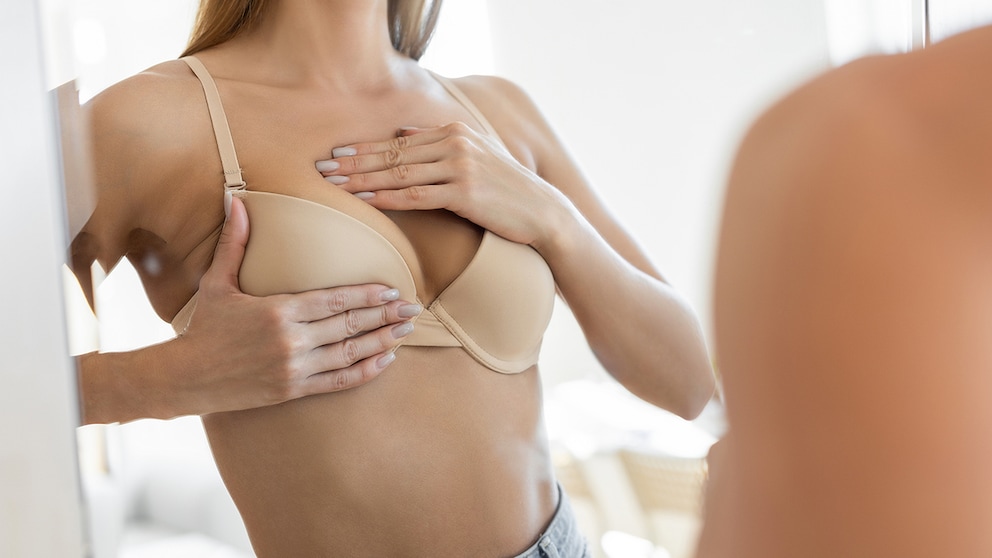
Knowing your own breasts can help you notice changes more quickly. It’s crucial not to focus solely on a possible lump. Skin and nipples, as well as the size and shape of the breast, can also show abnormalities.
However, self-exams have their limits. Especially in the early stages, breast cancer may not cause noticeable symptoms. Additionally, a tumor can be so small or located in such a way that it cannot be felt with the fingers.5
Mammography Can Detect Changes Earlier
This is where mammography comes into play. During the examination, breast tissue is imaged using low-dose X-rays. This can reveal noticeable changes long before they can be felt as a lump. Therefore, self-exams do not replace the recommended mammography screening.
A family history is also not a prerequisite for developing breast cancer. According to the World Health Organization (WHO), about 80 percent of breast cancer cases occur in women who have no specific risk factors other than gender and age.
For Lucy Davis, It Wasn’t a Classic Lump
The case of British actress Lucy Davis currently illustrates how inconspicuous such a change can be. The 53-year-old, known from “The Office” and “Shaun of the Dead,” publicly revealed that she has stage IV breast cancer. According to her, the disease has now spread to her spine, right hip, and ribs.6

Davis initially did not feel a classic lump. In an Instagram post, she wrote: “The first lump I felt was technically not a lump, but rather a hardened area. Really tiny. I almost didn’t have it checked. That’s why I want to say: Don’t ignore anything—get everything checked.”