


August 12, 2025, 6:07 pm | Read time: 7 minutes
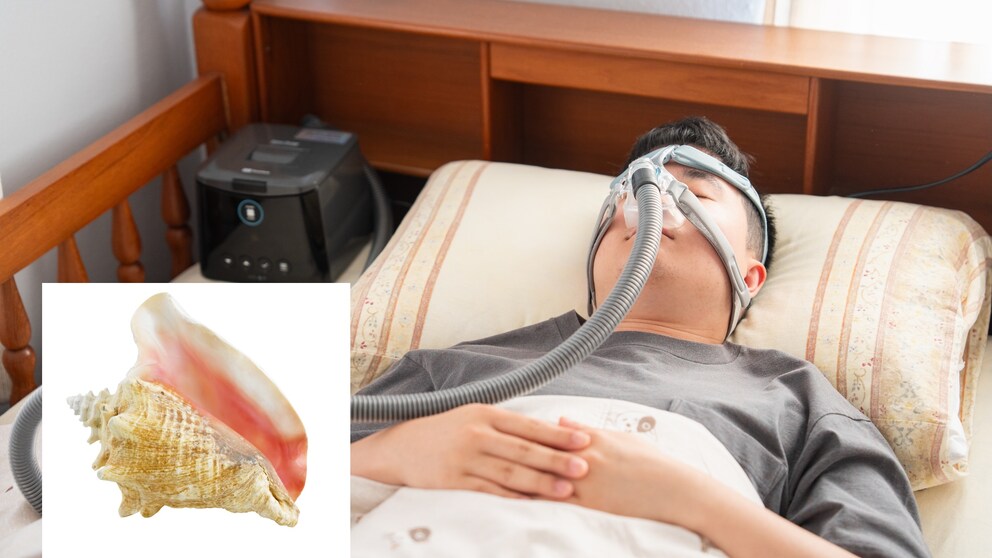
Can an ancient ritual from Indian culture alleviate a modern sleep disorder? A new clinical study has investigated just that—with surprising results. Participants in a study with sleep apnea noticeably benefited after just six months of regularly blowing a conch shell, known as Shankh or Conch. Daytime sleepiness, sleep quality, and breathing interruptions improved—all without device therapy.
Blowing a Conch Shell Against Sleep Apnea—What Researchers Wanted to Know
Obstructive sleep apnea syndrome (OSAS) is widespread globally, with up to 14 million affected in Germany.1 OSAS leads to severe daytime sleepiness, poor sleep quality, and long-term cardiovascular risks due to repeated breathing interruptions during sleep. While CPAP therapy (continuous positive airway pressure) is highly effective, many affected individuals do not accept or regularly use it. This is especially the case in mild to moderate cases. Alternative therapies such as mandibular advancement devices, positional aids, or surgeries often show limited effectiveness.
There are indications that targeted training of the upper airway muscles can alleviate OSA symptoms. This includes playing wind instruments or specific breathing exercises. Against this backdrop, the effect of a traditional yoga technique—the blowing of a Shankh (a spiral-shaped conch shell)—on sleep apnea was studied in India. The aim was to examine the effects of this specific breathing exercise on daytime sleepiness, sleep quality, and breathing interruptions in people with moderate OSAS.
Sleep Apnea—Symptoms and Causes
People with sleep apnea snore. This can manifest as a noticeably dry mouth in the morning. Due to apnea (translated: “non-breathing”), affected individuals frequently stop breathing for up to ten seconds at a time during sleep. During this time, they are awake without consciously realizing it. Symptoms of sleep apnea can therefore include microsleep during the day because affected individuals do not properly recover at night. Many of them, for example, find it difficult to concentrate at work and often have headaches. The exhausting syndrome can reduce quality of life and lead to various health consequences, such as loss of libido. Untreated sleep apnea can reduce life expectancy by an average of about ten years.2
The physical cause of sleep apnea or snoring is a narrowing of the throat. There are many known risk factors for this, such as advancing age, as the muscles in the throat become increasingly slack over the years. Genetic factors are also considered, as there are often multiple sleep apnea sufferers in families. However, the specific factors have not yet been thoroughly researched. The condition can also be based on past strokes, neurodegenerative diseases, or inflammatory brain diseases.3
Also interesting: How to Prevent Sleep Apnea
Conch Shell or Breathing Exercises—How the Direct Comparison Went
The prospective, randomized, controlled study was conducted at the Eternal Heart Care Centre and Research Institute in Jaipur, India.4 A total of 38 adults with newly diagnosed moderate sleep apnea syndrome participated. Half practiced Shankh blowing for 15 minutes five times a week over six months. The remaining 19 study participants practiced deep breathing exercises without the Shankh in the same rhythm. Eight people dropped out during the study.
Blowing a conch shell—whether as a Conch or Shankh—is an ancient practice with both practical and spiritual significance. The technique requires some practice and is similar to blowing into a brass instrument (like a trumpet or trombone). In Hinduism, blowing a Shankh is considered a proclamation of divine presence. In other cultures, such as in Japan, Tibet, or Polynesia, the conch is used as a horn.
Results: What 15 Minutes of Training for 6 Months with the Conch Shell Changed
The results show a significant improvement in the Shankh group. Improvements were measured using specific scales designed to objectively assess the extent of sleep problems.
- Daytime sleepiness, measured with the Epworth Sleepiness Scale (ESS), decreased from 14.6 to 9.6 points—a reduction of 34 percent. In the control group practicing deep breathing exercises, the change was only –0.31 points.
- Sleep quality, measured with the Pittsburgh Sleep Quality Index (PSQI), also improved with Shankh blowing: The PSQI score dropped by 1.8 points. The control group showed a slight deterioration.
- The number of nightly breathing interruptions per hour, the Apnea-Hypopnea Index (AHI), significantly decreased in the Shankh group by –4.4 events per hour. In the control group, an increase was observed. The reduction was particularly pronounced in the REM sleep phase (–21.8 percent).
- There was also an improvement in nighttime oxygen saturation.
- Finally, the study showed a significant reduction in neck circumference in the Shankh group. This suggests that structural changes may have occurred in the upper airway area due to the training—a sign of so-called “airway remodeling.”
Conch Shell Blowing Apparently Strengthens Muscles Crucial for Sleep Apnea
Blowing a Shankh requires exhaling with targeted pressure and controlled breathing. This particularly trains the muscles in the mouth and throat area, tongue and soft palate, as well as the auxiliary respiratory muscles in the chest and neck area. According to the study authors, regular training leads to better stability of the upper airways, making them less likely to collapse during sleep—a main mechanism in obstructive sleep apnea syndrome.
The strengthened muscles make the throat more resistant to collapsing during sleep—especially in the critical REM sleep phases, where many breathing interruptions occur. This could explain the significant reduction in the Apnea-Hypopnea Index (AHI). The breathing technique in Shankh blowing involves deep inhalation and powerful, controlled exhalation. This not only improves lung ventilation but also stabilizes breathing patterns, which can positively affect nighttime breathing. The improved oxygen saturation suggests that overall breathing became more efficient—likely due to fewer breathing interruptions and better breathing depth.
What Do the Results Mean?
The study shows for the first time that regularly blowing a Shankh can be an effective non-pharmacological therapy option for moderate obstructive sleep apnea syndrome. The clinically significant improvements in daytime sleepiness, sleep quality, and breathing interruptions suggest that targeted respiratory muscle training—similar to instruments like the didgeridoo—can achieve functional stabilization of the upper airways.
Especially for people who do not tolerate CPAP or whose symptoms are not severe enough for device therapy, this method offers a simple, cost-effective, and culturally rooted alternative. Additionally, adherence was high, the implementation had few side effects, and the technique was easy to learn. Changes in body measurements—such as a reduction in neck circumference—also suggest possible structural adaptations.
Given the central role of breathing interruptions in the REM sleep phase for the risk of cardiovascular complications, the effects shown here could be significant beyond symptom relief.
Pill Instead of CPAP? New Study Offers Hope for Sleep Apnea Patients

If This Happens at Night, the Risk of Erectile Dysfunction Increases
Study Assessment and Possible Limitations
This study represents an innovative contribution to non-invasive OSAS therapy. The use of a traditional instrument for respiratory muscle strengthening is unique and was methodically and carefully implemented. The randomized controlled structure, use of validated measurement tools, and objective polysomnography enhance its credibility.
However, there are limitations: It was an open study, so some influence of expectations cannot be ruled out. Additionally, the sample size was small, and only one center in India was involved. Therefore, the results are considered indicative but not yet generalizable. Possible influencing factors, such as physical activity outside the intervention, were also not systematically recorded.
Conclusion
The present study shows that blowing a traditional Shankh shell over six months leads to significant improvements in sleepiness, sleep quality, and breathing interruptions in people with moderate sleep apnea. The method is simple, culturally accepted, and could be an interesting treatment option, especially for those without access to or acceptance of CPAP. Further larger studies are needed to confirm the findings and better understand the underlying mechanisms.