


August 28, 2026, 4:03 pm | Read time: 7 minutes
The pancreas often only becomes noticeable when something is wrong. The signs can be surprisingly varied: changes after eating, weight loss, or unusual stools are just as much a part of it as unusually strong thirst. Such symptoms may indicate pancreatic insufficiency. A closer look reveals how it can be recognized and why the symptoms can vary so much.
Small Organ, Big Task: What the Pancreas Does
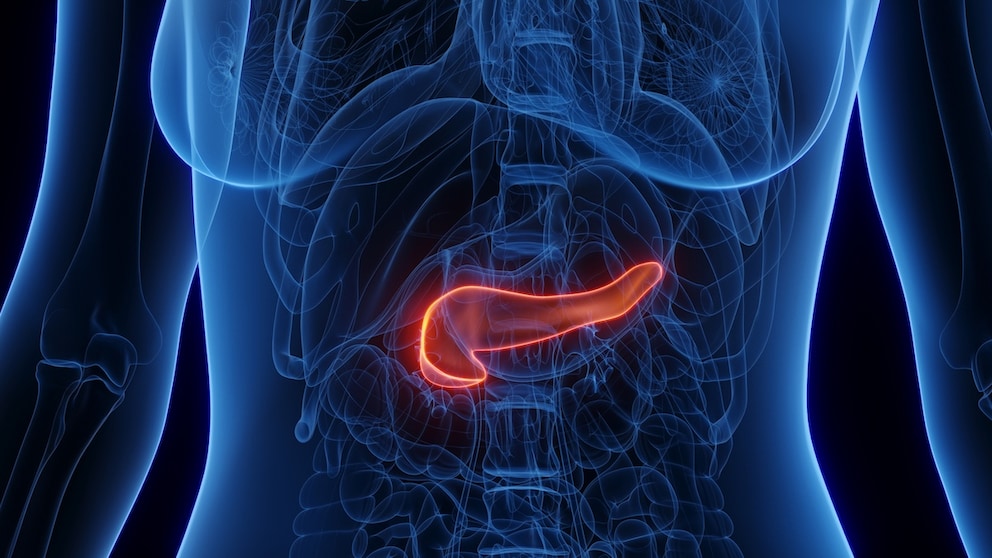
The pancreas, also known as the pancreas, is about 12 to 18 centimeters long and is located in the upper abdomen behind the stomach. It performs two important tasks: it aids digestion and produces hormones that regulate blood sugar.
For digestion, the organ produces about 1.5 to 2 liters of digestive juice daily. This contains enzymes that break down fats, proteins, and carbohydrates from food, allowing nutrients to be absorbed through the intestines. Doctors refer to this part of its work as the exocrine function.1
In addition, the pancreas produces hormones such as insulin and glucagon. Insulin helps transport sugar from the blood into the body’s cells, thereby lowering blood sugar levels. Glucagon ensures that more sugar is available when needed. The production of these hormones is referred to as the endocrine function.
When the Pancreas Falters: What’s Behind It
In pancreatic insufficiency, the pancreas can no longer adequately perform one or both of these tasks.
If digestive enzymes are primarily lacking, it is called exocrine pancreatic insufficiency. If the production of hormones that regulate blood sugar is impaired, it is called endocrine pancreatic insufficiency. Both forms can also occur simultaneously.
These Symptoms Can Be Noticed After Eating
In exocrine pancreatic insufficiency, food is no longer adequately digested. The processing of fat, in particular, can suffer. At the same time, the body absorbs nutrients less effectively.
Possible signs include:
- Weight loss
- Feeling of fullness, often about 30 to 60 minutes after eating
- Bloating
- Abdominal pain
- Noticeable fatty stools
Changes in stool can be particularly noticeable. If fat is not adequately digested, some of it remains in the intestines and is excreted. The so-called fatty stool can be voluminous, sticky, and particularly foul-smelling.
The tricky part is that symptoms do not necessarily appear early. Typical symptoms of exocrine pancreatic insufficiency may only show when about 90 percent of the corresponding organ function has already failed.2
Why the Pancreas Can Lose Its Function
Pancreatic insufficiency can have various causes. These include chronic inflammation of the pancreas, pancreatic cancer, surgical procedures on the organ, and the hereditary disease cystic fibrosis.
In chronic pancreatitis, recurrent bouts of inflammation occur. This can increasingly damage the cells of the pancreas, gradually reducing its performance.
A tumor can also impair function. If it blocks the pancreatic duct, digestive juice can back up, leading to inflammation and tissue damage.3
In cystic fibrosis, the secretions of certain glands are particularly viscous. If it clogs the pancreatic duct, the digestive function can initially be impaired. As the disease progresses, hormone production may also decrease.
When the Pancreas Suddenly Becomes Inflamed
In addition to chronic pancreatitis, there is also acute pancreatitis. This involves a sudden bout of inflammation that can cause severe symptoms and temporarily impair the organ’s function. The pancreas can fully recover afterward.
About 55,000 people are diagnosed with acute pancreatitis each year. Men are slightly more affected than women, and the age of onset is usually over 45 years.4
Gallstones Can Trigger Inflammation
The most common cause of acute pancreatitis is gallstones. In many people, the bile duct and the pancreatic duct empty into the intestine at the same point. If a gallstone blocks this area, the secretions cannot flow properly.
The backup can cause digestive enzymes to activate prematurely and damage the pancreatic tissue, leading to inflammation.
Heavy alcohol consumption is the second most common cause of acute pancreatitis. Other possible risk factors include elevated levels of certain blood fats, known as triglycerides, and elevated calcium levels in the blood. Less commonly, viral infections or certain medications may be triggers. In about 10 percent of cases, no clear cause can be identified.
These Pains Are a Serious Warning Sign
Acute pancreatitis often manifests as severe pain in the upper abdomen. These can spread in a belt-like fashion and radiate to the back.
Other possible symptoms include:
- Nausea and vomiting
- Fever
- Circulatory problems
- A bloated, rubbery abdomen
In four out of five patients, the inflammation subsides with treatment after about one to two weeks. However, about 20 percent of cases involve severe complications and can lead to a months-long recovery process. Possible complications include severe organ damage or a bacterial infection of the pancreas. About 3 percent of those affected die from complications of acute pancreatitis.
Severe upper abdominal pain with accompanying symptoms should therefore be promptly evaluated medically.
A Stool Test Can Provide an Important Clue
If there is suspicion that the pancreas is no longer producing enough digestive enzymes, the symptoms and medical history are first considered. Fatty stools, diarrhea, or problems with fatty foods can provide important clues.
A key test is a stool sample, which can determine the so-called pancreatic elastase. This is a digestive enzyme produced by the pancreas. A low level may indicate that the organ is no longer functioning adequately.
Depending on the symptoms, further tests may follow. Blood tests and imaging procedures such as ultrasound, computed tomography, or magnetic resonance imaging help identify inflammation, tumors, calcifications, or changes in the ducts. An endosonography may also be used, where the pancreas is examined with a small ultrasound probe brought close to the organ via the digestive tract.
When Blood Sugar Suddenly Becomes a Problem
Pancreatic insufficiency does not have to manifest through digestive issues. If the organ’s hormone production is impaired, blood sugar levels can become unbalanced instead.
Insulin is of particular importance. If the pancreas no longer produces enough of it, too much sugar remains in the blood, potentially leading to diabetes mellitus.
Possible signs of high blood sugar include:
- Unusually strong thirst
- Frequent urination
- Fatigue
- Lack of energy
The production of glucagon can also be impaired. If this hormone is lacking, the risk of hypoglycemia increases. The medical term for this is hypoglycemia.
Possible causes of this form of pancreatic insufficiency include chronic inflammation, pancreatic cancer, and surgical procedures on the organ. In type 1 diabetes, the immune system also attacks the insulin-producing cells of the pancreas.

Which Value Is More Indicative: Cholesterol or Triglycerides?

Bitter compounds can protect against obesity and diabetes
These Blood Values Provide Insight
Whether blood sugar regulation is impaired can be determined through blood tests. An important value is fasting blood sugar, which measures how much sugar is in the blood after a longer period without food. A level of 7.0 millimoles per liter or 126 milligrams per deciliter meets a diagnostic criterion for diabetes.
The so-called HbA1c value can also be examined. It provides a simplified indication of how high blood sugar has been over a longer period. A value of 6.5 percent or higher also meets a diagnostic criterion for diabetes.
A pronounced insulin deficiency can become dangerous if untreated. Severely elevated blood sugar levels can cause significant fluid loss and life-threatening metabolic imbalances.
What Can Be Done About Pancreatic Insufficiency
Treatment depends on which function of the pancreas is impaired and what is causing it. If the cause can be treated, it is the initial focus. Stones or narrowings in the duct can, for example, be removed or widened in certain cases through an endoscopic procedure.5
When Digestive Enzymes Are Missing
If the pancreas produces too few digestive enzymes, they can be replaced with medication. These preparations are taken with meals and help digest fats, proteins, and carbohydrates.
Impaired fat digestion can also affect the absorption of fat-soluble vitamins A, D, E, and K. If a deficiency occurs, vitamin replacement may also be necessary.
Exocrine pancreatic insufficiency is not curable. However, avoiding nicotine and alcohol can help reduce important risk factors.
When the Pancreas Lacks Insulin
If hormone production is impaired and the body does not have enough insulin, insulin therapy may be necessary. Blood sugar must be regularly monitored and treatment adjusted accordingly. In very rare cases, a pancreas transplant may be considered.
Symptoms Alone Are Not Enough for Diagnosis
Noticeable stool, weight loss, recurring digestive problems, or unusually strong thirst can indicate a pancreatic disorder but also have other possible causes. Whether pancreatic insufficiency is actually present can only be determined through medical examinations.