

November 23, 2026, 3:30 am | Read time: 10 minutes
Millions of people suffer from worn-out joints, with knees and hips being particularly affected. A new minimally invasive procedure aims to alleviate pain in knee osteoarthritis and possibly even delay joint replacement. However, the scientific results give cause for skepticism. What is behind knee joint embolization? Chief physician Prof. Thomas Kälicke, an orthopedic surgeon and trauma surgeon, explains to FITBOOK why he is not yet convinced by the new therapy.
I Try to Preserve Joints as Long as Possible
As an orthopedic surgeon and trauma surgeon, I have been dealing with the condition of osteoarthritis for decades. For many affected individuals, it marks a gradual loss of quality of life and independence.
I try to preserve joints as long as possible. And when osteoarthritis is too advanced, I replace them with artificial joints. That’s my daily business. This makes new procedures that promise to relieve pain and possibly delay surgery all the more interesting. One of these is the so-called genicular artery embolization, or GAE. In this procedure, tiny blood vessels around the knee joint are deliberately closed to reduce inflammation in the joint. Initially, this sounds quite promising. But does the procedure deliver on its promise?
Osteoarthritis Is Much More Than Simple Joint Wear
To understand this, we first need to look at what happens in osteoarthritis. Many people imagine joint cartilage like the tires of a car. The more miles driven, the more the tread wears down. Eventually, the tire is bald. This comparison is not entirely wrong, but it only partially explains osteoarthritis.
Osteoarthritis is a degenerative disease of the entire joint. Numerous factors contribute to its development: age, genetic predisposition, misalignments, previous injuries, obesity, weak muscles, and metabolic disorders. Above all, we now know that osteoarthritis has not only a mechanical but also an inflammatory component. This insight is crucial for understanding embolization.
Once Cartilage Is Lost, It Usually Does Not Grow Back
Our joint cartilage is a fascinating high-performance tissue. In the knee, it is only a few millimeters thick and yet must absorb multiple times our body weight with each step. The amazing thing: It has no blood vessels of its own. And it has no nerves either. Therefore, the cartilage itself cannot hurt. How is a tissue without blood supply nourished? Through the joint fluid. Nutrients reach the cartilage by diffusion. Movement helps with this.
Imagine the cartilage like a sponge. Under pressure, it is compressed, and fluid is squeezed out. When relieved, it expands again and absorbs fresh joint fluid with nutrients. Load, unload. Over and over.
That’s why I tell my patients: Movement is not a burden for your cartilage that you should generally avoid. It is an important prerequisite for its nourishment. The right dosage and regular alternation between loading and unloading are crucial. The problem is: Once cartilage is lost, it usually does not grow back. Its regenerative capacity is extremely low. And this often starts a vicious cycle.
When the Joint Lining Catches Fire
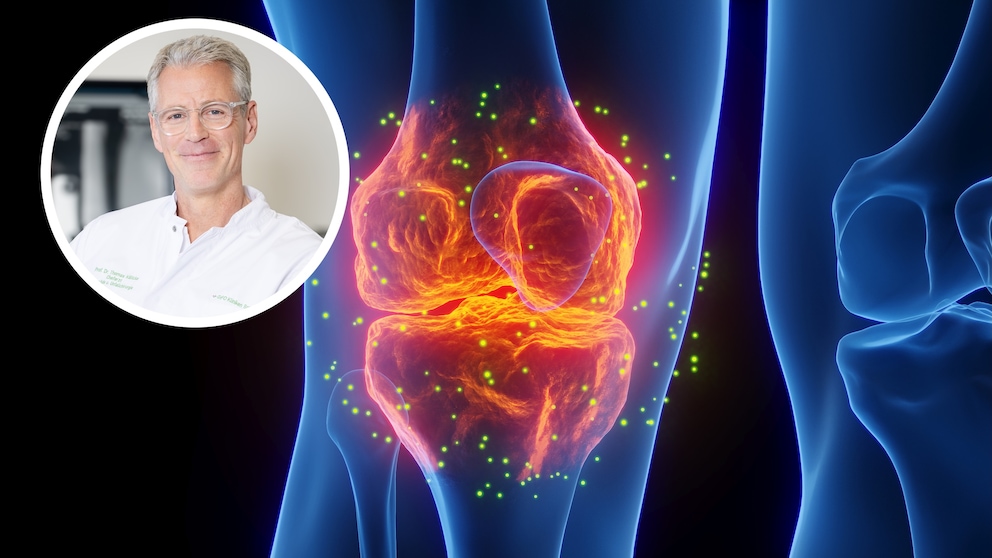
In osteoarthritis, the cartilage becomes rough, cracks form, and small cartilage particles can detach. These irritate the joint lining, the so-called synovium. Unlike cartilage, this lining is well supplied with blood and nerves. If it reacts to damage with inflammation, we speak of synovitis. The lining swells, more joint fluid is produced, and the knee can become swollen, warm, and painful. At the same time, inflammatory messengers are released, which in turn promote cartilage breakdown. A vicious cycle: Cartilage damage promotes inflammation, and inflammation accelerates cartilage damage.
External influences also play a role. Especially the fat tissue in the abdominal area is hormonally active and releases inflammatory messengers. Therefore, being overweight harms the joints doubly: through additional mechanical stress and by promoting inflammatory processes. This is one of the most important therapeutic levers in osteoarthritis. And this is exactly where embolization comes in.
What Exactly Is Done in Embolization
In a chronically inflamed joint lining, additional small blood vessels can form. We call this process neovascularization. Such newly formed vessels are associated with inflammatory changes and sometimes with the ingrowth of pain-conducting nerve fibers.
The idea behind embolization is to deliberately close these pathologically increased vessels. An interventional radiologist inserts a thin catheter through an artery, usually in the groin, to the small vessel branches at the knee joint. Tiny particles are then introduced to close selected vessels. This is intended to reduce the increased blood flow to the inflamed joint lining. The hope is that the inflammation will subside and, with it, the pain. The procedure is usually performed under local anesthesia and does not require opening the knee joint.
Procedure Does Not Replace a Destroyed Meniscus
The idea is certainly appealing. But one thing must be made clear: Embolization does not treat the actual cartilage damage. It neither corrects a bow-legged meniscus nor replaces a destroyed meniscus. And it does not make new cartilage grow. It targets only a possible partial mechanism of pain, namely the inflammatory changes in the joint. Whether this approach actually works must be shown by science.
The First Studies Gave Hope
A meta-analysis published in August 2026 by Alves and colleagues examined 18 studies with a total of 534 patients.1 The result sounds impressive: On a pain scale from zero to ten, complaints decreased by about four points on average after one month. Even after three, six, and twelve months, patients reported significant improvements. Those who previously had severe knee pain and then experienced significantly less discomfort naturally gain a real improvement in quality of life.
Further studies similarly came to positive results. A large meta-analysis from 2026, which evaluated 45 studies with a total of 2,205 patients, also found clinically relevant improvements in pain and joint function.2 One might think: The procedure works. But unfortunately, it’s not that simple.
The Crucial Catch: What Happens Without Real Embolization?
Many of the positive studies have a fundamental methodological problem. They compare patients’ complaints before and after treatment. What is often missing is a suitable control group. This is crucial because pain is not a fixed quantity. Especially in osteoarthritis, it fluctuates significantly. There are good and bad phases. A patient often comes for treatment when their complaints are particularly severe. That they feel better a few weeks later can also be part of the natural course of the disease.
Additionally, the placebo effect, which should not be underestimated, especially in invasive procedures, comes into play. A patient undergoes a complex procedure, is treated by specialists, has a catheter inserted, and expects improvement. All of this can influence their perception of pain.
To determine whether embolization actually has an additional effect, so-called sham-controlled studies are needed. In these, patients are randomly assigned to two groups. One receives the real embolization. In the other, a comparable procedure is performed without actually closing the intended vessels. Ideally, the patient does not know which group they belong to. And these studies so far deliver sobering results.
Real Embolization and Sham Treatment: Hardly a Difference
A Dutch research group led by van Zadelhoff studied 58 patients with mild to moderate knee osteoarthritis.3 Each group of 29 received either a real embolization or a sham treatment. After four months, pain had significantly improved in both groups. In the embolization group, the pain score improved by 21.4 points; in the control group, by 18.4 points. The difference was just three points on a scale of zero to one hundred and was not statistically significant.
Particularly interesting is the follow-up after twelve months, published in 2026.4 Even a year after the procedure, there was no statistically significant difference between the two groups. Moreover, the researchers used MRI to investigate whether embolization could actually reduce inflammation of the joint lining. They found no convincing evidence for this. Ironically, the biological mechanism through which the procedure is supposed to work could not be confirmed in this study.
Another meta-analysis from September 2026 evaluated the results of three sham-controlled randomized studies together.5 Here, too, there was no statistically significant advantage of real embolization over sham treatment. This does not mean that it has been definitively proven that embolization has no additional benefit for any patient. The previous controlled studies are too small, and the treatment techniques too varied for that. But it does mean that a specific additional benefit has not yet been convincingly demonstrated. This proof would be necessary to broadly recommend the procedure.
Is the Procedure at Least Safe?
This question must also be asked. Embolization is considered minimally invasive. Minimally invasive does not mean risk-free, however. Reported complications include bruising at the puncture site, temporary skin discoloration, and sensory disturbances. Unwanted vessel closures are also possible.
A meta-analysis from 2026 draws particular attention to individual cases of localized bone necrosis detected by MRI after the use of certain permanent embolization particles.6 This involves damage to the bone due to impaired blood supply. How often such changes actually occur and what long-term significance they have is not yet sufficiently clarified. Nevertheless, this point should give pause. After all, we are talking about a procedure in which blood vessels are deliberately closed without its additional clinical benefit having been convincingly demonstrated. A careful benefit-risk assessment is therefore indispensable.

Arthritis: Signs of the Incurable Disease and How to Prevent It

Do You Have Osteoarthritis? What to Watch for in Your Diet
What Really Helps with Knee Osteoarthritis?
Despite all the enthusiasm for new medical procedures, we should not lose sight of proven treatment options.
Osteoarthritis is multifactorial. Therefore, it also requires treatment that addresses multiple areas.
- Regular, appropriately dosed exercise is of central importance. It promotes cartilage nourishment and maintains joint function.
- Strong muscles stabilize the knee, improve joint guidance, and help absorb stress.
- A normal body weight relieves the joint. Especially reducing excess abdominal fat can positively influence inflammatory processes.
- A balanced, anti-inflammatory diet can also be a useful component. It does not replace medical therapy but can help reduce overweight and metabolic disorders.
- Depending on the stage of osteoarthritis, pain medications, targeted physiotherapy, injections, and joint-preserving surgeries may be considered for suitable patients.
- In cases of pronounced leg misalignments, an axis correction may be useful to better distribute the load in the joint.
- When cartilage is largely lost, symptoms are severe, and conservative measures are no longer sufficient, artificial joint replacement is a proven and very successful treatment option.
Conclusion: Embolization Does Not Convince Me So Far
I welcome any new treatment option that can help our patients reduce pain, maintain mobility, and delay joint replacement as long as possible. Embolization for knee osteoarthritis also deserves a fair scientific examination. The theoretical concept is understandable: Inflammation plays an important role in osteoarthritis, and the pathological formation of new blood vessels could contribute to pain development in certain patients.
But we must distinguish between a plausible theory, an observed improvement, and scientifically proven efficacy. And at this point, embolization does not convince me so far.
If patients experience significantly less pain after a procedure, but achieve almost the same improvement after a sham treatment, one cannot derive a confirmed therapeutic benefit of the actual procedure from this.
Perhaps in the future, it will be possible to identify those patients who truly benefit. Perhaps better embolization materials and more precise techniques will be developed. For this, we need larger, methodologically sound studies with sufficiently long follow-up. Until then, I consider a broad application outside of controlled studies premature.
And one more thing is important to me: Even a minimally invasive procedure should only be performed after a careful benefit-risk assessment. Patients need to know what benefits we can actually demonstrate, what risks exist, and what questions remain open. If, despite exhausted conservative treatment, an artificial joint is ultimately required for advanced knee osteoarthritis, then this step should not be postponed indefinitely just because of the promise of a new procedure.
After all, we do not treat X-rays, study results, or technical possibilities. We treat people. And their quality of life should always be the focus.