


May 18, 2026, 2:48 am | Read time: 9 minutes
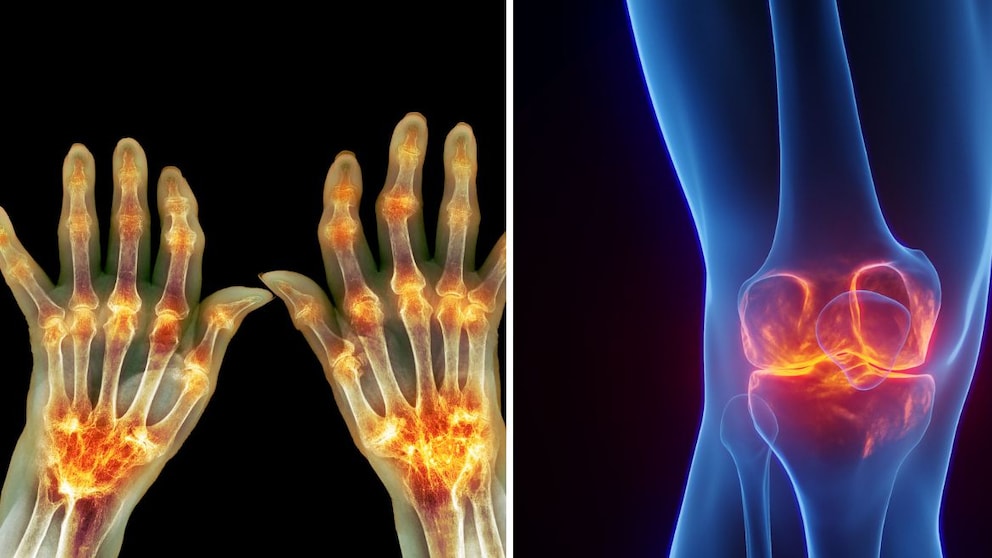
Arthritis and arthrosis—both start with the same letter. And if we’re honest, they sound similar at first glance. But while one refers to inflammatory joint diseases, the other describes a painful, incurable wear and tear of the joint cartilage. Learn about the causes and symptoms of both here.
What Is Arthritis?
Arthritis is a collective term for inflammatory joint diseases. The word comes from Greek: “arthron” means joint, and “-itis” stands for inflammation. That’s exactly what happens with arthritis: an inflammatory reaction occurs in the joint.
The inflammation not only attacks the joint itself. The synovial membrane, surrounding tendons, or bursae can also be affected. If left untreated, the inflammation can damage cartilage, bone, and thus the joint’s mobility over time. Arthritis can occur anywhere in the musculoskeletal system—from fingers to the spine. Hands, fingers, knees, or feet are particularly often affected.1
Doctors Distinguish Between Different Forms of the Disease
They refer to monoarthritis when only a single joint is affected. If several joints are inflamed, it is called oligoarthritis or polyarthritis, depending on the number. Arthritis can also be acute or chronic. Some symptoms appear suddenly within a few hours or days. Others develop gradually over weeks or months.2
Particularly insidious: Inflammatory joint diseases often affect not only older people. Younger adults and, in rare cases, even children can also be affected. Juvenile idiopathic arthritis is considered the most common rheumatic disease in childhood and adolescence.
Many affected individuals initially notice nonspecific symptoms. Fingers feel stiff in the morning, opening a bottle is difficult, or joints suddenly appear swollen. This is why arthritis is often initially mistaken for overuse or normal signs of aging.
What Causes Arthritis?
Arthritis can have a variety of triggers:
Autoimmune Diseases
The most well-known form is rheumatoid arthritis, also called chronic polyarthritis. In this case, the immune system mistakenly attacks the body’s own tissue. The inflammation attacks joints and can damage cartilage and bone over time.
It is typical for symptoms to often begin in the small finger and toe joints. Often, both sides of the body are affected simultaneously.
Women are more frequently affected than men. According to the German Rheumatism League, the disease usually begins after the age of 50 but can occur at any age.
Infections
Bacteria, viruses, or fungi can also trigger joint inflammation. Bacterial arthritis is particularly feared because it can worsen rapidly.
The pathogens enter the joint either through the bloodstream or directly from the outside—for example, through injuries, surgeries, or joint injections.
Metabolic Disorders
Metabolic disorders such as gout can also cause arthritis. In this case, uric acid crystals deposit in the joint and trigger inflammation there.3
What Symptoms Indicate Arthritis?
The severity of symptoms depends, among other things, on the cause and course of the disease. Some people experience sudden severe pain within a few days, while others struggle with gradually increasing symptoms over months.
Inflammatory joint diseases often occur in flares. This means: Phases of more severe symptoms are followed by times when symptoms can temporarily improve.4
Classic Signs of Inflammation
Typical signs include swelling, redness, warmth, tenderness, and limited mobility.
Many affected individuals also report pronounced morning stiffness. The joints feel immobile for a long time after getting up. Unlike arthrosis, the symptoms often do not improve immediately with movement.
Some people also experience general symptoms such as:
- Fatigue,
- Exhaustion,
- Fever,
- Night sweats
- or weight loss.
Rheumatoid arthritis, in particular, affects not only individual joints but can also influence the entire body. In severe cases, organs such as the lungs, heart, or eyes can also be involved.
How is Arthritis Diagnosed?
To determine the cause of the symptoms, the doctor combines various examinations. First, the medical history is taken: When do the pains occur? Which joints are affected? Are there any pre-existing conditions or family history? This is followed by a physical examination. Swollen or warm joints provide important clues.
In addition, imaging techniques such as ultrasound, X-rays, MRI, or CT may be used. Blood tests also play an important role. In these tests, inflammation markers such as CRP or specific antibodies are determined.
How is Arthritis Treated?
Treatment should begin as early as possible. Untreated inflammation can permanently damage joints. Especially in rheumatoid arthritis, early therapy is considered crucial to positively influence the course of the disease.
The therapy depends on the cause. In bacterial infections, the pathogens must be combated as quickly as possible—usually with antibiotics.
In rheumatoid arthritis, controlling the inflammation is the focus. The goal is to prevent permanent joint damage. Anti-inflammatory medications, cortisone, so-called basic medications, biologics, as well as physical and occupational therapy are used.
Early treatment is important. Experts believe that the first few months can be particularly decisive in how much the disease progresses later.
What is Arthrosis?
Arthrosis is one of the most common joint diseases. In Germany alone, millions of people are affected. The disease often begins after the age of 50. Women are slightly more frequently affected than men, which experts partly attribute to hormonal changes during menopause.5
Many affected individuals hardly notice the disease at first. The symptoms develop slowly and are therefore often ignored for a long time. Initially, the knee only hurts after long walks, the fingers feel stiff in the morning, or the hip acts up after getting up. Over time, even everyday movements can become increasingly difficult.
Unlike arthritis, arthrosis does not primarily result from inflammation but from changes in the joint cartilage.
Arthrosis is the most common joint disease worldwide. Unlike arthritis, it does not start with inflammation but with the progressive wear and tear of the joint cartilage. Cartilage functions as a smooth protective layer between two bones. It ensures that movements run as smoothly as possible and absorbs shocks.
If this cartilage becomes thinner or is destroyed, bone surfaces increasingly rub against each other. This causes pain, stiffness, and movement restrictions. Arthrosis occurs particularly often in the knees, hips, fingers, and spine.
How Does Arthrosis Develop?
The most important risk factor is age. Over a lifetime, joints have to absorb enormous loads. The knee joint absorbs several times the body weight with each step. The hips, ankles, and spine are also exposed to high forces daily. Over the years, the cartilage metabolism changes, resilience decreases, and the cartilage wears down.6
In addition, factors such as being overweight, misalignments, previous injuries, heavy physical strain, lack of exercise, and genetic factors play a role. Inflammatory diseases such as rheumatoid arthritis can also promote so-called secondary arthrosis in the long term.
Typical Symptoms of Arthrosis
Many affected individuals initially describe arthrosis as an unpleasant pulling or tension. Only over time do noticeable pains develop.
It is characteristic that the symptoms usually intensify slowly. Unlike inflammatory joint diseases, arthrosis often begins inconspicuously and is therefore underestimated for a long time. Arthrosis usually develops gradually.
An early warning sign is the so-called start-up pain. After sitting for a long time or in the morning after getting up, the joint hurts during the first movements. The symptoms often improve after a short time. Later, pain occurs mainly under stress—for example, when walking, climbing stairs, or carrying.7
In advanced stages, permanent pain, limited mobility, joint stiffness, muscle tension, and swelling can occur. Sometimes an arthritic joint becomes additionally inflamed. Doctors then speak of activated arthrosis. The joint becomes warm, swells, and hurts more.
How is Arthrosis Diagnosed?
The diagnosis is not always immediately clear. Joint pain can have many causes—from overuse to inflammation to injuries. Therefore, the doctor first tries to find out when the symptoms occur, how long they last, and whether certain movements worsen the pain.
The diagnosis also begins with a conversation and a physical examination. Unlike arthritis, blood values in arthrosis usually do not show typical signs of inflammation. Important clues are provided by imaging techniques such as X-rays, ultrasound, or MRI.
On X-rays, doctors can, for example, see if the joint space has narrowed or if changes have formed on the bone.
What Treatment Helps with Arthrosis?
The treatment mainly depends on how severely the joint is already damaged and how much the symptoms affect daily life. Damaged cartilage cannot yet be fully restored. Therefore, the treatment mainly aims to relieve pain and maintain mobility for as long as possible.
Regular exercise is particularly important. Many experts even see a lack of exercise as a factor that can further promote arthrosis. Joints need to be moved. Only then is the joint fluid evenly distributed, and the cartilage supplied with nutrients.8
Many affected individuals avoid using their joints out of fear of pain—but this can worsen the symptoms in the long run. Movement improves cartilage supply and strengthens the muscles around the joint. Particularly suitable are joint-friendly forms of exercise such as swimming, cycling, Nordic walking, or regular walks. They keep the joints mobile without excessively straining them.
These Sports Should Be Avoided
Less favorable are sports with abrupt stops and quick changes of direction, such as tennis, soccer, or volleyball. These exert high forces on the joints.
Additionally, physical therapy can help strengthen the muscles around the affected joint. Strong muscles stabilize the joints and can reduce pain. Painkillers or anti-inflammatory medications can also be used.
In cases of severely advanced arthrosis, surgery may be necessary, such as an artificial knee or hip joint.

Arthritis: Signs of the Incurable Disease and How to Prevent It

Do You Have Osteoarthritis? What to Watch for in Your Diet
Arthritis vs. Arthrosis–The Key Difference
The key difference lies in the cause: Arthritis is an inflammation, while arthrosis is a wear-and-tear process. Therefore, the pain often differs as well.
In arthrosis, symptoms usually occur initially under stress and often improve after some movement. Arthritis, on the other hand, often causes rest pain and clear signs of inflammation such as swelling, redness, and warmth. However, the boundaries sometimes blur. Arthrosis can become inflamed, which doctors refer to as activated arthrosis. For those affected, the difference is often difficult to recognize.9
When Should Joint Complaints Be Medically Clarified?
Joint pain should be taken seriously if it persists, joints swell, warmth or redness occurs, mobility is significantly restricted, or sudden severe symptoms arise. Fever in connection with joint pain should also be medically clarified. Inflammatory joint diseases, in particular, should be detected as early as possible to prevent permanent damage.