

May 22, 2026, 11:48 am | Read time: 5 minutes
After just a few weeks of training, something unexpected happens: pain. This pattern is something Prof. Thomas Kälicke encounters repeatedly in clinical practice. The specialist in surgery, orthopedics, and trauma surgery says the cause often isn’t where patients expect it. His advice? Patience–and the right training in the right order. What he specifically recommends, you can read here.
We Go All Out, the Body Remembers
When people start exercising again after a long break, a very typical scenario often unfolds. Previously active, then work, daily life, and family took over–exercise took a back seat. Eventually, you stand in front of the mirror and realize: The body has changed. A small belly is there, you feel stiffer, slower, less capable. And then we often make the crucial mistake: We go all out.
Muscles have a kind of memory. My old track and field coach used to say, “Muscles never forget.” And that’s exactly how it is! Even after long breaks, muscles respond surprisingly quickly to new training stimuli. They are well-supplied with blood, efficiently nourished, and can adapt quickly. Strength and performance often increase significantly in a short time.
Why Tendons React More Slowly
Tendons, on the other hand, play by completely different rules. They have poorer blood supply, their metabolism is slower, and their adaptation processes are significantly more sluggish. Additionally, structural changes in the tissue can develop over the years. A central mechanism is glycation–a kind of “sugar coating” of protein structures that leads to cross-linking in collagen. The tissue becomes stiffer, less elastic, and more prone to injury.
The problem: While the muscle is ready again, the tendon is not. And this is where it gets tricky. In the first few weeks, training often works surprisingly well despite high intensity. Performance increases quickly, motivation is high–many things even feel better than expected. This gives a false sense of security. Until it tips over.
Also interesting: Chief Physician and Longevity Expert: “I’ve Lived by These 7 Rules for 20 Years”
The Most Dangerous Moment Comes Later
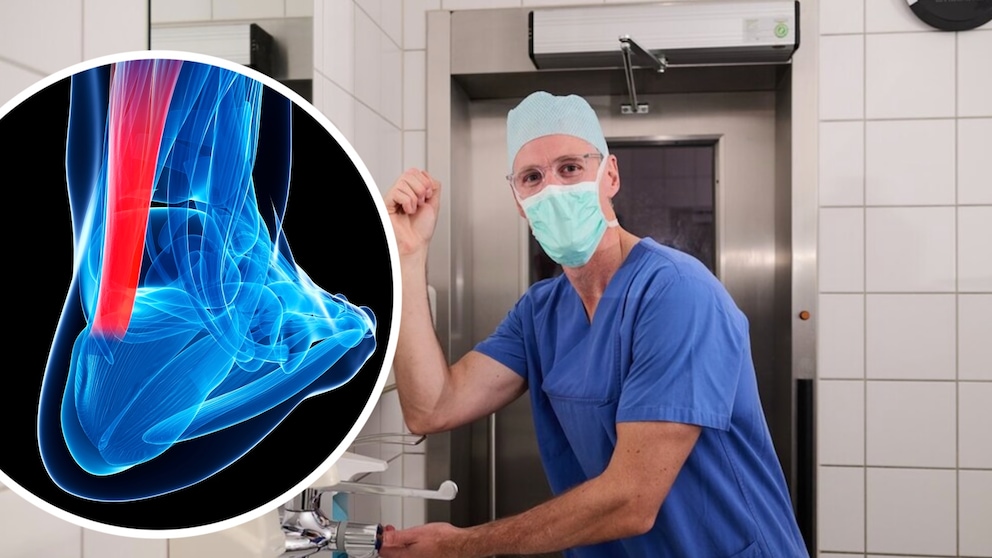
Then come overuse reactions, painful irritations, or in the worst case, structural damage like an Achilles tendon rupture. Even more common are chronic tendon problems that accompany sufferers for months or even years, severely hindering training progress–or in the worst case, leading to the complete abandonment of sports.
“It Popped on the First Sprint!”
In the clinic, I often hear another very typical story–especially with Achilles tendon ruptures. I ask, “How did it happen?” The answer is surprisingly often the same: “I wanted to start exercising again. Played badminton, soccer, or basketball for the first time again…” And then comes the crucial sentence: “It popped on the first sprint.” At that moment, the patient’s Achilles tendon ruptured.
These injuries rarely occur after a gradual, continuous build-up of stress. They often happen exactly when, after a long break, explosive loads suddenly occur again–at the moment when the muscle can perform again, but the tendon is not yet structurally prepared for it.

Chief Physician and Longevity Expert: “I’ve Lived by These 7 Rules for 20 Years”

Germany no longer dies suddenly—we die quietly! This “pill” could prevent it.
Why Patience Is Crucial at the Start
When I coach patients, I deliberately take a different approach. Before we incorporate more intensive training forms like HIIT, the focus in the first few months is almost exclusively on moderate endurance training. For many, this initially seems unspectacular, but a lot actually happens during this phase: Heart pumping capacity increases, metabolism becomes more efficient. But above all, tendons get time to adapt to the new load and become more stable.
This initial phase–where tendons need time to adapt–is crucial. Skipping it risks injury. What also belongs to it: targeted stretching. To specifically reach the tendon tissue, stretches must sometimes be held for minutes instead of 10, 20, or 30 seconds. The tendon needs time!
First Durability, Then Performance
Those who consistently go through this phase lay the foundation for other forms of training that involve significantly higher stress on tendons and joints: training with short, very intense phases of stress, where you consciously push to your performance limit.
If you want to put it in a simple formula: At the beginning, patience is needed. After that, performance becomes possible.
About the Author: Prof. Dr. med. Thomas Kälicke is a specialist in surgery, orthopedics, and trauma surgery with additional qualifications in special trauma surgery, hand surgery, and physical therapy. In early 2011, he became chief physician at the GFO Clinics Bonn at the age of 38. Since 2025, he has also been the chief physician of general surgery at the CURA Hospital in Bad Honnef. In addition to his clinical work, he has been advising and accompanying people for many years who want to change their lifestyle and stay healthy in the long term. As a sought-after speaker, he conveys scientifically sound insights into longevity in an understandable and practical way. He is the author of the book “LNGVTY – LÄNGER – BESSER – LEBEN.”