

September 8, 2026, 11:38 am | Read time: 4 minutes
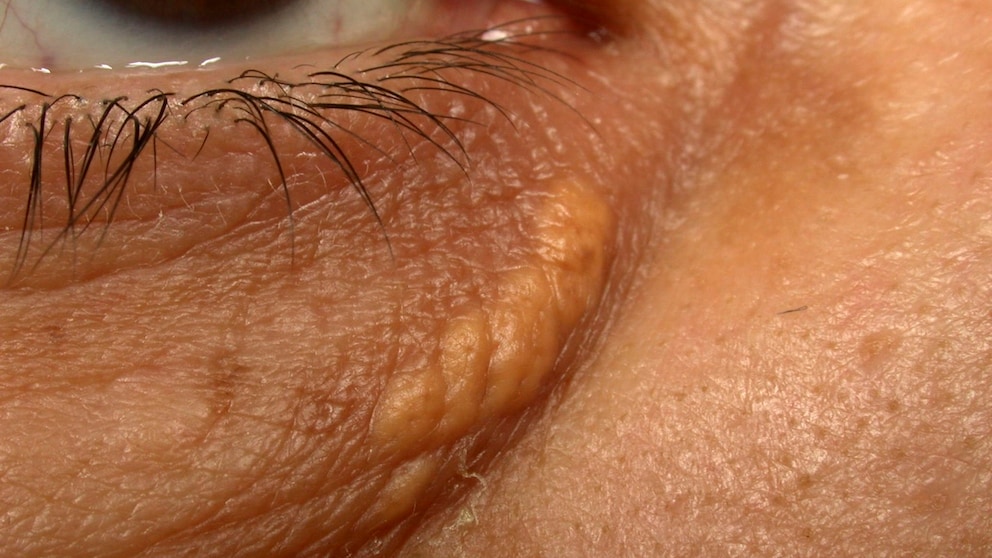
Yellowish fat deposits on the eyelids, known as xanthelasmas, are usually harmless and often perceived mainly as a cosmetic issue. However, these noticeable skin changes may reveal more about health than is apparent at first glance. A large analysis from the U.S. examined whether xanthelasmas are linked to cardiovascular diseases.
Xanthelasmas as Possible Warning Signs
People with xanthelasmas in the study more frequently experienced a heart attack, stroke, or a transient ischemic attack (TIA), often referred to as a “mini-stroke.” The increased risk was evident both in the short and long term and persisted even after accounting for known risk factors such as high blood pressure, diabetes, obesity, smoking, and elevated blood lipid levels. However, there was no difference in overall mortality between people with and without xanthelasmas. The results were published in the journal “Atherosclerosis.”1
How the Study Was Conducted
Xanthelasmas form due to the accumulation of fat-rich cells in the skin of the eyelids. Previous studies had already suggested that they might be associated with lipid metabolism disorders and arteriosclerosis.2 However, the previous findings were inconsistent.
The researchers aimed to determine whether people with xanthelasmas more frequently develop severe cardiovascular and cerebrovascular diseases. To do this, they analyzed health data from the international network “TriNetX.”
After statistical matching, 17,770 adults with xanthelasmas were compared with an equal number of people without these skin changes. The comparison group specifically included individuals with presbyopia to ensure that all participants had undergone an eye examination.
Individuals who had already suffered a heart attack, stroke, or TIA were excluded. The two groups were made as comparable as possible in terms of age, gender, blood lipid levels, high blood pressure, diabetes, obesity, and smoking. The researchers then examined how often heart attacks, strokes, and TIAs occurred over up to ten years.
The Risks Differ Significantly
The differences were particularly pronounced in the first year. One percent of people with xanthelasmas suffered a heart attack compared to 0.35 percent in the comparison group. For strokes, the rates were 0.95 versus 0.30 percent, and for TIAs, 0.60 versus 0.19 percent.
After ten years, the rates for heart attacks were 3.13 versus 1.73 percent, for strokes 3 percent versus 1.53 percent, and for TIAs 2 percent versus 1.13 percent. However, the study cannot prove that xanthelasmas cause these events. The results rather suggest that the deposits could be a visible indicator of an increased cardiovascular risk.

Simple Morning Routine to Reduce Risk of Fatal Stroke

Lowering Your “bad” Cholesterol Can Reduce Dementia Risk by 26 Percent
Strengths and Weaknesses of the Study
The strengths include the large number of participants and the long observation period of up to ten years. Additionally, the researchers considered numerous known cardiovascular risk factors to make the groups as comparable as possible.
However, the study also has limitations. Since it is based on electronic health records, errors or gaps in the recorded diagnoses cannot be ruled out. Moreover, some potentially relevant information was missing, such as specific laboratory values of individual cholesterol types, socioeconomic status, and the start, duration, and dosage of cholesterol-lowering medications. Treatments outside the participating health facilities might also have been overlooked.
These limitations are important for context: Even though the study does not provide direct causal evidence, it underscores that xanthelasmas can be a valuable external indicator for doctors to more closely examine patients’ heart health early on. The study was not financially supported. The authors reported no relevant conflicts of interest.
Also interesting: What your eye color reveals about your susceptibility to diseases
What Previous Studies Have Already Shown
The question is not new–and the study landscape remains inconsistent. The most well-known is a Danish population study that followed 12,745 people aged 20 to 93 over an average of 22 years.3 Here, too, people with xanthelasmas had an increased risk of heart attack and ischemic heart disease, independent of cholesterol and triglyceride levels. Additionally, the researchers found indications of more pronounced arteriosclerosis. Unlike the current U.S. analysis, the Danish study did not show a connection with strokes–but did show a slightly increased risk of death. One reason for this difference in mortality risk could be the significantly longer observation period: The Danish participants were followed for an average of 22 years, while in the U.S. it was a maximum of ten.
However, there are also studies that find no connection. An Israeli study compared 203 people with xanthelasmas to 2,030 people without the skin changes, all from a large preventive program.4 No differences were found in blood lipid levels or the frequency of cardiovascular diseases. However, the authors note that the data were retrospectively collected from only one center and the participants self-selected for the preventive examination–people with particularly high risk might therefore be underrepresented.