



March 12, 2026, 3:37 pm | Read time: 8 minutes
The dark season is a problem for many people. They feel listless, are in a bad mood, and are constantly tired. Light therapies, such as daylight lamps, promise to help combat such winter depression. But is there any evidence for their antidepressant effect? FITBOOK spoke to a psychiatrist and somnologist about the subject. Below, we explain what you should look out for when buying a daylight lamp and how you can benefit as much as possible from its effects.
You want to crawl inside and never leave your bed, because everyday life is accompanied by frequent yawning anyway. In the end, the constant tiredness leads to a bad mood. The popular term for such an experience is “winter depression” or “winter blues.” In psychology, the term “seasonal affective disorder” (SAD) is used when depressive episodes clearly occur in a seasonal pattern. One of the recommended treatment approaches is light therapy with daylight lamps. FITBOOK spoke to psychiatrist and somnologist Dr. Dirk Schwerthöffer about what a lack of light does to the body—and how you can treat SAD yourself with a daylight lamp. He is a senior physician at the Clinic for Addiction Medicine and Psychotherapy at kbo-Isaar-Amper-Klinikum Region München and medical director of the Sleep Medicine Center at Klinikum rechts der Isar.
Overview
- Terms – Winter Blues, SAD, and Winter Depression
- What a Lack of Light Does to the Body – and How Severe It Is in Winter
- What You Can Do About It
- Treating Winter Depression With a Daylight Lamp? Medical Expert Answers
- What Studies Say About the Antidepressant Effect of Lamps
- What to Look Out for When Buying a Daylight Lamp
- At What Time and for How Long Should You Sit in Front of the Lamp?
- Conclusion: Daylight Lamps Can Help Prevent Winter Depression
- Sources
Terms – Winter Blues, SAD, and Winter Depression
- The term winter blues is colloquial and refers to a “depressed mood in the winter months,” says Dr. Dirk Schwerthöffer. Many people are affected by these mild mood lows in winter.
- Seasonal affective disorder (SAD) is a “depressive illness that occurs regularly, typically in the fall and winter, and meets certain diagnostic criteria”. Common symptoms include persistent low mood, an increased need for sleep, lack of energy, and cravings for carbohydrates.
- Winter depression is the colloquial term for SAD that occurs in winter.
Note: We use the terms “winter depression” and SAD interchangeably in this article—even though seasonal affective disorder does not only include winter depression, it can theoretically also occur in summer—but summer depression is far less common than winter depression.
When should you see a doctor?
If the depressive mood lasts longer than two weeks, worsens, or leads to severe impairment in everyday life, a doctor or therapist should be consulted.
What a Lack of Light Does to the Body – and How Severe It Is in Winter
The body absorbs light through the skin and eyes. This has a strong influence on our hormone balance: if we absorb too little light via the retina of the eyes, the so-called happiness hormone serotonin cannot be produced in sufficient quantities—we feel depressed. At the same time, a lack of light signals to the body that it is dark, causing us to produce more of the sleep hormone melatonin.
“In winter, the organism and biorhythm change—also due to the reduced amount of light,” Schwerthöffer explains to FITBOOK. This can cause measurable biological changes, such as a change in melatonin and vitamin D concentrations. This makes us tired and sleepy, even during the day, and thus disrupts our sleep rhythm. At the same time, it can also lead to “noticeable psychological impairments such as depressive symptoms”. People who are prone to SAD or have other aggravating living conditions (such as shift work, physical illness, or severe psychosocial stress) can be particularly affected by this.
A few examples of light intensity measured in lux, the unit of illuminance: up to 100,000 lux are reached in the blazing summer sun. On bright summer days, it is around 40,000 to 50,000 lux. In the shade, it is still 10,000, while office lighting only reaches 300 to 750 lux.
People who spend most of their days in the office and in closed rooms in winter have a light deficit. According to research, this is the main cause of winter depression. Important: There are several factors that play a role in its development. When making a diagnosis, psychologists therefore also check whether the symptoms are due to chronic illnesses, stress, or life circumstances.
What You Can Do About It
The lack of light, the main trigger of winter depression as mentioned, can be counteracted with two different measures. Schwerthöffer recommends taking a one- to two-hour walk every day in the fresh air and, of course, in daylight. Even on cloudy winter days, around 1500 to 3500 lux are still achieved, which is significantly more than in closed rooms! This not only raises serotonin levels but also boosts the important vitamin D production.
Many people often don’t have time for a long walk at lunchtime in their everyday working life. For this reason, the second measure is light therapy, with daylight lamps.
Treating Winter Depression With a Daylight Lamp? Medical Expert Answers
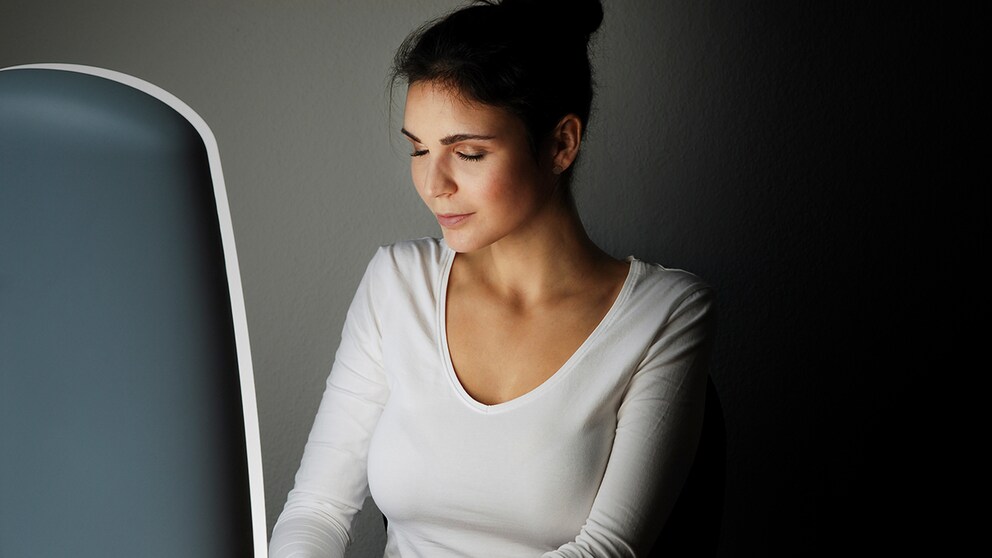
Schwerthöffer answers the question about the effectiveness of daylight lamps for winter depression with a “definite yes”. In addition to the mood-enhancing effect, the light stops the release of melatonin in the body, which makes us alert. This helps us to get going, especially in the morning.
Important: Daylight lamps are not a panacea for depression. The expert points out: “Sufficient exercise and fresh air are essential, especially for people who are prone to depression,” says Schwerthöffer. And: anyone suffering from severe depressive symptoms should always consult a doctor.
What Studies Say About the Antidepressant Effect of Lamps
There are studies that prove the effectiveness of light therapy in treating winter depression. For example, a study carried out in Canada in 2006 with 96 patients..1 For the study, the test subjects were divided into two groups. One group was treated with a daylight lamp for 30 minutes every morning for eight weeks and also received a placebo medication. The other group was treated for eight weeks with ineffective daylight lamps, but with a genuine and effective antidepressant. The therapy took place over a total of three years in the winter season.
The result: the light therapy worked just as well as the antidepressant—and even faster. Most of the test subjects reported positive effects after just one week of treatment with the light shower. Additionally, the light therapy was found to have no side effects. However, the light therapy did not work equally well for everyone. A third of the test subjects did not perceive a mood-lifting effect from either the light therapy or the antidepressant.
The positive influence of light on depression was also confirmed by a meta-study from 2020, which was conducted by scientists at Danube University Krems on behalf of the Institute for Quality and Efficiency in Healthcare (IQWiG)..2 The scientists reviewed 21 different studies on light therapy with a total of 1441 adult participants with regard to depression-related symptoms. As a result, they found an “indication of a short-term benefit of light therapy using light lamps”.
What to Look Out for When Buying a Daylight Lamp
“With daylight lamps, it is particularly important to ensure that they have a sufficiently high lux level and have been tested as a medical device,” Schwerthöffer points out. Appropriate lamps should reach a brightness of at least 10,000 lux to combat winter depression. The strong light boosts serotonin production and therefore has a mood-lifting effect.

How to Stay in Good Spirits Through Fall and Winter

Trainer: “Why Spring Can Be a Weight Loss Accelerator”
At What Time and for How Long Should You Sit in Front of the Lamp?
Schwerthöffer told FITBOOK: “Exposure to light should take place in the morning to reduce the concentration of melatonin left over from the night.” His recommendation is to sit close enough to the lamp for around 45 minutes. The further away the lamp is from the eyes, the smaller the effect and the longer you have to use it to achieve an effect.
Conclusion: Daylight Lamps Can Help Prevent Winter Depression
Daylight lamps can be an effective tool to manage the winter blues or winter depression, provided it is a condition that can be self-treated. Studies show that they have a mood-lifting effect, similar to an antidepressant. Additionally, the light from the lamps inhibits the release of melatonin in the body, helping us wake up. This helps us to get going, especially in the morning. However, light therapy with daylight lamps does not work equally well for everyone. Instead of using the lamp for 30 minutes a day, you can take a one-hour walk during daylight. This has even more positive effects, because in addition to exercise, the UV light also produces vitamin D in the body. Daylight lamps, which are low in UV light, cannot offer this. If the depressive mood persists for longer than two weeks, worsens, or leads to severe impairment in everyday life, a doctor or therapist should be consulted.