


November 17, 2026, 6:53 pm | Read time: 7 minutes
Robert Pattinson now has a license to kill. He will be the new James Bond. It’s official as of November 16. Pattinson was confirmed as the new 007 through James Bond’s social media channels. He faces a role that will likely demand a lot physically. What the actor might expect in terms of training and diet can be read here.
For months, speculation ran high about who would take on the James Bond legacy. Callum Turner, Jack Lowden, or Nicholas Hoult? That Pattinson outshone them all has the internet buzzing. People are calling it a “Generational Run.” No wonder, as Pattinson is currently stringing together one blockbuster after another. From his beginnings in “Harry Potter” and “Twilight” to “The Batman,” “The Odyssey,” and the upcoming third “Dune” film. But for Bond, it’s not just Pattinson’s current box office streak that counts. The role also demands a lot physically. Longtime 007 fitness coach Simon Waterson once revealed what preparing for Bond entails. Sports scientist, personal trainer, and functional training lecturer Markus Bremen explains for FITBOOK what Pattinson might face physically.
Craig and Brosnan Have Trained with Him
Simon Waterson is something of a star fitness coach in the British film industry. On his Instagram channel, Waterson currently showcases his work with Tom Hiddleston, Liam Hemsworth, and Jeremy Renner. And, of course, he has had a hand in the quintessential British film export. For “James Bond,” he got Pierce Brosnan in shape for “The World Is Not Enough” in 1999 and continued to train him for his last Bond film, “Die Another Day.” Waterson also took on Brosnan’s successor, Daniel Craig, and trained him for all his Bond films. So, the chances are good that Robert Pattinson might also get to know him.
Why Simon Waterson seems tailor-made for the Bond films also has to do with his own military background. He reportedly joined the military at 16 and later served in an elite special forces unit.1
The Philosophy of the Bond Body
With Waterson, the physical preparation of James Bond actors changed fundamentally. While the physical form of earlier Bonds was less significant, with Daniel Craig, there was a deliberate attempt to physically shape a believable special agent. Craig appeared significantly bulkier and more muscular in his first Bond film, “Casino Royale,” in 2006. According to Waterson, it was “a clear intention to make him appear more imposing and shocking.” However, it wasn’t just about Craig’s appearance. He also needed to be physically capable of credibly performing the stunts and action scenes typical of Bond. “He had to look like he could handle the task he was taking on,” Waterson explained to the “Gentleman’s Journal.”
Craig was not supposed to look like a bodybuilder but like a man whose physique suited his profession. According to Waterson, this required speed, responsiveness, strength, and agility. He tailored the training to the script. If large sprints or specific stunts were required, those demands were specifically trained. “The key word is relevance,” Waterson explained in an interview on “007.” Everything in the training should serve a specific purpose for the role.
The diet also follows this logic. According to Waterson, it is also tailored to the script and shooting schedule. There are no extreme diets, nor are specific foods completely eliminated. Instead, the focus is on ensuring a high energy supply, adequate hydration, and regular food intake throughout the day. Waterson also emphasizes anti-inflammatory measures. For example, Craig was given turmeric root juice during filming.
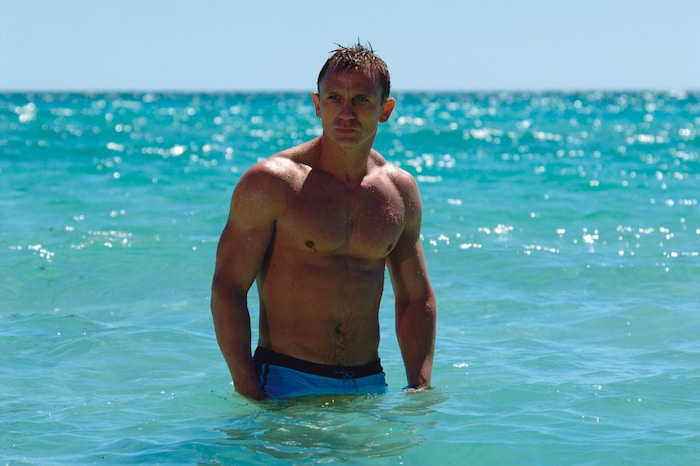
Does Pattinson Need to Build More Muscle for Bond?
To assess the physical differences between Craig and Pattinson, we showed Markus Bremen two photos of the actors. The sports scientist particularly noticed the difference in muscle volume. Craig appears “more compact and stronger,” especially in the shoulders, chest, and upper arms. Pattinson, on the other hand, seems overall “slimmer” but also has visible muscles in the chest, shoulders, and abdomen.

However, not much can be inferred from individual pictures. Bremen points out that light, perspective, and body tension can influence the visual impression. Photos also do not provide reliable information about an actor’s strength, speed, or endurance.
“If Craig’s Bond physique serves as a guide, I would focus on additional muscle building in Pattinson’s shoulders, chest, and back,” he explains. At the same time, Pattinson doesn’t have to physically copy Craig. According to Bremen, he can “also interpret the role with his own, leaner athleticism.” Ultimately, it depends on “what kind of Bond the director wants to show.”
If additional muscle building is indeed the goal, it’s important to emphasize that, according to Bremen, it requires not only systematically structured strength training but also adequate energy and protein intake, as well as sufficient sleep and recovery.
Not Uncharted Territory for Robert Pattinson
If Pattinson indeed has to train similarly for Bond as Daniel Craig once did, it wouldn’t be entirely new territory for him. He already prepared intensively for the physical demands of his Batman role. Back then, he focused on short, intense, and functional training sessions. These included circuit training, boxing, regular runs, and military workouts with sandbags on the beach. The goal was quite similar to what Waterson demands from a Bond actor. Pattinson was not just supposed to look more muscular but also be physically capable of handling the stunts and fight scenes.2
From Markus Bremen’s perspective, Pattinson’s Batman training would already be a good foundation for Bond. Strength training provides the physical base, running promotes endurance, and boxing trains footwork, coordination, and quick movements. However, for 007, Bremen would train even more specifically. “For Bond, I would additionally incorporate short sprints, controlled braking, changes of direction, and jumps with clean landings. Pull and carry exercises would also be useful.” The specific preparation for individual action scenes would then need to be done in collaboration with the stunt team.
Specific Exercises and Bremen’s Assessment
Which exercises might be on the training plan likely depends on the specific film and the script’s requirements. In the past, for “Casino Royale,” a mix of dynamic, explosive movements and heavy strength training was the method of choice. “We always try to incorporate dynamic movements into every workout,” Waterson explained to the “Gentleman’s Journal.” The exercises included mountain climber push-ups and bodyweight dips. For later films, the training was repeatedly adjusted. In “Skyfall,” for example, plyometric exercises were used, while Craig performed goblet squats on a BOSU balance trainer, rollouts, and planks for “Spectre.” For “No Time to Die,” he reportedly trained with heavy sandbags and various step exercises to improve stability and strength for sprints.
Plyometric exercises are explosive movements where muscles are first stretched and then powerfully contracted in a very short time. The goal is to train speed and explosive strength.
Also interesting: How DJ Khaled lost an impressive 88 pounds
But how effective are these exercises from a sports science perspective? Bremen generally rates them positively. Mountain climber push-ups, for example, train endurance, coordination, and core control. Dips and deadlifts are also beneficial. He is more critical of goblet squats on the BOSU balance trainer. While the unstable surface increases balance demands, it can limit strength development. “For targeted strength and muscle building, I would therefore prefer a solid surface.” Bremen considers explosive movements particularly relevant for Bond, such as jumps, short accelerations, or medicine ball throws.