


July 28, 2025, 2:11 pm | Read time: 9 minutes
Vegetables are removed from the plate with pinched fingers, salad is stubbornly ignored, and casseroles are suspiciously picked apart. Indeed, it can sometimes be really difficult to successfully serve children anything other than spaghetti with tomato sauce. FITBOOK explains what’s behind the problem and how you can gradually make your child more open to trying new foods.
Follow the FITBOOK channel on WhatsApp now!
First: Personal Experience
As a nutrition therapist, I’ve seen many parents on the verge of a nervous breakdown because their children steadfastly refuse broccoli or find bell peppers disgusting and push them off the plate. Vegetables, in particular, are a sensitive topic for children.1 The comforting thing is perhaps this: Almost all parents experience stress at the table at some point because the healthy stuff gets left behind. Studies show that every second to fifth child is very, very picky when it comes to eating.2 These situations always require patience; there’s no way around it. But my experience is: Knowing what’s behind it and having a few tricks up your sleeve can make it much easier to maintain that inner calm.
Why Do Kids Love Pasta So Much?
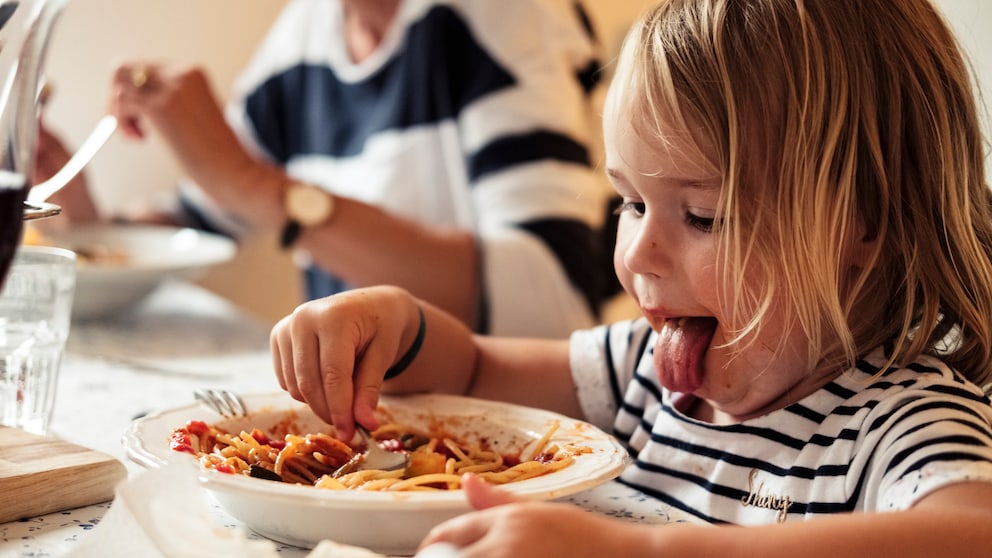
As a child, I adored my father’s so-called “canteen plates.” These are plates with separate “compartments”—a large one for the main part of the meal (such as meat or fish) and two smaller ones for the sides. Wonderful! So neat and tidy! Interestingly, it’s not just a personal preference why I liked these plates so much, but a pattern: Preschool children prefer simple, clear things. Not just with toys, but also with food. Pasta, potatoes, rice, a piece of sausage, or bread are ideal. “Mixed” dishes on the plate also confuse them. That’s why casseroles or stews are often problematic: So many things at once, many different colors, textures, flavors, and many ingredients are no longer recognizable. Pasta with tomato sauce is visually wonderfully simple. And on a plate where everything is side by side and not on top of each other, even more so.
Additionally, many children go through a phase between the ages of two and five where they initially reject anything new. This “strangeness” also applies to food.3 What is unfamiliar is pushed away. Since pasta is often introduced quite early in complementary feeding, it has a “head start”: It is known and familiar. That’s why pasta almost always works throughout life. The good news is: This “strangeness” usually resolves itself, and curiosity takes over again.4

What Parents Can Do to Encourage Kids to Eat More Vegetables

In the Air Fryer: 3 Quick Pasta Recipes with Extra Protein
Pasta Until You Drop?
But what if the kids want to eat almost nothing but pasta? In nutrition therapy, there’s a strategy to robustly address children’s love of pasta. Namely: Pasta to the fullest. Every day. Until you drop. Literally. I know this: One of my friends and his brother “fought” for a week of canned ravioli as kids. The initial triumph was predictably short-lived. Because as humans, we are evolutionarily programmed for diverse eating:
This is ensured by the phenomenon of “specific sensory satiety”: Too much of one taste, and we get sick of it. That’s why the canned ravioli diet ended as expected: By the third day, the two brothers couldn’t stomach the pasta anymore. However, I don’t think much of such weaning strategies—partly because they sound like intentional trauma, and partly because they don’t teach how to handle a delicious food or understand good nutrition. That’s why I’ve compiled other tips that, in my experience, are very promising. Here’s how it works step by step:
Also interesting: Why children should balance, jump, and climb—and how to promote it specifically
Step 1: Use Pasta Cleverly
If new things are initially viewed with suspicion, the first strategy is: Combine new with familiar. That means using pasta as a “vehicle” to introduce new vegetables or flavors.
- Prepare pasta sauce with fine vegetable additions (such as small peas, carrots, or zucchini, finely grated at first)
- Try alternative types of pasta: spelt, whole grain, legume pasta (such as chickpea or lentil), which provide more nutrients but a familiar taste
- Prepare pasta sauces with similar textures but more nutrient-rich ingredients (such as mixing pureed lentils with tomato sauce).
Important—even if it sounds strange at first: The child should always have a portion of “just pasta” to choose from: This way, they retain control and choose independently, significantly reducing pressure and resistance.
Step 2: Offer, Offer, Offer
Nature has programmed various food-related behaviors into us, such as a preference for sweet things (= non-toxic, energy-rich) or a fear of bitter things (= possibly toxic). Some of this is unfortunately not very helpful in our modern civilization with its crazy offerings—like the preference for sweet things. But other innate mechanisms can be used to our advantage. Like the so-called “mere-exposure effect.” This means: The more often I come into contact with something, the more likely I am to like it.5
This effect has also been proven for food: Children tried a small piece of a new vegetable daily—this led to a measurable increase in acceptance and consumption.6 The safety of the new food was literally learned. This strategy is especially important for savory foods, like salad or vegetables, because sweet things are immediately accepted by everyone. Specifically: Offer a few forkfuls of a less-loved vegetable every day—without pressure, but playfully. Typically, it takes 10 to 16 days for a child to gain trust in the new food. Most parents give up after three to four failed attempts. My advice: Patience and persistence, it’s worth it in the long run, even if it can be very annoying in the short term.
Step 3: Incorporate Small Rewards
In school, there’s a gold star for a particularly nice notebook entry and a shiny trophy in sports if you win. Those eyes light up! This joy can also be used with food. Studies show: Combining the aforementioned trial offers with small rewards (such as stickers, small figures) can motivate even the pickiest eaters.7 But be careful: The reward should never be food itself (like sweets or fast food)—this leads to a very unhealthy and emotionally driven eating behavior in the long run and increases the risk of obesity.8
Step 4: Diversity as a Role Model
Parents significantly shape their children’s eating habits: If they eat monotonously and always the same thing, the child is more likely to be reluctant to try new things.9 Therefore: The earlier children see that the family enjoys a “colorful” and varied diet at the table, the more natural it becomes for them. Or, as the Munich comedian Karl Valentin put it: “We don’t need to educate our children; they imitate us anyway.”
Step 5: Let Them Participate
Children have a need for autonomy and self-efficacy from a very early age.10 They push a stuffed animal off the table and grin from ear to ear when it falls. Because that shows them: I did that, I can do that! People also want to express themselves through food: What we eat is part of our unique personality.11 This starts in childhood. Accepting this allows you to approach your child differently, rather than just labeling them as “picky” or “fussy” when the vegetables are pushed away. And work with this need, not against it:
- Offer food buffet-style: Studies show that when children can choose between different types of vegetables, they consume more vegetables overall.12
- Let them participate: Involve children in shopping and cooking: let them smell, touch, or cut ingredients. Cookie cutters or colorful boards can help children express their creativity and playfulness. This fosters curiosity and acceptance.
- Even though parents should decide when, where, and what is cooked—the child decides whether and how much to eat. This keeps pressure out and maintains self-efficacy.
Step 6: Relaxation at the Table
Stress is not only felt by adults but also by children. Because our body perceives stress as something hostile, our brain tries to remember the situations in which stress occurred to avoid it: We have a pronounced “stress memory.”13 To prevent shared meals from becoming a daily drama where everyone wishes they were on another planet, relaxation at the table should be the most important goal. Eating and enjoying together in a cheerful, relaxed atmosphere lays the foundation for curiosity, a willingness to experiment, and the courage to try new things. A relaxed atmosphere, positive accompaniment, and patient waiting promote
My Opinion on the Perfect Lunchbox
They are always in a good mood, perfectly groomed, and, of course, 1,000 percent there for their children: the “momfluencers.” For several years now, “super moms” have been flooding social media channels, showcasing their perfectly styled lunchbox contents for their kids. Homemade spelt sourdough brioche with cheese topping in heart shapes, along with cherry tomatoes and radishes carved into little roses. Styled like this, it’s promised, every child will eat the intended portion of whole grains and vegetables!
As a nutrition therapist, I find this trend problematic. Because eating and cooking become a tense “performance,” a competition, a pursuit of perfection. And that never ends well—especially not when it comes to food. It puts pressure on parents and demands hours of or late-night creative acrobatics in the kitchen, in addition to an already demanding daily routine. So: If you occasionally enjoy some lunchbox beauty, go ahead.
But it is neither the touted panacea against children’s vegetable phobia nor a strategy that can be sustained in the long term. And that’s without probably burning out at some point. Better to use patience and inner calm for the 16th time “Here comes the broccoli floret flying!” Then the kids will eventually eat it on their own, whether or not it has two olive eyes and a tomato slice mouth stuck on it.