


May 13, 2026, 5:55 am | Read time: 7 minutes
In the so-called “Blue Zones,” the highest number of centenarians live worldwide. Author Dan Buettner has traveled to these places and observed how their residents consume alcohol. His finding: People who live exceptionally long lives are by no means abstinent.
Alcohol consumption is not known to be health-promoting, as numerous studies confirm.1,2 A slightly different picture emerges when looking at the residents of the so-called “Blue Zones”: Here, people live exceptionally long—and they are by no means abstinent. The centenarians from Ikaria (Greece), Loma Linda (California), Sardinia (Italy), Okinawa (Japan), and Nicoya (Costa Rica) enjoy a glass now and then. Longevity expert and author Dan Buettner discovered this in his research on the drinking habits of centenarians.
Overview
The Drinking Habits of Centenarians in the Blue Zones
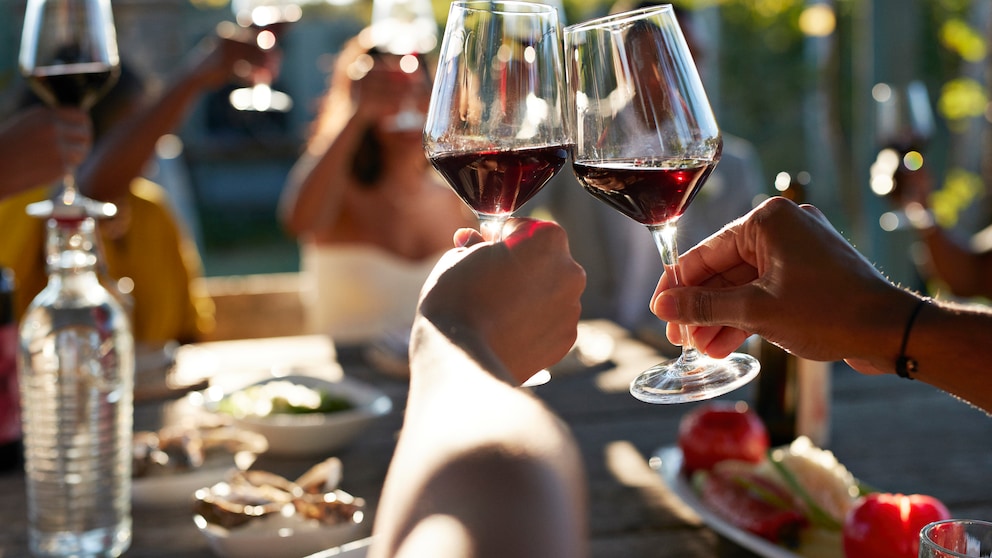
Dan Buettner’s first observation: The centenarians in the Blue Zones consume alcohol very consciously and with great enjoyment. They primarily drink in social settings and generally with meals. “I know there are studies showing that alcohol can increase the risk of breast cancer in women or cause falls, car accidents, and other fatal events,” Buettner explained in an interview with the U.S. magazine “Well+Good.” “But I can tell you that the small amount of alcohol consumed in all five Blue Zones contributes to their quality of life.” Fascinated by the exceptionally long-lived people in certain parts of the world, Buettner has been researching and studying longevity for a long time. He has written numerous books on the subject, and he shares his findings on the website “bluezones.com.”
How Regularly Is Alcohol Consumed?
The oldest people in the world have very regular drinking habits. That means they consume alcohol almost every day, but only in small amounts. “These people, who live the longest of anyone on Earth, enjoy a little of their favorite alcoholic drink every day,” Buettner further observed. A little means in this case one or two glasses. What they don’t do is abstain for two weeks and then drink 14 drinks at once. That would be fatal for health.
What Alcohol Do the Oldest People in the World Drink?
It also greatly depends on what the Blue Zoners drink. Spirits and sugary cocktails are not part of the centenarians’ drinking habits. Particularly noticeable—especially in the Mediterranean regions—is the love for red wine. In Sardinia, Cannonau is mainly served. This variety contains three times more flavonoids than regular red wine. Flavonoids are active plant compounds that give the wine its deep red color and are also highly effective antioxidants. They lower, for example, blood pressure, are good for the heart and brain, and according to a study, protect against cognitive decline and even depression.3 All these are prerequisites for healthy aging and potentially reaching an advanced age.
In the Japanese prefecture of Okinawa, where people also live exceptionally long, Awamori is consumed. This rice-based distillate has been part of the local culture for over 600 years and is enjoyed in small sips, mixed with plenty of water. Here too, Buettner noticed that alcohol is consumed in moderation. The diet of the people there is predominantly plant-based.
Why Do People Who Live Exceptionally Long Drink?
Blue Zoners do not use alcohol to relieve frustration, forget worries, or reduce other stress. The only reason a bottle is opened is because friends are visiting or the family is gathered around the table for a meal. Alcohol is seen as a connecting element that lifts the mood and contributes to joie de vivre. But it is not the reason, just a kind of carrier. Those who drink solely for joyful occasions are less likely to fall into the trap of addiction—one of Dan Buettner’s most interesting observations.
Are the Drinking Habits of Centenarians a Model? Here’s What Science Says
Buettner repeatedly emphasizes that he sees himself as a traveling observer and not as a scientist in the classical sense. The number of studies that see even small amounts of alcohol as problematic, as well as those that attribute a glass in honor of good heart health, would exceed the scope here. Interesting at this point is a 2014 study that considers moderate red wine, embedded in a Mediterranean diet, as part of a healthy lifestyle.4 The finding was: Red wine can indeed protect the heart if combined with plenty of fish, legumes, olive oil, and vegetables. Regular exercise and a bit of “Dolce Vita feeling” are also important—just like the Blue Zoners. In fact, the heart-protecting flavonoids are said to only fully develop their effect in conjunction with essential nutrients from healthy foods.5
A similar result was also found in an alcohol study from 2021. The result: Light to moderate alcohol consumption can reduce the risk of heart attack and stroke by 50 percent in people with pre-existing cardiovascular diseases. This means about six grams per day, equivalent to half a glass of wine or one bottle per week.6
Possible Link Between Alcohol, Stress Response, and Heart Health
Researchers at Massachusetts General Hospital examined data from over 50,000 adults in 2023. Using brain scans, they measured how active the amygdala—a region in the brain that responds to stress—is with different drinking habits. The result: People who regularly drank small amounts of alcohol (e.g., a glass of wine a day) had lower activity in the amygdala. At the same time, they were less likely to experience cardiovascular diseases such as a heart attack or stroke.
The study shows a possible link between low alcohol consumption, reduced stress processing in the brain, and a lower risk of cardiovascular diseases. Whether alcohol is actually the cause remains unclear. The researchers also do not recommend alcohol consumption.7

9 Rules From the Blue Zones for Living to 100

If You Want to Stay Fit at 60, You Should Focus on Berries and Black Tea
No Clear Advantage of Alcohol Regarding Life Expectancy
A large analysis of 107 international studies with a total of about 4.8 million participants examined in 2023 whether alcohol consumption is associated with longer life expectancy. The result: People who drink occasionally or in small amounts do not live statistically longer than those who completely abstain from alcohol. Indications from older studies that a glass of wine a day is good for the heart could, according to the researchers, be due to weaknesses in the data analysis at the time.
It also showed: For women, the risk of dying earlier increases from about two glasses of wine per day. For men, this increase was at about three glasses. The more alcohol consumed, the higher the risk in both groups.8
What the WHO Says
The World Health Organization (WHO) clarified at the end of 2022 that, from a medical perspective, no amount of alcohol is considered safe. Even small amounts can increase the risk of certain diseases. The link with cancer is particularly well-researched: Alcohol is classified as carcinogenic, comparable to tobacco or asbestos. Even a daily glass can increase the likelihood of breast or colon cancer. In Europe, about every second alcohol-related cancer case can be traced back to low to moderate alcohol consumption. The WHO emphasizes: Even small amounts of alcohol pose a health risk.9
Problems with Alcohol–Where to Find Help?
According to the German Center for Addiction Issues, a low-risk alcohol consumption for women is 12 grams of alcohol per day (an eighth of a liter of wine), for men, it is 24 grams (0.5 liters of beer) per day. Additionally, two days a week should be alcohol-free.
Those affected can find help at the Addiction and Drug Hotline: 01805/31 30 31 (around the clock, 14 cents/minute from a landline) and at the counseling phone of the Federal Center for Health Education: 0221/89 20 31.
Alcoholics Anonymous offers open discussion groups and telephone counseling throughout Germany, information at anonyme-alkoholiker.de.