

November 14, 2020, 7:23 am | Read time: 6 minutes
In the series of 10-minute workouts, FITBOOK presents effective training sessions for in-between times. The protagonists are people with extensive knowledge in their field, including trained coaches and well-known athletes. One of them is athletic trainer and former competitive athlete Timo Kirchenberger. In this video, the abs are intensively trained–without neglecting the counterpart: the core muscles.
This holistic 10-minute workout by athletic coach Timo Kirchenberger targets the body’s center: a strong core. The expert in bodyweight exercises guides you through a total of ten exercises–an intense workout for the core and abs.
Who Is the Trainer in the Video?
Timo Kirchenberger was a competitive athlete in track and field for twelve years. He now works as a professional athletic trainer in Berlin. His top priority is a lasting improvement in well-being–and he is convinced that maximally efficient training is a key lever for this. According to his philosophy, the Berlin Recycling Volleys, Olympic champion Robert Harting, the national karate team, and the Berlin Hockey Club train, among others.
What Is the Idea Behind This Core-Ab Training?
As a coach, Timo Kirchenberger constantly encounters the desire for a flat, toned stomach. However, a blunt training of the straight and oblique abdominal muscles that only targets appearance is not an option for him. From the athletic trainer’s perspective, this is neither effective visually nor health-wise, because the counterpart is not sufficiently considered: the core muscles. This intensive 10-minute workout therefore tackles the entire core area–with a focus on the abs.
Also interesting: 10-Minute Workout–Core Training with a Focus on the Back
How Is the Training Conducted?
The workout is structured as demanding interval training: 50 seconds of exertion followed by 10 seconds of rest. Simply follow the trainer’s instructions. You don’t need any equipment, just train with your own body weight.
Also interesting: What Does Core Stability Training Actually Mean?
Which Muscle Groups Are Strengthened?
The entire core is trained, with special emphasis on the front, deep, and lateral abdominal muscles. “This body center has an extremely large influence on the general movement of the human body and the absence of pain and ailments,” explains Kirchenberger. The more stable this area is, the better you are in your sport, such as running, strength training, tennis, etc.
Also interesting: More Effective Home Workouts
10-Minute Workout: Core Training Focused on the Back
60-Minute “Core” Workout – Strengthen Your Midsection
What Should Be Considered in This Core-Ab Training?
This training is demanding. Anyone with acute pre-existing conditions, injuries (such as herniated discs, fiber tears, strains in the abdominal muscles), or pain should refrain or at least consult their doctor first.
Otherwise, according to Kirchenberger, anyone can try it out–from ambitious teenagers to retirees. The advantage of the workout is that you can adjust the intensity: Beginners shorten the exertion interval and take longer breaks accordingly.
Also interesting: Can You Lose Weight in Specific Areas Through Exercise?
Core-Ab Training: The Exercises at a Glance
Core Rotation
Lie on your back on the floor and bend your legs, with your heels firmly on the ground. Then bring your arms forward and hold them parallel to your thighs. Now bring your hands together while lifting your shoulders off the floor. The next step: rotate your upper body left and right. You’re doing it right when your abs really burn. Do not rest your upper body on the floor during the rotation!
Diagonal Jackknife
The same starting position as in exercise one. Keep your legs bent, with your back and heels on the floor. Now bring the diagonally opposite limbs together over your stomach. To do this, lift your shoulders off the floor again, and the respective arms and legs should touch. After one repetition, switch the arm-and-leg pair.
Bicycle Rocker
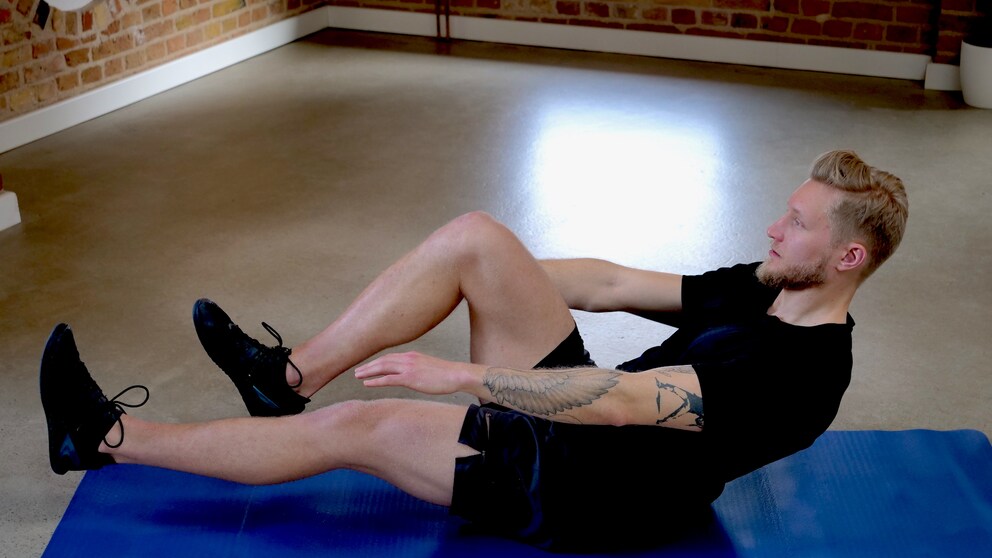
Sit on the floor with an upright upper body. Important: Only your butt should be on the ground, and lift your legs. Now bring your knees alternately toward your upright upper body. Use your arms to maintain balance and increase the exercise intensity with rocking movements. Do not rest your legs or arms during the entire exercise!
Criss Cross Leg Raise
Bend your legs again. Place your hands under your butt and stretch your legs in the air at a 90-degree angle to your upper body. Now cross your legs alternately and move them stretched toward the floor–but do not touch the floor! Repeat several times.
Side Plank Wiper (Left and Right)
From the plank position (= forearm at a right angle to the floor, upper body straight), move your hips up and down.
Quadruped Leg Extensions
The starting position for this exercise is the quadruped stance. Only hands and toes touch the ground. Now alternately lift one leg off the ground and extend it backward. Important: In the final position, the leg should be straight as an extension of the back.
Plank X-Lift
Starting from the classic plank, lift the diagonally opposite limbs, hold–and lower them again. Here, too, arms and legs should be an extension of the back. Thumbs point to the ceiling.
Reverse Crunch
In this exercise, the upper body remains firmly on the ground. Bend your legs and place them on your heels, bringing your knees to your chest. For stabilization, place your arms and palms on the ground at your sides. Make sure your butt lifts at the highest point. Keep your legs in the air with each subsequent repetition.
Leg Levers
For the last exercise, place your hands under your buttocks while lying on your back. Stretch your legs and move your feet (without bending) toward the ceiling. The end position is a right angle between your legs and upper body. Repeat several times–and then you’re done.