


August 1, 2025, 6:28 pm | Read time: 5 minutes
The wall sit (also known as the wall squat) is an effective exercise that not only strengthens the leg and glute muscles but also enhances willpower and endurance with regular practice. That’s why I’ve designed a 30-day wall sit challenge for you. It’s perfect for taking your leg muscles and willpower to a new level. So don’t wait, join in!
What is the Wall Sit?
The wall sit is an isometric exercise that trains the leg, glute, and core muscles. The term “isometric,” derived from Greek, means “equal measures” or “equal lengths” and refers in the fitness world to a type of muscle contraction where a muscle is tensed without significantly changing its length. Thus, muscles work during isometric exercises without joint movement. Another example of an isometric exercise is the plank.
Benefits of isometric exercises include joint-friendly muscle development and strengthening of the core and deep muscles.
Also interesting: How long you should be able to hold the wall squat
Muscles Trained by the Wall Sit
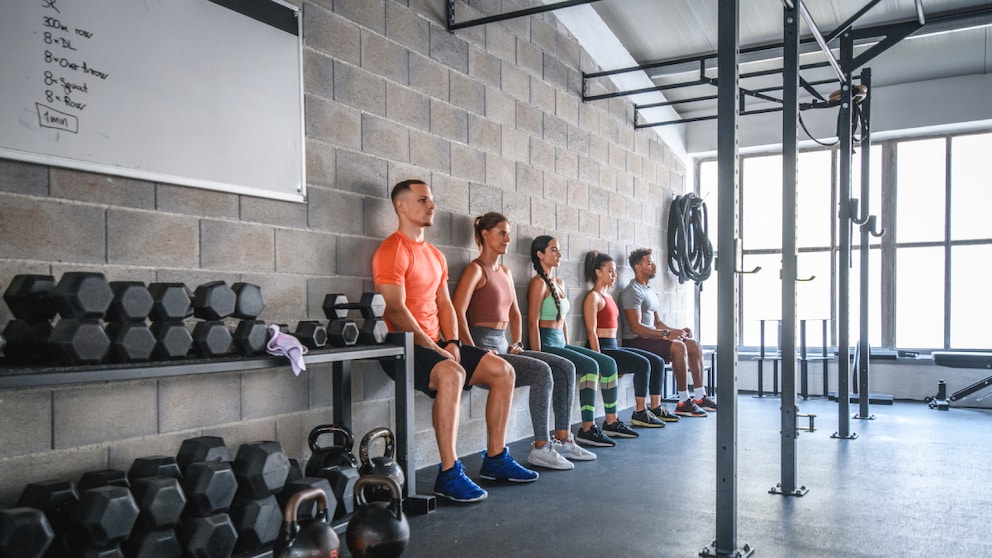
From the outside, the wall sit may look simple–yet it is often performed incorrectly. For the wall sit, position your back against the wall. The legs should be set at a 90-degree angle. It’s important that the back is completely fixed against the wall and no arch forms. Tilting the pelvis forward and pulling the navel inward helps achieve this. This creates a noticeable abdominal tension. The arms hang loosely beside the body and do not rest on the legs. To endure as long as possible, breathing should be slow and controlled. Inhale slowly through the nose and exhale slowly through the mouth.
Importance of Willpower in the Wall Sit
Willpower plays a significant role in static exercises. Since there is no movement and thus no distraction, you focus entirely on the exercise and the resulting effort. It’s crucial to train willpower to fully exploit the potential of the exercise and muscles.
Also interesting: How many push-ups per day lead to visible muscles

“What 14 Days of Wall Sits Did to My Body”

Why the Wall Sit Is an Underrated Exercise
Goal of the Wall Sit Challenge
This is where my wall sit challenge comes in. Over four weeks, we gradually approach the wall squat, increase the duration, and inadvertently train willpower. Without it, completing the challenge would be difficult. But I’m confident: It’s doable, even for you!
Training Plan for the 30-Day Wall Sit Challenge
To achieve the longest possible hold duration and increase willpower, a well-structured training plan is necessary, where both factors are gradually but consistently increased. Therefore, we don’t push to the maximum in the first week but build the challenge more strategically–as follows:
Week 1: Basics
The first week focuses on establishing the basics. Here, technique is the priority, followed by hold duration. The wall sit is performed daily, initially with a hold duration of 30 to 45 seconds and a total of two sets.
It’s important to focus on technique and try to target the muscles specifically. Additionally, the back should be firmly fixed against the wall. Breathing is slow and controlled. To enhance willpower, try closing your eyes and focusing your thoughts on something other than the effort. Tip: Try to enter a meditative state.
Week 2: Official Start of Training and Increasing Time
Once the basics and especially the technique are solidified, the hold duration can be extended, and the actual wall sit training begins. We will now train every other day with a total of three sets.
On the first day of the training week, three sets of 45 seconds each, with a 45-second break between sets, are completed.
On the second training day, three sets are also planned. The first set aims for a hold duration of 60 seconds. In the following sets, hold for 45 seconds each.
On the third training day, three sets are also performed. This time, the first two sets last 60 seconds, and only the third set lasts 45 seconds. On the last training day of the week, all three sets are held for 60 seconds.
Week 3: Supplementary Exercises
To strengthen the leg muscles beyond the wall sit, we add exercises in the third week that achieve just that. Additionally, we extend the duration of the wall sit in the first set from 60 to 90 seconds and to 60 seconds in the last two sets.
Exercises that can be performed in addition to the wall sit and enhance endurance by strengthening the leg muscles include:
- Squats
- Lunges
- Lateral lunges
- Plank
- Side plank
It’s important that the exercises are performed after the wall sit to avoid pre-fatiguing the leg and core muscles and unintentionally shortening the hold duration.
Week 4: Variations of the Wall Sit
By week four, the hold duration of the wall sit should already be extended, and willpower trained. Therefore, in addition to duration, the intensity of the exercise is adjusted through specific additional movements and weight. The variations can be changed from day to day.
Variation 1
In this variation, a weight plate is placed on the legs during the wall sit, providing extra challenge to the leg muscles.
Variation 2
In the second variation, the shoulder muscles are involved. A weight plate is held in the hands and lifted to shoulder height while exhaling. Once at shoulder height, it is briefly held. The arms are extended. While inhaling, the plate is slowly lowered back toward the legs.
Variation 3
The third variation requires a Pilates ball. It is placed between the thighs and squeezed. At the same time, the wall sit is held as usual. The additional tension created by squeezing the Pilates ball particularly trains the adductors. The pelvic floor is also engaged through this tension.
Variation 4
This variation is for advanced athletes for whom the standard wall sit is no longer challenging. First, assume the conventional wall sit position. Core and leg tension are a must. Once established, alternate lifting one leg. If possible, hold this position briefly before switching legs.