


December 14, 2025, 4:41 pm | Read time: 7 minutes
Relatively simple yet effective exercises are often particularly popular. Step-ups definitely fall into this category, primarily training our glutes and legs. They also burn calories at the same time. With some adjustments, the workout can be made even more varied to include the upper body. FITBOOK author Tony Poland explains the key variations of stair climbing.
What Are Step-ups?
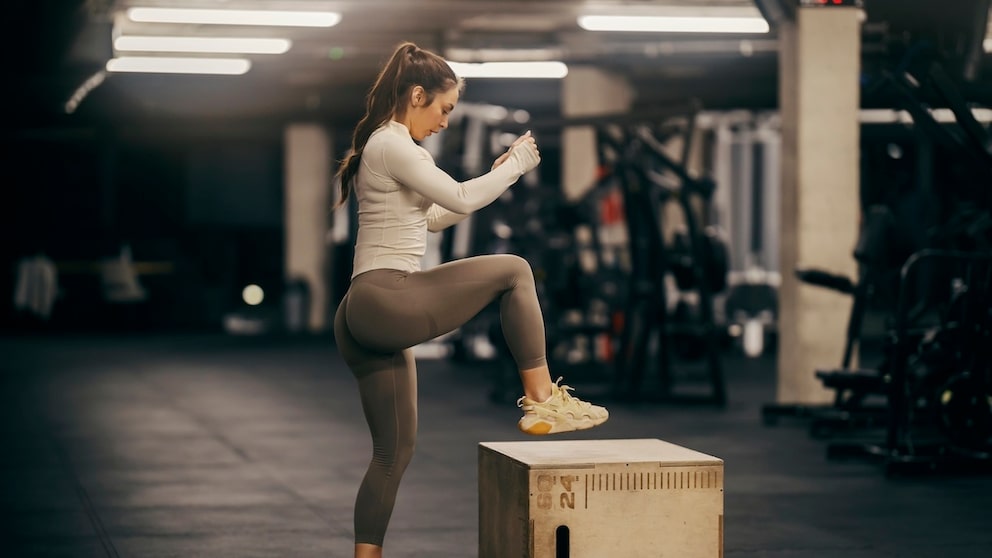
In essence, step-ups involve stepping onto an elevated surface, usually a bench or a box, by pushing yourself up with your leg and glute muscles. You then immediately step back down and switch to the other leg.1
This particularly activates the front and back thighs, as well as the glutes. Additionally, the core is strengthened. We build strength while also promoting balance and stability. The faster you perform the step-ups, the more the cardiovascular system is stimulated, improving cardiovascular endurance and kick-starting fat burning. The exercise is extremely versatile.
“Step-ups are among the most functional lower body exercises because they simultaneously train single-leg strength, balance, and hip stability—exactly the skills we constantly need in everyday life and sports,” emphasizes personal trainer Markus Bremen.
Front Step-ups vs. Side Step-ups
The execution is also versatile. Step-ups can be performed with body weight or with weights or dumbbells, either frontally (Front Step-ups) or laterally (Side Step-ups). There are differences: “Front Step-ups primarily emphasize the quadriceps and glute muscles in a linear movement, while Side Step-ups additionally engage the lateral hip muscles and adductors more,” explains Markus Bremen. “Neither variant is better—they simply cover different movement angles and muscle chains,” says the fitness expert.
The following five variations can be integrated into the training program by both beginners and experienced individuals.
Front Step-ups (with Dumbbell)
This exercise is the classic of stair climbing, with which even beginners can start calmly with a dumbbell (lightweight) in both hands after a few attempts.
To do this, stand upright in front of a bench, feet hip-width apart, forming a slight arch in the lower back. Also, keep your gaze forward and your abdominal muscles tense. Now place one foot completely on the bench, i.e., neither the heels nor the toes should be in the air. The other leg remains almost fully extended on the ground, while the arms hang at the side of the body.
It is also important: The elevation should be set in advance so that the upper and lower legs form about a right angle after each step onto the bench.
Now push yourself up with the leg that is on the bench and exhale while doing so. The standing leg remains almost fully extended and follows the hip, which now also moves upward. This continues until the second leg is also on the bench, so the legs are hip-width apart on the bench, and you come into an upright posture. Then inhale as you step back or descend and return to the starting position.
Tip: Experienced trainees can also work with an additional weight in the form of a barbell. This is held behind the body and placed on the rear shoulder muscles.
Side Step-ups (with Dumbbell)
With lateral stepping, you essentially train the entire glute. Holding a dumbbell in each hand further increases effectiveness.
To start, stand hip-width apart sideways to the equipment, so one side of your body faces it. Now place one leg on the elevation, centered, so that the entire weight can be shifted onto it. Don’t forget the tense abdomen and upright back!
Now step onto the elevation by pushing your body up with the “training leg.” The second leg remains extended and on the ground. Only in the final phase of the upward movement is the leg that was previously on the ground also moved onto the elevation. Now place it briefly next to the second leg or let it hover without losing tension in the “training leg.”
Then perform the entire movement in reverse order. At the end, the second leg is back on the ground. After a brief pause—keeping the “training leg” tense—start again from the beginning. After a few repetitions, switch sides.
Also interesting: 6 Exercises With the Step That Effectively Burn Fat
Step-ups on the Smith Machine (with Barbell)
Step-ups on the Smith machine are also performed laterally but require a certain level of prior experience. The advantage of this training device: With the guided barbell, you have much more stability, allowing for a cleaner execution of the exercise, and you can move heavier loads.
First, position the bench approximately in the middle of the barbell. The higher the bench is set, the greater the subsequent range of motion. To specifically train the glutes, the position of the upper body is important. This means: The hip should be behind the barbell, and the foot placed on the bench should be approximately under the barbell.
Now position the barbell on the upper back (exactly like in a squat). Then lower the hip as far down as possible and push yourself back up using only the heel of the working leg. The non-working foot only briefly taps the ground; all the power comes exclusively from the working leg. Once you are fully on the bench, lower yourself back down in a controlled manner. After completing all planned repetitions on one side, switch sides.
Step-ups on the Cable Tower
Only attempt step-ups on the cable tower if you have mastered the classic front step-ups. Here, you pull against the resistance of the cable while stepping up, which creates additional stabilization and muscle tension.
To start, place the bench or box as close as possible to the cable tower. Then hook the handle onto the lower cable and step onto the elevation with one foot. Now grab the cable with one hand, and you can stabilize yourself on the cable machine with the other hand.
Once this is done, position the standing foot squarely on the elevation. The weight is evenly distributed on the heel, midfoot, and big toe. The other leg goes back, and the hip remains straight. Now push the glutes back into the stretch and begin to bend the leg, pushing the glutes back so that a sharp angle is created in the hip. Here, the entire front leg is under load, and the glutes are maximally stretched and tense. Then push yourself back up to the starting position.
Afterward, go directly back: push the glutes back, bend the leg, maximum stretch, tense the glutes, and push back up.

Strengthen Your Core: 6 Pro Exercises for Core Power

7 Effective Squat Variations for Strong Legs and a Firm Butt
Rotating Step-ups (with Medicine Ball)
The fifth variant, which belongs to the front step-ups, particularly trains our diagonal core muscles and the oblique abdominal muscles through rotation.
To do this, stand in front of an elevation, one leg on the box, the torso upright, and the abdomen tense. At the same time, hold a medicine ball in front of your chest, with elbows slightly bent.
Now push up over the front leg, and here comes the main part: Rotate your upper body with the medicine ball in your hands consciously and controlled to the side of the standing leg, with the arms following in a controlled manner. The rotation comes from the thoracic spine, not from the knees or pelvis. Now slowly rotate back to the center and step back down in a controlled manner. Then switch sides or complete all repetitions on one side.
The background: The resistance or the medicine ball provides an additional load, intensifying the training in terms of strength, muscle building, speed, and explosiveness.
Which Variant the Expert Recommends
Fitness coach Markus Bremen also has a preferred variation of step-ups. “I prefer step-ups with moderate additional weight or overhead step-ups,” he reveals. In this, you hold a weight, such as a barbell, kettlebell, or two dumbbells, stretched over your head, and then step onto the elevation with one leg in a controlled manner. Now stretch fully upward without losing the weight. Then slowly step down and repeat the process with the other leg.