


March 25, 2026, 4:28 pm | Read time: 10 minutes
Strong arms naturally include a powerful biceps and triceps, but we shouldn’t neglect the shoulders either. Muscular shoulders not only look impressive, but they also play a role in countless everyday movements. If not strengthened, injuries can occur. As you can see, there are good reasons for shoulder training. Here, I’ll share six exercises that regularly set my shoulders on fire.
Overview
Workout I Keep Returning To
First things first: I’d much rather train legs, glutes, and abs. I enjoy back and chest workouts less; my arms would be neglected if I only trained based on my mood. But knowing that only a fully trained body is ideally balanced and optimally functional keeps me motivated. Plus, I simply find well-toned arms attractive. That’s why I can’t skip arm and shoulder exercises. Fortunately, there are various training methods and exercises targeting these body parts, adding variety to the workout.
What has also helped me is creating a basic shoulder workout from some dumbbell classics that I can always fall back on. The exercises are easy to implement, require no equipment other than dumbbells, can be done at home just as well as in the gym, and quickly show results when performed correctly. The following six shoulder exercises help me stay on track even during less motivated phases. You can always find 20 minutes in your day to complete them. So, let’s get started!
Choosing the Weights
The weight of the dumbbells used in arm and shoulder training naturally depends on your current fitness level. Your daily form also plays a role. You might not be able to lift heavy weights every day. As a rule of thumb, choose weights heavy enough to make the exercise challenging, so that you might struggle with the last few repetitions. But remember: Form always takes precedence over weight. If the weight compromises your form, it’s a sign to switch to lighter dumbbells.
Having done strength training for many years, I usually start with heavier weights but keep lighter dumbbells nearby to switch during a set (a set where you reduce the weight is called a “drop set”). Typically, I start shoulder exercises with 5-kilogram dumbbells and have a set of 3-kilogram and 1-kilogram dumbbells ready.
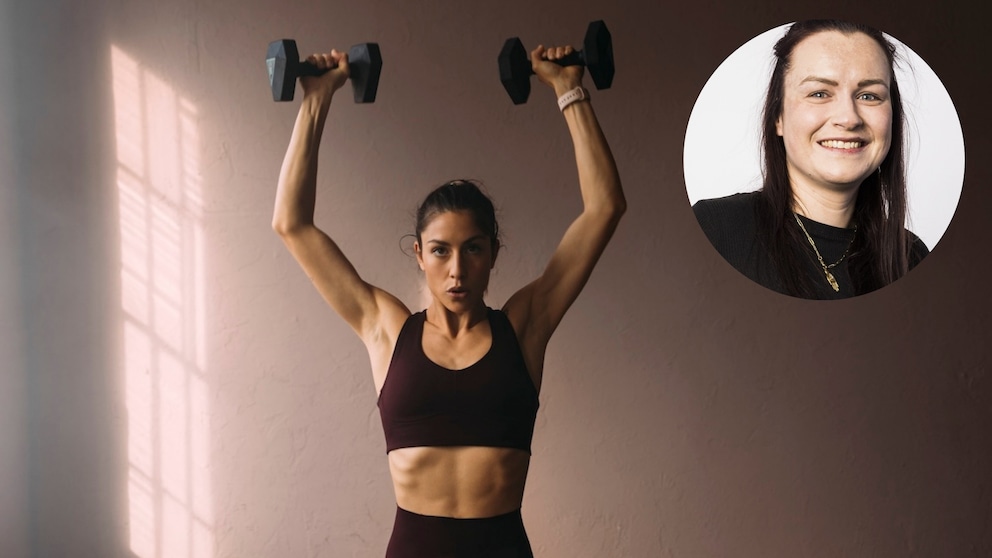
Shoulder Press
The shoulder press can be done sitting or standing. I prefer the standing version because it requires me to engage my core and glutes for proper execution, giving these areas a bit of a workout too.
For the shoulder press, I take a 5-kilogram dumbbell in each hand and lift my arms to the sides, slightly above chest height but just below shoulder height. My inner arms face forward. From this position, I slowly and controlledly press both arms upward until they are almost fully extended. Once at the top, I briefly contract my chest and shoulder muscles before lowering my arms again. Without pausing at the bottom, I lift my arms back up.
Shoulder Shrugs
Shoulder shrugs, also known as shrugs, involve lifting the shoulders to the ears while holding weights. These can be dumbbells or a barbell. I prefer dumbbells and doing the exercise standing, though it can also be done sitting. This exercise targets the shoulder and neck muscles. It’s important to perform the shoulder movement slowly and deliberately, especially when using heavier weights. I’ve strained a shoulder muscle before due to improper form, so I now usually use 3-kilogram dumbbells for this exercise.
Standing Lateral Raises
These exercises can also be performed sitting or standing. For the reasons mentioned above, I usually do them standing.
I take the dumbbells (usually the 3-kilogram ones) in both hands, with my arms extended downward in front of my body. I then move my arms sideways in a controlled manner until they are almost at shoulder height. To avoid straining my shoulders, my arms are not completely in line with my torso but slightly in front (like a slight V-shape). I also keep my arms slightly bent at the elbows to create more tension in the arm muscles. Once at the top, just below shoulder height, I hold my arms briefly before lowering them again.
It’s important here (and in all exercises) that both the upward and downward movements are slow and controlled. The downward movement (eccentric) is just as important for effectively engaging and training the muscles.
As a variation, you can perform the exercise one side at a time, doing it one-armed instead of two-armed. The advantage is that you can focus better on each side, which is beneficial for optimal exercise execution. However, if you’re short on time, training both arms simultaneously is also effective.
Also interesting: Lateral Raises with Dumbbells for Broader Shoulders
Front Raises
Why only lift to the side? Lifting weights frontally (front raises) also trains the shoulders. Again, the exercise can be done sitting or standing. In the standing version, I stand with my feet about hip-width apart, engage my entire body, and alternately lift each arm straight in front of my body from bottom to top with the dumbbell. I stop at chest height before slowly and controlledly lowering the arm and switching sides.
If you prefer, you can perform the exercise with both arms simultaneously. However, I prefer the one-armed version because I feel I can control and train both arms more evenly.
Bent-Over Lateral Raises
Bent-over lateral raises are a variation of the previously described lateral raises. For this, I stand with slightly bent knees to protect my knee joints, take a dumbbell in each hand, bend my torso forward from the hips, and perform the lateral raises from this position. The palms face the ground when lifting the arms sideways. When lowering the arms, I bring the hands with the dumbbells together under my torso. This exercise trains the back as well as the shoulders.
Alternatively, you can perform the exercise sitting. To do this, sit on the edge of a workout bench or chair and lean your torso forward. From this position, perform the lateral raises.
Bench Press
The bench press is a classic strength exercise that I like because it trains the chest muscles in addition to the shoulders. If you find a free workout bench at the gym or have one at home, lie on it with your legs positioned on the floor on either side.
Since I like to do this exercise at home but don’t have a bench, I perform it on the floor, lying on a fitness mat–and instead of a barbell, I use dumbbells. The dumbbells make the bench press a bit more challenging for me because I have to consciously control both sides to move and load them evenly.
Here, I use my heavy dumbbells (five kilograms, sometimes even ten kilograms on good days), holding one in each hand. I then open my arms to the sides at a 90-degree angle, with my hands pointing from the floor toward the ceiling. From this position, I press the weights evenly upward and then lower my arms in a controlled manner.
Again, form is crucial: The pressing of the dumbbells should come from the chest and shoulders, not the arms. When the arms are at the top, I consciously contract the chest muscles, and when lowering, when the arms are back down, I engage the back muscles.
Arnold Press
The Arnold Press is one of the more demanding shoulder exercises–at least from my perspective. It’s reportedly one of Arnold Schwarzenegger’s favorite strength exercises and is named after him.
When I’m at the gym, I use a kettlebell for this exercise because it’s easier on the joints. At home, a classic dumbbell works too, and if in doubt, I simply use a lighter weight to avoid overloading or incorrectly loading my wrists.
Again, the exercise can be done sitting or standing. I stand with my feet hip-width apart and engage my entire body to avoid using momentum from the torso or legs, which would make the exercise ineffective for the shoulders. I take a dumbbell (kettlebell) in one hand and hold it with a bent arm in front of my chest. The hand is almost at chin height, with the palm facing away from the face. From this position, I press the arm upward with a 180-degree rotation over my head, so the arm extends and the palm faces backward. Then I move the arm back to the starting position with another rotation. I usually complete my repetitions on one side before switching sides and doing the same number of repetitions there.

7 Exercises for Defined Shoulders

David Corenswet’s Training for Superman Shoulders and Chest
Option 1: Pure Shoulder Training
Speaking of repetitions: When I do pure shoulder training, focusing only on the described exercises, I prefer to do three sets of twelve repetitions each. I work with enough weight that I might only manage ten repetitions in the last set or even have to reduce the weight to complete this number of cleanly executed repetitions.
If I’m short on time or want to turn strength training into strength-endurance training, I perform the exercises as a superset workout. This means I do them quickly in succession, not counting repetitions but setting a time per exercise and doing as many repetitions as I can within that time.
For example, you can work in pairs of sets. Pair two exercises, do the first for 45 seconds, followed by a 20-second break, then the second exercise for 45 seconds, followed by a 60-second break before repeating the superset. Then move on to the next pair, or the next superset.
Option 2: Integrate into a Broader Upper Body Workout
Another training option is not to perform the shoulder exercises alone but to integrate them into a longer upper body workout that also includes exercises focusing on other muscle groups (back, chest, abs, biceps, triceps). The advantage: By incorporating exercises between shoulder exercises that don’t heavily load the shoulders, the shoulder muscles don’t fatigue as quickly. You can therefore work with more weight for the individual shoulder exercises.
I definitely notice how quickly my shoulder muscles fatigue when I target only this body region during training. Sometimes I want exactly that, and other times I enjoy combining shoulder exercises with other types of exercises. But hey: Variety is key–both for motivation and effective muscle stimulation.