


September 27, 2025, 3:17 pm | Read time: 5 minutes
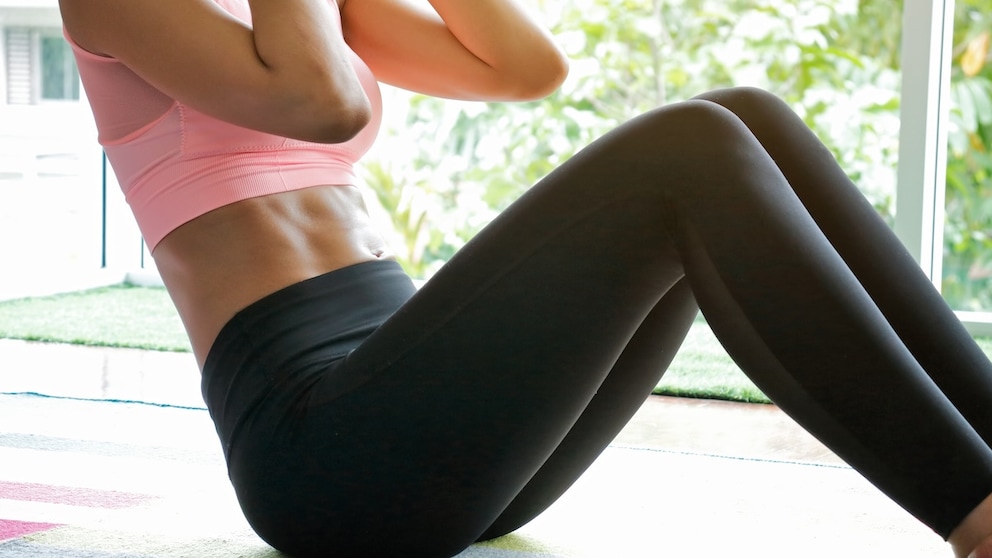
Sit-ups and crunches are two of the most well-known abdominal exercises and often have a permanent place in workout plans. However, there are now many opinions and studies questioning the effectiveness of these two exercises. But are sit-ups and crunches really ineffective? Trainer and FITBOOK expert Alina Bock provides clarity.
Sit-ups and crunches can be performed easily, quickly, and from anywhere—which is precisely why they are so well-known and popular. They are also favored because they train the rectus abdominis, the visible abdominal muscles, and the much-desired six-pack.
Why Some Exercises Are Considered More Effective Than Sit-ups and Crunches
Sit-ups and crunches primarily target the upper part of the rectus abdominis, thus covering only a small portion of this muscle region. The deep abdominal muscles, which are responsible for stabilizing and coordinating the torso and maintaining an upright posture, are less engaged during sit-ups and crunches. For this reason, other abdominal exercises such as plank or side plank variations are often recommended, as they also engage the transverse, oblique, and deep abdominal muscles.
Additionally, sit-ups and crunches are associated with common training errors, such as performing them too quickly with momentum and lacking abdominal tension, or lifting the lower back, which is also related to insufficient core tension.
Variations That Enhance the Effectiveness of Sit-ups and Crunches
To activate the entire abdominal muscles, sit-ups and crunches don’t need to be removed from the workout plan—there are numerous variations of these exercises that also train other parts of the core muscles and increase training intensity.
Slow Roll-Down
A simple method to make sit-ups and crunches more effective is the slow roll-down. It ensures that the movement is controlled and performed with maximum tension. Once the end position of the sit-up or crunch is reached, the roll-down is performed as slowly as possible. The slower it is, the longer the tension is maintained. Performing the exercise slowly also reduces the risk of injury, as it is done without momentum and with high muscle tone.
Crunches with Simultaneous Abduction
For the following exercise, you need a Pilates ball. As with a regular crunch, start lying on your back with your legs bent. Your feet should be about shoulder-width apart, and your toes pointing outward. The Pilates ball is placed just below the knees between the thighs. Inhale deeply, then, while exhaling, squeeze the ball with your thighs. Maintain the tension throughout the exercise. Now perform the crunch slowly and controlled. The simultaneous squeezing of the Pilates ball additionally trains the deep abdominal muscles, pelvic floor, and abductors, along with the rectus abdominis.
Strengthening the deep abdominal muscles and pelvic floor can help prevent or alleviate back pain. It also contributes to an upright and healthy posture and a healthy pelvic floor function.
Crunch with Leg Extension
The crunch with leg extension also involves holding the crunch position and adding a leg extension. Start lying on your back with your shoulder blades and legs raised. Place your hands behind your head to support your cervical spine. Now alternately extend your legs. The lower you lower your legs toward the floor, the more intense the exercise. Beginners can keep their legs slightly higher to maintain abdominal tension.
It’s important that the lower back remains firmly on the floor throughout the exercise. If this is no longer possible, the exercise should be stopped.
Holding Crunch with Pilates Ball
In this crunch variation, you hold the crunch—the shoulder blades are thus lifted off the floor for the entire duration of the exercise. Additionally, the legs are lifted off the floor, and the knees are drawn toward the torso. The Pilates ball is then fixed between the knees and elbows. To support the cervical spine, you can place your hands behind your head. Now, squeeze the Pilates ball with full force using your elbows and knees. Hold the position for 20 to 60 seconds, depending on your fitness level.
Diagonal Crunch with Pilates Ball
This variation trains not only the rectus abdominis but also the oblique, transverse, and deep abdominal muscles. The Pilates ball is fixed diagonally between the right knee and the left elbow. The shoulder blade must lift off the floor for this. Now extend the left leg just above the floor. Then draw the leg toward the torso, lift the right shoulder blade off the floor, and move the right elbow toward the Pilates ball. Now the left knee and right elbow fix the Pilates ball, and the right leg is extended. Perform this exercise for 12 to 15 repetitions per side.