

September 1, 2020, 2:09 pm | Read time: 3 minutes
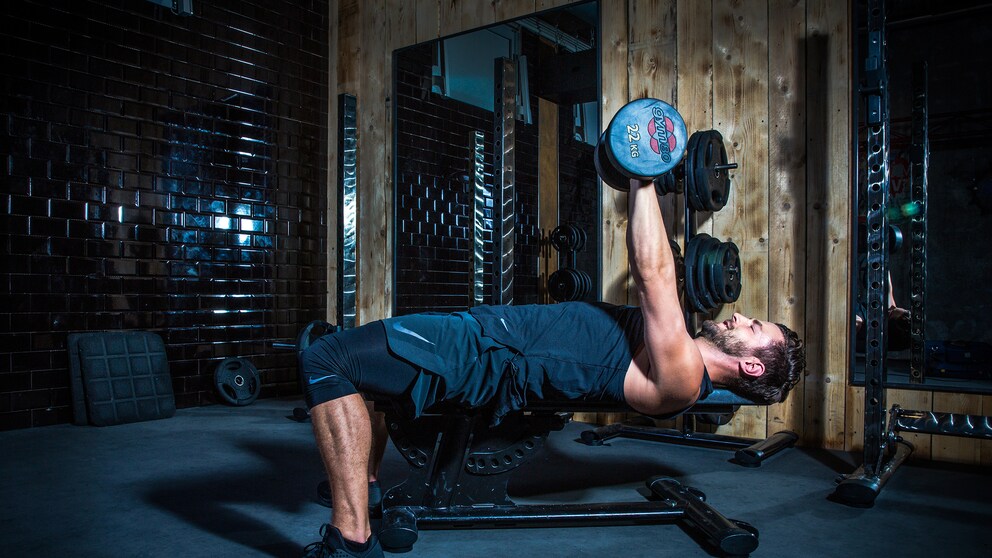
Bench pressing is usually done with a barbell. In this version, the exercise targets the chest muscles, with the triceps and front shoulder muscles also engaged. Using dumbbells, however, requires more coordination and has a significant effect on the deep stabilizing muscles. Therefore, you should definitely try one-arm bench pressing, advises celebrity trainer Erik Jäger.
Muscles That Are Trained
Because one-arm bench pressing moves the weight on only one side, the body undergoes strong rotation, which it must counteract. For this reason, one-arm bench pressing with a dumbbell trains muscle groups often neglected by many amateur athletes: the deep core and oblique abdominal muscles. Plus, like the barbell version, one-arm bench pressing intensely targets the chest and front shoulder muscles.
Also of interest: Muscles often neglected in training
Advantage Over the Classic Barbell Version
The forced activation of the deeper stabilizing muscles of the core during one-arm bench pressing has additional benefits: It can correct or prevent muscular imbalances that may have developed through training. Such imbalances can lead to posture issues and, for example, back problems. One-arm bench pressing also effectively trains intramuscular coordination (muscle-nerve connection).
Also of interest: Single-leg squats – a secret weapon for the glutes

Bench Pressing: Targeted Muscles, Technique, and Common Mistakes

Bench press – better on the machine, with free weights, or with a barbell?
One-Arm Bench Pressing with Dumbbell – How It’s Done
Starting Position
Lift the dumbbell with both hands. Slowly shift the weight to one side, then carefully release one hand and stabilize the position first.
Lowering the Weight
Take a deep breath before you lower the dumbbell to chest height in a controlled manner. The wrist and elbow should form a straight line. Also, actively engage the glutes and core–instability could cause you to fall off the bench.
Pressing the Weight Up
The goal is to press the weight up in a straight line without tilting the upper body to the side. Exhale while pressing up and extend the free arm to the side.
Also of interest: Military Press – the ultimate exercise for broad shoulders
One-Arm Bench Pressing – Common Mistakes
Mistake 1: Too Much Weight
One-arm bench pressing is challenging. Even if classic bench pressing is part of your routine, please start with significantly less weight than you might prefer. Only after you have adapted to the unfamiliar load should you gradually increase the weight.
Mistake 2: Lack of Core Tension
Lack of core stability is often the limiting factor in this exercise. The result can be an unnatural arching of the lower back or excessive rounding of the spine. This can be avoided by actively engaging the core muscles.
Mistake 3: Bending Elbow
With ideal technique, the elbow, wrist, and dumbbell should always form a straight line–at chest height, not shoulder height!
Also of interest: Variety improves training performance
About the Author: Erik Jäger is a functional fitness instructor and has been a successful personal and athletic trainer for many years. On his Instagram channel, the “Hauptstadttrainer” motivates people to exercise daily. His clients include numerous celebrities.