

March 28, 2026, 7:12 am | Read time: 4 minutes
It can be said that the barbell squat is the ultimate discipline in fitness–whether for basketball players, soccer players, football players, or MMA fighters. It is firmly anchored in almost every professional training plan. Here, we provide you with a complete overview of the correct execution, the muscles involved, and the key benefits for your training.
Follow the FITBOOK channel on WhatsApp now!
The Correct Execution of the Back Squat
Assume Position
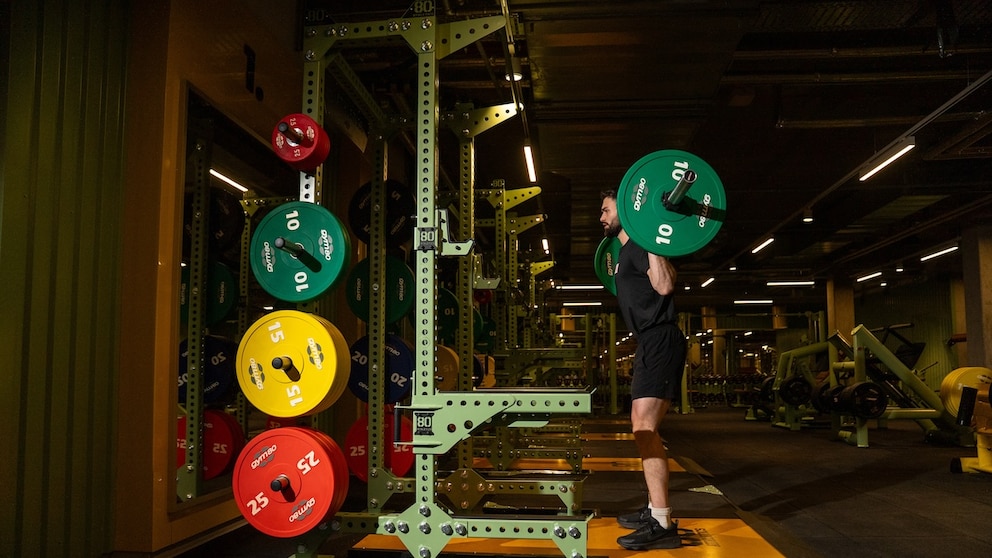
- First, set the pins in the rack–where the bar rests–at about chest height, so you can slightly bend your knees and lift the bar cleanly.
- Position yourself under the barbell so that it rests on the trapezius muscle, the upper part of the back muscles.
- Grip the bar slightly wider than shoulder-width, pull the shoulder blades together, and push the elbows slightly back and down.
- With an upright torso and a slight arch in the lower back, lift the bar from the rack and take two to three steps back.
- Place your feet about shoulder-width apart–toes pointing slightly outward, as naturally as feels comfortable for you.
- Push your chest forward, look straight ahead, and actively engage your abdominal and back muscles.
For the squat, the safety pins should be set just below your deepest squat position–slightly below hip height at the lowest point.
Movement Sequence
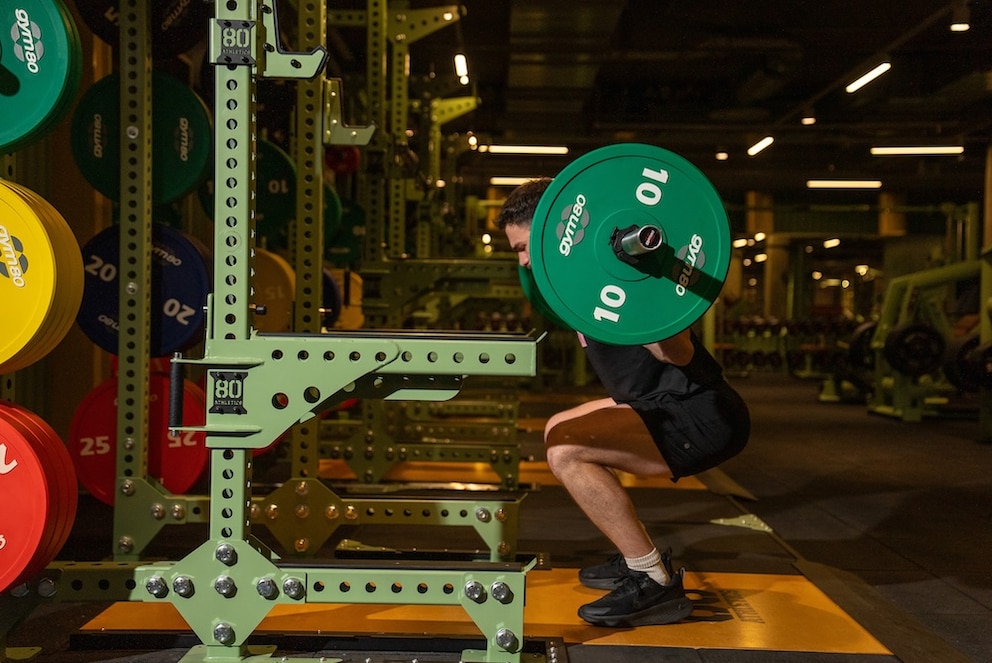
- Control the hips backward and down as if sitting on a chair. The buttocks are stretched backward.
- The torso leans slightly forward but remains upright with a slight arch; the back should never round.
- The knees move in the same direction as your toes and may extend beyond them.
- Lower yourself until the thighs are at least parallel to the floor–heels remain firmly on the ground.
- Push powerfully back up from the lowest position while exhaling.
- Hips and torso rise evenly until you are standing upright again.
Regarding breathing: Hold your breath while lowering, exhale only after the most challenging point is overcome.
Muscles Involved
- The quadriceps and glutes: The large thigh muscle (quadriceps) and the glutes (gluteus maximus) generate the force to push the body back up from the deep position.
- The core and back muscles: To keep your torso stable under the barbell’s weight, the abdominal and back extensor muscles also work. They form a natural corset that supports and protects the spine.
- The hamstrings and adductors: The back of the thighs and the inner sides of the legs provide support. They stabilize the knee joints and help maintain balance.
- The calves: The lower legs are also involved. They ensure a firm stance on the ground and are an essential part of the power transmission chain.
Squats or Deadlifts: Which Strength Exercise Is Better for You
How Effective Are Front Squats for Leg Training
Athletes Benefit Especially
Of course, the barbell squat shapes well-defined muscles in the lower body, but more importantly, it also trains the foundation of almost all explosive movements in sports–the so-called triple extension.
Deep squats, in particular, measurably improve jumping power and strengthen the muscle chains needed for explosive actions such as punches, throws, or sprints.1 The high load with the barbell also massively promotes core stability, making the body more resistant to injuries. Therefore, tennis players, martial artists, and even golfers benefit from this enormous transferability to their specific movement patterns.2
“Triple Extension”/“Dreifachstreckung”–the be-all and end-all for athletes
The so-called “triple extension”/“Dreifachstreckung” is, on the one hand, jargon for a movement sequence in two Olympic weightlifting exercises. The term also refers to the coordinated extension of the hip, knee, and ankle joints–and is thus the foundation for running, jumping, and sprinting. Therefore, this sequence is essential in countless sports.
High-Bar, Low-Bar, or Front Squat–the Agony of Choice?
Depending on where you place the barbell, you set slightly different emphases for your body. In the classic high-bar squat (the variant mentioned above), the bar rests on the trapezius muscle, which forces an upright posture and primarily makes the front of the thighs burn.3 In contrast, those who choose the low-bar variant, where the bar rests a bit lower on the rear shoulder, can usually move more weight, as the strong hip muscles and lower back help more intensively.
Also interesting: Back squats really kickstart calorie burning
For athletes seeking maximum core tension, the front squat is interesting. Here, the load is on the front of the shoulders, preventing “slumping” and extremely challenging the abdominal muscles. There are various other variants, each with its advantages and disadvantages. In the end, it’s like a toolbox. There is no “best” variant, only the one that best suits your body type and athletic goals to safely transfer power to the ground.4